
The Otsu Probation Officer Murder: A Trusted Meeting, a Life Sentence and a Pending Appeal
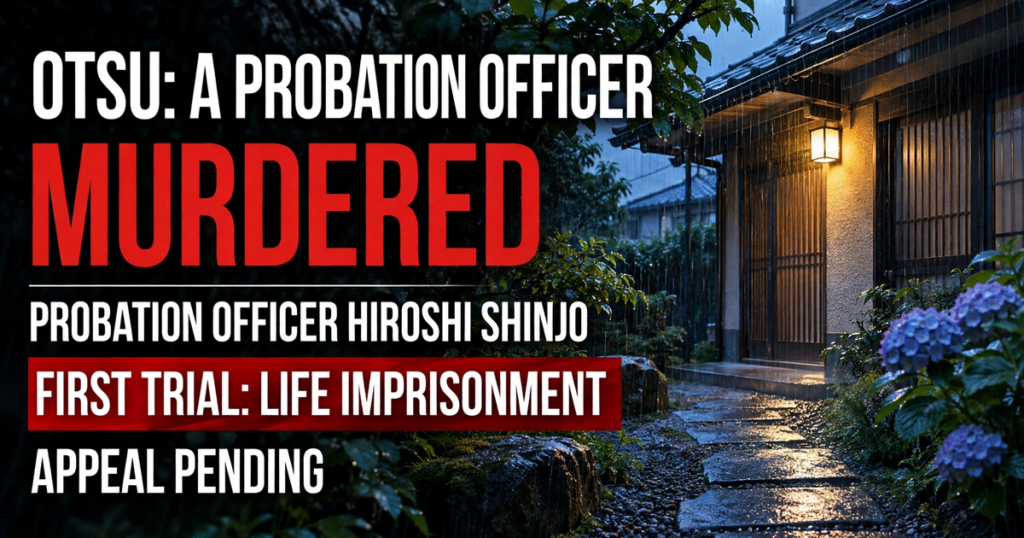
On the evening of May 24, 2024, probation officer Hiroshi Shinjo, aged 60, was due to meet Kohei Iizuka, a person under probation whom he had been supporting. Shinjo was found dead at home two days later with more than ten knife wounds. Iizuka was arrested for carrying a knife on May 28 and re-arrested on suspicion of murder on June 8. The Otsu District Court imposed life imprisonment on March 2, 2026, finding full criminal responsibility. Iizuka appealed on March 6; the sentence was not final in the latest public status located for November 2026.
A scheduled support meeting became the setting for a killing
On May 24, 2024, probation officer Hiroshi Shinjo, aged 60, was due to meet Iizuka Kohei at Shinjo's home at 7:00 p.m. The meeting was part of the ordinary work of a probation officer supporting a person under supervision. Shinjo had worked as a probation officer since 2006 and was involved in local rehabilitation activities. His family found him in the living room on the afternoon of May 26. He had more than ten cuts and stab wounds to the upper body, including defensive injuries, and the cause of death was hemorrhagic shock.
Shinjo had supported Iizuka after an earlier robbery conviction
Iizuka had been convicted in June 2019 of robbery at a convenience store in Otsu. He received a three-year prison sentence suspended for five years with probation. Shinjo became the probation officer responsible for supporting him. Reports stated that the two met approximately two or three times a month, discussing Iizuka's daily life and employment. The probation period was due to end on July 9, 2024. The killing occurred less than two months before that date. Shinjo's work was not a brief or incidental contact; he had been providing continuing support intended to help Iizuka rebuild his life.
The investigation focused on the planned meeting and the two-day interval
Shinjo's body was not found until approximately two days after the scheduled meeting. Investigators reviewed the intercom camera at his home, the meeting arrangement and Shinjo's communications and visitors after the evening of May 24. The arrest allegation later placed the offence between about 7:00 p.m. on May 24 and 4:00 p.m. on May 26. The meeting time and Iizuka's presence at the house became important investigative leads. Police had to reconstruct the period before the family discovered the body, rather than responding to an immediate report from the scene.
Iizuka was first arrested for possessing a knife
On the night of May 28, four days after the scheduled meeting, police officers watching the area around Shinjo's home questioned Iizuka. A knife was found in his backpack, and he was arrested on suspicion of possessing it without a lawful reason under the Swords and Firearms Control Law. He reportedly explained that he had the knife for hiking. This first arrest was not for murder. Police continued examining the intercom footage, the planned meeting and Iizuka's movements before and after the killing. On June 8, he was re-arrested on suspicion of murdering Shinjo. At that point he denied the murder allegation.
The prosecution followed a psychiatric assessment lasting more than four months
The Otsu District Public Prosecutors Office placed Iizuka under psychiatric assessment to examine his criminal responsibility. The period was extended and lasted more than four months. On November 18, 2024, he was indicted for murder and obstruction of public duties, among other charges. The obstruction charge reflected the fact that Shinjo was carrying out his public probation duties when the incident occurred. A probation officer is a part-time national public officer commissioned by the Minister of Justice and works with probation officers to support people returning to the community.
At the first trial, Iizuka admitted the indictment but responsibility remained disputed
The lay-judge trial began at the Otsu District Court on February 17, 2026. Iizuka admitted the charged conduct, changing his position from the denial he had expressed after his arrest. He said in court that he had acted after hearing the voice of a “guardian deity.” The defence referred to traits including autism spectrum disorder and argued that he lacked criminal responsibility or, at minimum, had diminished responsibility. The prosecution argued that he retained the ability to understand and control his actions. The main dispute was therefore not whether Shinjo had been killed, but the defendant's mental state at the time.
The prosecution described the motive as retaliation against the probation system
The prosecution argued that Iizuka had become dissatisfied with probation and government institutions and directed that resentment toward Shinjo, the officer who had supported him. It also pointed to conduct before the offence, including a visit to the area, as evidence of planning. The attack involved a knife and an axe, with repeated blows to Shinjo's chest and neck. During the trial, evidence was presented that Shinjo had tried to persuade Iizuka to think about returning to society even while being attacked. Shinjo's wife participated as a victim in the proceedings and described the trust and time the family had shared with him.
The district court found full criminal responsibility and imposed life imprisonment
On March 2, 2026, the Otsu District Court found that Iizuka had full criminal responsibility and sentenced him to life imprisonment, matching the prosecution's request. The court did not find a mental disorder that impaired his responsibility. It assessed the “guardian deity” explanation as arising from Iizuka's own thinking rather than an external voice controlling him. The court regarded the strong intent to kill, the use of a knife and axe, the exploitation of Shinjo's trust and the attack on a person who had supported his rehabilitation as especially serious. It described the maliciousness as comparable to that of an indiscriminate killing.
The defendant appealed, so the life sentence is not final
Iizuka's defence filed an appeal on March 6, 2026. The appeal means that the district court's life sentence is not final. The latest public status located for this translation, dated November 5, 2026, continued to describe the case as pending in the appeal process. The appellate court may review the district court's assessment of mental state and sentence. The English record therefore does not describe the life sentence as final or imply that the appeal has been dismissed.
The case prompted changes to probation-officer safety arrangements
The killing led to a review of how probation officers meet people under supervision. Measures discussed included appointing more than one probation officer in some cases, increasing direct involvement by professional probation officers and securing meeting places outside officers' homes. A revised Probation Officers Act was enacted in December 2025 and established national responsibility for ensuring suitable places for interviews. These policy responses form part of the public aftermath of the case, but they do not change the legal status of Iizuka's prosecution: the district court imposed life imprisonment in March 2026, and the defendant appealed four days later.
Original Japanese record: 大津市保護司殺害事件|新庄博志さんを担当対象者が殺害、無期懲役判決と控訴
Last updated:
Related articles
Case record
The Koto Memorial Hospital Case: A Twelve-Year Sentence Overturned by Retrial, and a Death Not Proven to Be Homicide

Case record
The Hino Town Robbery-Murder: A Posthumous Retrial, Disputed Police Reconstruction and Newly Disclosed Alibi Evidence

Case record
The Kawasaki Stalking Murder: Nine SOS Calls, a Failed Police Response and a Pending Murder Trial

Case record