
The Kyoto Hino Elementary School Murder: A Child's Death, a Suspect's Death and No Criminal Trial
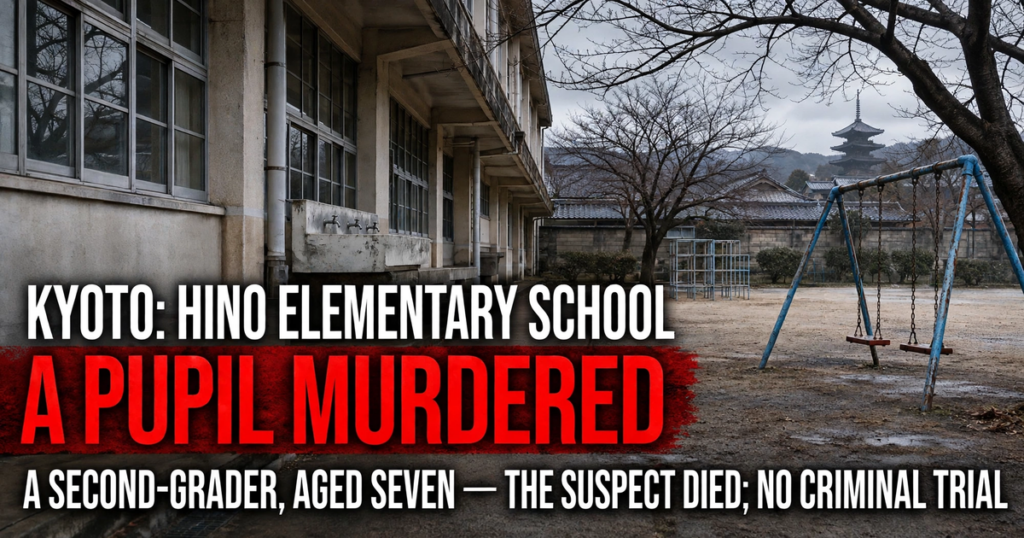
On December 21, 1999, seven-year-old second-grader Toshiki Nakamura was killed in the schoolyard of Kyoto Municipal Hino Elementary School in Fushimi, Kyoto. A document containing the phrase “Teruku Hanoru” was left at the scene and attracted intense public attention. Investigators later focused on a 21-year-old man. On February 5, 2000, he fled while police were seeking his voluntary cooperation and died after falling from an apartment building. The case was not prosecuted after his death. No criminal court determined his guilt, the motive or the meaning of the document.
A seven-year-old child was killed at school
On December 21, 1999, Toshiki Nakamura, a seven-year-old second-grade pupil, was killed in the schoolyard of Kyoto Municipal Hino Elementary School in Fushimi Ward, Kyoto City. The location was a school where children ordinarily spent their days, and the killing immediately raised questions about the safety of school grounds and access by outsiders. The public archive identifies the child by name and age. The record does not establish a criminal conviction against anyone, and this translation carefully distinguishes the confirmed death of the child from the later police investigation of a man who was never tried.
A document left at the scene became a focus of public attention
The crime scene contained a weapon, several items of evidence and a handwritten document. The phrase “Teruku Hanoru,” described in the document as a sign by which the writer could be identified, became widely discussed. Many interpretations and theories later circulated about the phrase. However, no criminal court examined the document in a trial and issued a finding about its meaning, purpose or authorship. The phrase should therefore be described as wording found in a document at the scene, not as a solved code or a confirmed explanation of the offender's identity.
Police investigation focused on a 21-year-old man
Investigators followed physical items and related materials and came to focus on a man who was 21 at the time. On February 5, 2000, Kyoto Prefectural Police sought his voluntary accompaniment so that they could question him about the incident. Voluntary accompaniment is not the same as an arrest. It is a request for a person to accompany officers, based on consent, and does not itself make the person a defendant in a criminal trial. At that stage the man was a suspect under investigation, not a person whose guilt had been determined by a court.
The man fled and died during the attempt to question him
While officers were trying to persuade him to accompany them, the man suddenly ran away. He fell from an apartment building and died. A later explanation by Kyoto police to the Diet described the sequence as the man breaking away from officers during the request for voluntary accompaniment and jumping or falling from the building. His death meant that investigators could not obtain his account in a completed interview or bring him before a criminal court. The date recorded in the archive is February 5, 2000.
The case ended without prosecution, not with an acquittal
After the man's death, prosecutors did not bring charges. A decision not to prosecute because the suspect has died is not an acquittal. An acquittal is a judgment delivered by a court after criminal proceedings. Here, no trial was held and no court issued a finding of guilt or innocence. At the same time, the fact that police investigated the man as a suspect cannot be treated as a substitute for a conviction. The legally accurate description is that police investigated him, he died during the process of seeking voluntary cooperation, and the case was not prosecuted.
The absence of a trial left important questions legally unresolved
Because there was no defendant and no public criminal trial, the evidence could not be tested through witness examination and cross-examination in court. The motive, the precise meaning of the handwritten document and the strength of individual items of evidence were not resolved by a criminal judgment. The archive stresses that later theories about the phrase or psychological interpretations should not be presented as established facts. The distinction matters particularly in a case involving a child victim: public attention and investigative suspicion do not eliminate the need to identify what was and was not legally determined.
The parents preserved their experience in a published memoir
In July 2000, Nakamura's parents, Seishi and Yuiko Nakamura, published a book titled “Kike, ‘Teruku Hanoru’ yo.” The National Diet Library describes it as a memoir of accusation and mourning written by parents who had lost their child. In a case without a criminal trial, the family's account of the investigation and its aftermath is an important historical record. At the same time, the parents' interpretation and experience must be distinguished from a court's findings, because no court issued a judgment in this case.
The incident influenced school-safety measures
The Ministry of Education identified the Hino Elementary School incident as an intrusion-related incident in the 1999 school year. On January 7, 2000, shortly after the killing, it issued a notice concerning the safety of children and school security management. Later government materials discussed the incident alongside other school-intrusion cases and emphasized access control at gates and buildings, checking visitors, supervision by school staff and cooperation with local communities. Kyoto City's education authorities also described the event as a catalyst for stronger school-community safety activities.
The correct legal status must remain explicit
The confirmed public record establishes that Nakamura was killed at school, that police investigated a 21-year-old man, that he died on February 5, 2000 during the request for voluntary accompaniment, and that the case was not prosecuted. There is no criminal trial and no conviction. The words “Teruku Hanoru” remain unexplained by a judicial finding, and the motive has not been established in court. The case therefore cannot be described as one in which a named offender was convicted. Preserving these limits is essential to an accurate account of both the investigation and the legal outcome.
Original Japanese record: 京都日野小学校児童殺害事件|中村俊希君殺害、被疑者死亡で刑事裁判が開かれなかった理由
Last updated:
Related articles
Case record
The Uji Cram-School Murder: Eighteen Years Reduced to Fifteen After a Diminished-Responsibility Finding
Case record
The Gyoza no Ohsho President Shooting: A Nine-Year Investigation, an Acquittal and the Prosecution's Appeal
Case record
The Murder of Kyoto Seika University Student Daisaku Chiba

Case record