
The Gyoza no Ohsho President Shooting: A Nine-Year Investigation, an Acquittal and the Prosecution's Appeal
On December 19, 2013, Gyoza no Ohsho president Takayuki Ohto was shot dead outside the company's Kyoto headquarters. A Kudo-kai-affiliated executive was arrested in 2022 and tried on circumstantial evidence, including DNA from cigarette butts. The Kyoto District Court acquitted him on October 16, 2026; prosecutors appealed on October 29.
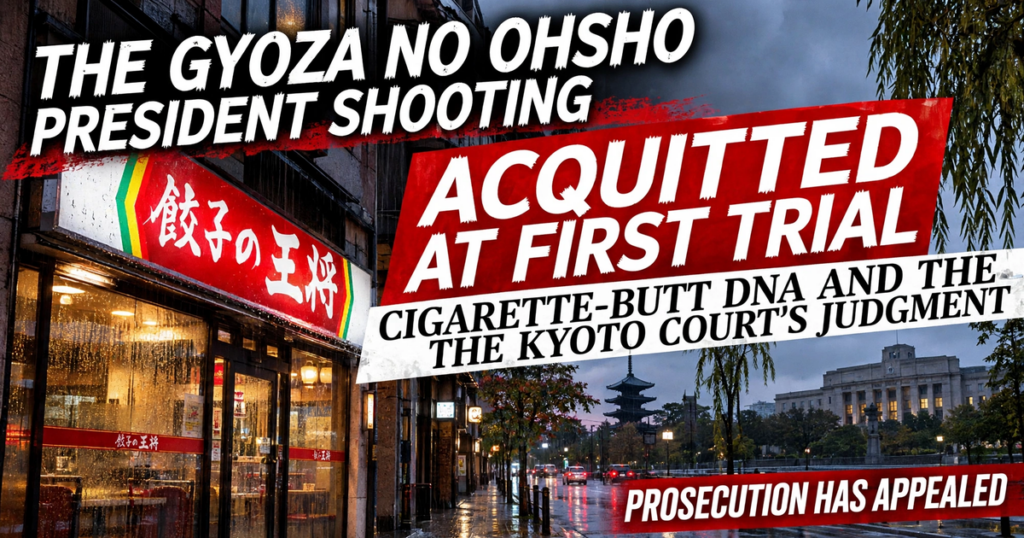
The company president was shot outside his headquarters before dawn
At about 5:45 a.m. on December 19, 2013, Takayuki Ohto, the 72-year-old president of Osho Food Service, was shot in the parking area outside the company's headquarters in Yamashina Ward, Kyoto. Ohto had arrived for work when he was attacked. He sustained multiple gunshot wounds to his chest and abdomen and died at the scene. The company operated the Gyoza no Ohsho restaurant chain, making the killing of its president a major corporate crime as well as a homicide. The location and timing suggested that the attacker knew Ohto's early-morning routine. The shooting was not treated as an ordinary robbery: the victim was specifically targeted, and the motive remained unclear for years.
Investigators spent nearly nine years trying to identify the shooter
Kyoto Prefectural Police examined the scene, recovered ballistic and other physical evidence, reviewed nearby security-camera footage and traced vehicles that might have been used to approach or leave the headquarters. The investigation also considered possible connections between Ohto, the company and organized crime. The length of the investigation reflected the difficulty of turning scattered circumstantial clues into evidence identifying a particular shooter. The police did not announce an arrest for almost nine years. The case attracted public attention because the victim was a prominent business executive and because the identity of the person who ordered or carried out the killing remained unknown. The fact that investigators examined organized-crime connections did not, by itself, establish who was responsible.
A Kudo-kai-affiliated executive was arrested in October 2022
In October 2022, police arrested Yukio Tanaka, an executive affiliated with a group within the Kudo-kai designated crime syndicate. Tanaka was already serving a prison sentence in connection with another firearms case when he was arrested in the Osho investigation. Prosecutors indicted him for murder and violations of the Firearms and Swords Control Law. Tanaka denied the charges. His arrest moved the case from a long-running investigation into a criminal trial, but an arrest and indictment are allegations, not proof of guilt. The prosecution still had to establish beyond reasonable doubt that Tanaka was the shooter.
The prosecution relied heavily on cigarette butts and DNA
A central part of the prosecution case was cigarette butts recovered near the scene. DNA obtained from saliva on the butts was reported to match Tanaka's DNA profile. Prosecutors argued that the butts had been smoked and discarded by Tanaka near the headquarters shortly before the shooting. They also presented experiments concerning the butts' condition and how they had been extinguished, seeking to connect them to the time of the attack. The DNA result could identify the person who had used a cigarette, but the trial had to address a separate question: when and where had the butts been left? A DNA match alone does not prove that the person who smoked a cigarette later carried out a shooting.
The defence challenged the timing and origin of the evidence
Tanaka's lawyers argued that the condition of the cigarette butts did not establish that he had smoked them at the scene on the morning of the murder. They questioned the amount and appearance of ash and argued that the butts could have been discarded on another occasion or brought to the location by someone else. Tanaka consistently denied being the shooter. The case therefore depended on whether the physical evidence, the movements of the people involved and the surrounding circumstances formed a coherent chain that excluded other reasonable explanations. The prosecution did not present a confession or a clear video recording of the shooting. The court had to decide whether the circumstantial evidence identified Tanaka as the actual killer, rather than merely showing that his DNA was present on an item found nearby.
The trial did not establish a clear personal motive or connection
The prosecution argued that the evidence as a whole showed Tanaka had carried out the shooting. However, the public trial did not clearly establish a direct personal relationship between Tanaka and Ohto or a specific motive for Tanaka to kill him. The company had previously examined questionable business dealings, and investigators considered whether the background to those dealings might be relevant. But the existence of corporate disputes or possible organized-crime connections could not substitute for proof of Tanaka's own role. The court had to distinguish between a possible explanation for why Ohto was targeted and evidence identifying the person who fired the gun. The absence of a known motive did not automatically require acquittal, but it formed part of the overall evidentiary picture.
The District Court acquitted Tanaka on October 16, 2026
On June 29, 2026, prosecutors sought a life sentence, arguing that the cigarette-butt DNA and other circumstantial evidence established Tanaka's responsibility. On October 16, the Kyoto District Court found him not guilty of murder and the firearms offences. The court considered that the butts could have been discarded on another day or brought to the scene by a third party. It concluded that the evidence did not establish beyond reasonable doubt that Tanaka had left them there at the time of the shooting and then carried out the murder. The ruling did not identify the actual shooter or resolve the broader background to Ohto's killing. It was an acquittal of the defendant on trial, not a finding that the murder had not occurred.
The prosecution appealed, so the acquittal is not final
On October 29, 2026, the Kyoto District Public Prosecutors Office appealed the acquittal to the Osaka High Court, arguing that the first-instance judgment contained errors of law and fact. The appeal means the October 16 acquittal has not become final. It does not mean that the High Court has overturned the judgment or found Tanaka guilty. As of November 22, 2026, the case is at the appellate stage, and no decision by the Osaka High Court has been reported. The identity of the person who shot Ohto therefore remains a matter for the ongoing criminal proceedings and investigation. The correct current description is a first-instance acquittal under appeal, not a final acquittal or a conviction.
Original Japanese record: 餃子の王将社長射殺事件|田中幸雄被告に一審無罪、吸い殻DNAをめぐる京都地裁の判断
Last updated:
Related articles
Case record
The Nagaokakyo Murders: Two Women Killed While Gathering Wild Plants
Case record
The Murder of Kyoto Seika University Student Daisaku Chiba
Case record
The Kyoto Hino Elementary School Murder: A Child's Death, a Suspect's Death and No Criminal Trial
Case record