
The Gunma Two-Women Murders: Two Killings Committed While on Parole
Two women working in fields in Gunma Prefecture were killed on October 2, 1981 and July 3, 1982. The victims were Ms. Mitsuyama, 56, and Ms. Akuzawa, 79. Shinohara had previously received a life sentence for a 1959 murder and was released on parole in 1976. The Supreme Court finalized his death sentence on May 20, 1988. He was executed on December 21, 1995.
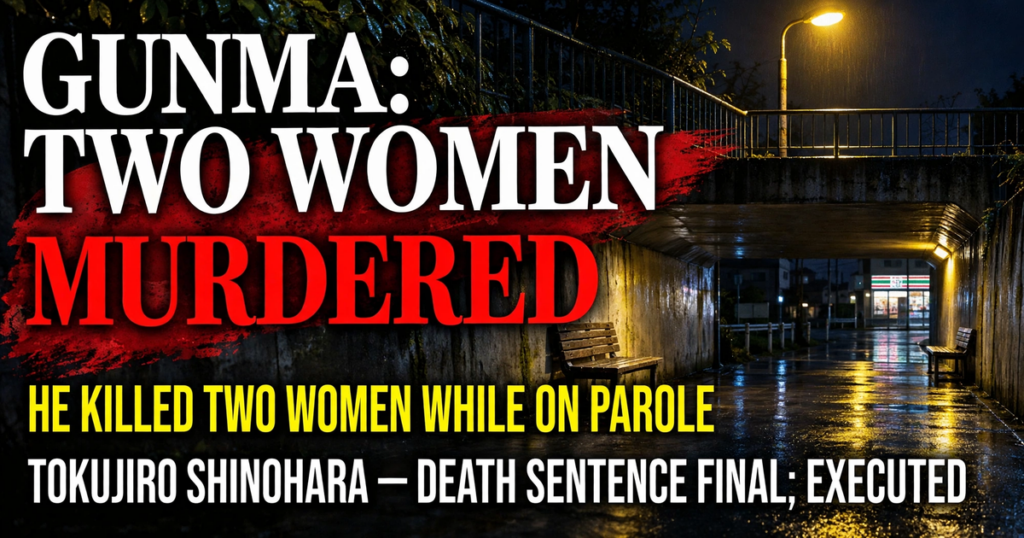
Two women were attacked while working in fields
The two murders occurred in Gunma Prefecture, approximately nine months apart. On October 2, 1981, Ms. Mitsuyama, aged 56, was attacked while working in a mulberry field in the former Sakai Town, Sawa District. On July 3, 1982, Ms. Akuzawa, aged 79, was attacked while weeding a field in the former Miyagi Village, Seta District. Both women were engaged in ordinary agricultural work. The victims were not connected to the offender through a dispute or an established relationship. The public record identifies two separate dates and locations, and the English account preserves them rather than presenting the murders as one continuous incident.
Shinohara had previously served a life sentence
Shinohara had a prior murder conviction. In 1959, he killed a young woman and was sentenced to life imprisonment. He served that sentence and was released on parole in 1976. The two Gunma murders occurred approximately five years after his release. The parole history was relevant to the later sentencing assessment because the new offences were committed after he had already served a lengthy prison term for a serious violent crime. The earlier 1959 killing is not counted as one of the two victims in the Gunma case; it is a separate offence and must be kept distinct from the 1981 and 1982 murders.
Mitsuyama was killed while working in a mulberry field
The first of the two murders occurred on October 2, 1981, in the former Sakai Town. Mitsuyama was working in a mulberry field when Shinohara attacked her. Contemporary reporting on the first- and second-instance judgments described sexual violence, strangulation with a hand towel and stabbing with a small knife. The court did not find that Mitsuyama had done anything to provoke the attack. The location and circumstances show that she was engaged in routine agricultural work when she was targeted. The account does not need graphic detail to establish the seriousness of the crime; the legal record rests on the killing and the evidence of the attack.
Akuzawa was killed nine months later
The second murder occurred on July 3, 1982, in the former Miyagi Village. Akuzawa was 79 and was weeding a field when Shinohara attacked her. The archive states that he strangled her with a hand towel, causing her death by suffocation. The two murders were separated by approximately nine months. Both victims were women working outdoors in agricultural settings. The similarities between the incidents, together with the investigation of Shinohara after the first killing, became relevant to how the second offence was detected and how the two cases were handled together.
Police were investigating Shinohara after the first murder
Later records state that after Mitsuyama's death, police treated Shinohara as an important investigative subject and kept him under observation. On July 3, 1982, he left during a period when surveillance had been interrupted and Akuzawa was killed. After the second incident, an officer following him reportedly questioned him on his way home, and he was subsequently arrested. The two offences were investigated together because they involved women working in similar circumstances within Gunma Prefecture and occurred within a relatively short period. The account distinguishes the reported surveillance history from the court's final findings and does not imply that every detail of the police operation was itself a judicial finding.
The district and high courts both selected the death penalty
The Maebashi District Court sentenced Shinohara to death on December 16, 1983. The Tokyo High Court dismissed his appeal on January 17, 1985, maintaining the sentence. Shinohara then appealed to the Supreme Court. These dates are important because the Supreme Court did not finalize the death sentence until 1988. In Japan, the district-court judgment and the high-court disposition are separate stages of review. A death sentence pronounced at first instance is not automatically final; it becomes final after the ordinary appeal process ends or is otherwise terminated according to law.
The Supreme Court emphasized the short interval and the victims' lack of fault
On May 20, 1988, the Supreme Court's Second Petty Bench dismissed Shinohara's final appeal. The Court emphasized that he had killed two women within only nine months, that neither victim had done anything to bring about the attacks and that the motive offered no meaningful basis for leniency. It also considered the fact that he had committed the murders while on parole after a prior life sentence for murder. The Court upheld the death sentence imposed by the lower courts. This was a substantive appellate decision, not an appeal withdrawal.
The death sentence was carried out in December 1995
After the Supreme Court's dismissal, Shinohara remained under a final death sentence for approximately seven and a half years. Amnesty International's record states that he was executed on December 21, 1995, at the age of 68, on the same day as two other prisoners. The execution occurred more than thirteen years after the second murder and about fourteen years after the first. The legal sequence is therefore: two murders, conviction and death sentences in the district and high courts, Supreme Court dismissal and finality in May 1988, followed by execution in December 1995. These stages should not be compressed into a single date.
Original Japanese record: 群馬2女性殺人事件|仮釈放中に2人を殺害、篠原徳次郎の死刑確定と執行
Last updated:
Related articles
Case record
The Ogo Town High-School Girl Abduction-Murder: A Life Sentence Replaced by Death on Appeal
Case record
The Mishima Student Murder: A Life Sentence Replaced by Capital Punishment

Case record
The Gunma Pachinko-Parlor Robbery-Murders: Two Employees Killed for Store Keys and Cash
Case record