
The Hiroshima First-Grader Murder: A Life Sentence After a Complex Appeal and Remand
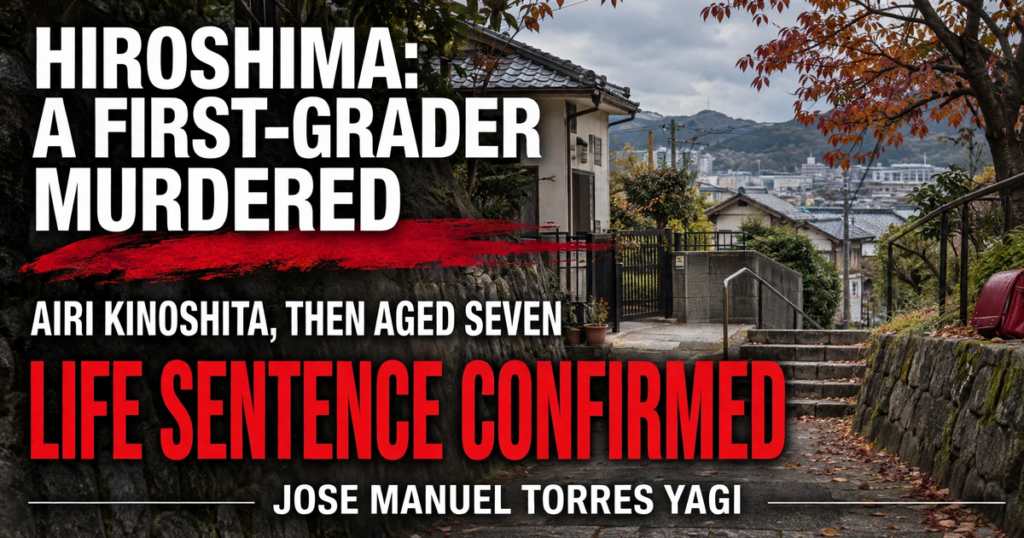
Seven-year-old Airi Kinoshita was abducted and murdered after leaving school in Hiroshima on November 22, 2005. José Manuel Torres Yagi was convicted and sentenced to life imprisonment, but the case passed through several appellate stages, including a Supreme Court decision that overturned a High Court remand order. After the case returned to the Hiroshima High Court, the life sentence was upheld in July 2010 and became final. The legal history must be distinguished from the separate immigration offences also addressed in the proceedings.
A seven-year-old girl disappeared on her way home from school
On November 22, 2005, seven-year-old Airi Kinoshita left school in Aki Ward, Hiroshima City, after a health check. She left at about 12:40 p.m., earlier than usual. Between approximately 12:48 and 12:53 p.m., several local residents saw a man facing a young girl near a flight of steps along her school route. Her body was later found in a cardboard box in a vacant lot. The case involved the abduction and murder of a child during an ordinary school-day journey. This account uses the victim's name respectfully and avoids unnecessary detail about the injuries or the handling of her body.
The investigation focused on a man seen near the school route
Witnesses reported seeing a man in the area around the time Airi disappeared. Investigators examined the route from the school, the timing of the sightings and the circumstances in which the child's body was discovered. The suspect was José Manuel Torres Yagi, a Peruvian national. The prosecution alleged that he had taken the child, sexually assaulted her and killed her. These allegations were tested through the criminal proceedings, including the trial evidence and several appellate decisions.
The first-instance court imposed life imprisonment
On July 4, 2006, the Hiroshima District Court convicted Torres Yagi and sentenced him to life imprisonment. The prosecution had sought the death penalty. The court assessed the evidence of the child's movements, witness accounts, forensic findings and the defendant's conduct. The sentence reflected the court's assessment of the crime and the applicable sentencing principles. The defence challenged the conviction and sentence, while the prosecution also appealed aspects of the judgment. The case therefore proceeded to the Hiroshima High Court.
The first High Court decision remanded the case
On December 9, 2008, the Hiroshima High Court set aside the district court judgment and remanded the case to the district court for further proceedings. The appellate court considered issues concerning the evidence and the way the first-instance court had assessed the case. A remand is not an acquittal: it returns a case to a lower court for further proceedings in accordance with the appellate ruling. This procedural distinction matters because the case was not finished in 2008, and the original life sentence was no longer the operative final judgment at that stage.
The Supreme Court overturned the remand order
On October 16, 2009, the Supreme Court's Second Petty Bench overturned the High Court's remand decision and sent the case back to the Hiroshima High Court. The Supreme Court considered the operation of pretrial arrangement proceedings, in which the parties and court identify disputed issues and decide which evidence will be admitted. A trial court has reasonable discretion in making those evidentiary decisions. An appellate court seeking to overturn them must specifically show why the trial court's exercise of discretion was unreasonable. The Supreme Court held that the High Court had not demonstrated such an error. It did not itself conduct a new trial or impose a final sentence.
The High Court reconsidered the case after remand
After the Supreme Court's decision, the Hiroshima High Court reviewed the case again. On July 28, 2010, it dismissed the appeals and upheld the life sentence imposed by the district court. The result meant that the first-instance conviction and sentence remained in force. Neither side pursued a further appeal, so the judgment became final. The sequence—district court, High Court remand, Supreme Court reversal of that remand, and a new High Court decision—is why the procedural history is more complex than a simple first-instance conviction followed by an ordinary appeal.
The final sentence was life imprisonment, not death
Although prosecutors had sought the death penalty, the final criminal sentence was life imprisonment. The courts considered the circumstances of the killing, the defendant's responsibility and the sentencing standards applicable in Japan. The fact that the victim was a young child and that the offence involved abduction and sexual violence did not automatically require a death sentence. Japanese courts assess the death penalty under a body of sentencing principles that considers factors such as the number of victims, the nature of the crime, motive and other circumstances. The final result in this case was life imprisonment. In explaining why it did not impose death, the district court also noted that the victim was one person, that the evidence did not establish that the defendant had selected a child in advance or planned the killing, and that an allegation of a prior offence in Peru had not resulted in a proven conviction. The court applied the factors associated with the Supreme Court's Nagayama sentencing framework.
Immigration offences were a separate part of the legal record
Torres Yagi had also been in Japan without lawful immigration status. The criminal record included separate allegations concerning unlawful entry and overstaying. Those offences were distinct from the charges relating to Airi's abduction and murder. It is important not to conflate immigration status with proof of the violent offences: the murder conviction rested on the evidence examined in the criminal case, while immigration violations were separate legal matters. The victim's nationality, the defendant's nationality and the criminal findings should be kept distinct in any account.
The case demonstrates the complexity of appellate procedure
Japan's criminal procedure allows appeals to higher courts, and an appellate court may quash a judgment and remand a case when it identifies a legally significant problem. The Supreme Court may then review the appellate decision on grounds permitted by law. A Supreme Court reversal of a remand order does not necessarily mean that the defendant is acquitted; it may mean that the appellate court must reconsider the case. The Hiroshima proceedings show why each stage must be identified precisely rather than summarised as one continuous appeal.
The final legal status is a life sentence
The final sequence is clear: the Hiroshima District Court imposed life imprisonment on July 4, 2006; the Hiroshima High Court ordered a remand on December 9, 2008; the Supreme Court overturned that remand on October 16, 2009; and the Hiroshima High Court upheld the life sentence on July 28, 2010. The judgment became final when no further appeal was pursued. The legal outcome is therefore a final life sentence for Torres Yagi. The account should focus on the verified court history and treat the child victim with dignity.
The victim's sunflower seeds became part of a school-safety initiative
The case also left a lasting memorial at Yano Nishi Elementary School. Airi had carefully grown sunflowers, and the school received seeds from those plants. Beginning in the 2008 school year, it cultivated them as the "Sunflowers of Happiness." Hiroshima City later distributed harvested seeds to schools that wished to take part, with the stated aims of preventing the killing from fading from memory and sustaining awareness of children's safety. The city reported that by the 2020 school year the flowers were being grown at 116 elementary schools and one kindergarten. This remembrance is distinct from the criminal proceedings, but it is part of the public record of the case.
Original Japanese record: 広島小1女児殺害事件|木下あいりさん殺害、無期判決と最高裁が破棄した「地裁差戻し」
Last updated:
Related articles
Case record
The Hatsukaichi High-School Girl Murder: Fingerprints and DNA Solved a Case After Thirteen and a Half Years
Case record
The Ibaraki University Student Murder: DNA Evidence, Two Life Sentences and a Third Suspect Still Sought
Case record
The Imaichi First-Grade Girl Murder
Case record