
The Hatsukaichi High-School Girl Murder: Fingerprints and DNA Solved a Case After Thirteen and a Half Years
On October 5, 2004, 17-year-old high-school student Satomi Kitaguchi was murdered at her home in Hatsukaichi, Hiroshima Prefecture. Her grandmother was also attacked and seriously injured, while her younger sister escaped and provided an eyewitness account. The case remained unsolved for more than thirteen years. In April 2018, fingerprints and DNA recovered from the scene were matched to Manabu Kashima during an investigation into a separate assault. He admitted the charges at trial. On March 18, 2020, the Hiroshima District Court sentenced him to life imprisonment; neither side appealed, and the sentence became final.
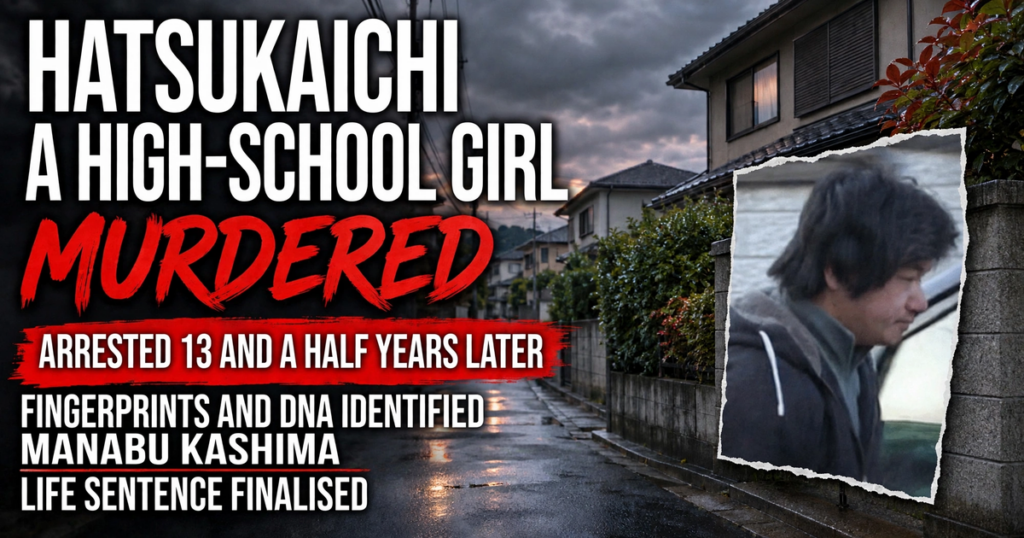
A 17-year-old student was attacked at her home
On October 5, 2004, 17-year-old Satomi Kitaguchi, a second-year high-school student, was attacked at her home in Hatsukaichi, Hiroshima Prefecture. She had left school early and returned to a detached part of the family home. Her grandmother heard a noise and went toward the building, where she was also attacked with a knife and seriously injured. Kitaguchi's younger sister was at home and saw the intruder. She escaped and later described the man's appearance to police. Kitaguchi died, while her grandmother survived.
The younger sister's account and scene evidence guided the first investigation
Police collected material from the scene, including bloodstains believed to have come from the attacker. The younger sister's account was used to prepare a facial sketch, which was made public on October 8, 2004. Investigators conducted interviews and sought information from the public. The grandmother's injuries and the younger sister's escape were important parts of the reconstruction. The early investigation had witness information and physical evidence, but it did not identify the attacker. The case remained open as the family waited for an arrest.
The investigation continued for more than thirteen years
For years, the case remained unsolved despite repeated appeals for information. The police retained the physical evidence collected at the scene, including fingerprints and biological material. The fact that the case was not solved quickly did not mean that the evidence had been discarded or that the investigation had ended. Investigators continued to preserve and review the material. The long period before an arrest became a central feature of the case, but it is important not to suggest that every lead was exhausted or that the evidence alone identified a suspect without a later comparison.
A separate assault investigation produced a fingerprint match in 2018
The breakthrough came in April 2018. During an investigation into a separate assault in Yamaguchi Prefecture, police obtained fingerprints from Manabu Kashima. Those prints matched material retained from the Hatsukaichi crime scene. DNA testing also produced a match. The evidence linked a person who had not previously been identified in the original investigation to the 2004 attack. Kashima was arrested on April 13, 2018, on suspicion of murder. He was arrested again on May 3 in connection with the attack on the grandmother.
The prosecution included the murder and attacks on surviving family members
On May 24, 2018, prosecutors indicted Kashima. The charges included murder, rape resulting in death and attempted murder. The case concerned not only Kitaguchi's death but also the attack on her grandmother. The younger sister's eyewitness account, the injuries to the grandmother and the physical evidence from the scene were part of the record. The fingerprint and DNA match was central to identifying Kashima, but the trial also examined the circumstances of the attack and the defendant's conduct on the day of the crime.
Kashima admitted the charges at the first trial hearing
The Hiroshima District Court began the lay-judge trial on March 3, 2020. Kashima admitted the charged facts. The central issues at trial therefore concerned the circumstances of the offences and the appropriate sentence, rather than a contested claim that the wrong person had been arrested. In questioning, the court heard evidence about Kashima's movements before the attack, including his travel from Yamaguchi and the purchase of a knife. Such details were considered as part of the evidence at trial and should not be presented as independently established beyond what the court heard and accepted.
The Hiroshima District Court imposed life imprisonment
On March 18, 2020, the Hiroshima District Court sentenced Kashima to life imprisonment. The prosecution had sought life imprisonment. The court considered the murder of a 17-year-old student, the serious attack on her grandmother and the circumstances of the offences. Neither the prosecution nor the defence appealed. The first-instance judgment therefore became final without a review by the High Court or Supreme Court. The final status should be stated accurately: this was a life sentence imposed by the Hiroshima District Court and left in place because neither side appealed.
The case was solved through evidence preserved at the scene
The arrest came about because fingerprints and DNA collected in 2004 remained available for comparison after a separate investigation produced new identifying material in 2018. The case illustrates the value of preserving physical evidence in unsolved investigations. It also shows the limits of eyewitness descriptions: the younger sister provided an important account, but the suspect was not identified until the later forensic match. The arrest did not depend on a newly discovered witness who had suddenly remembered the offender; it depended on comparing new prints and DNA with evidence retained from the original crime.
The end of the criminal case did not end the family's loss
The life sentence brought the criminal proceedings to a close, but it could not restore Kitaguchi's life or remove the effects of the attack on her grandmother and sister. The family had spent more than thirteen years without knowing who had committed the crime. The arrest and trial answered the question of criminal responsibility, but the harm continued after judgment. A complete account should recognise both the evidentiary significance of the case and the human consequences of a long-unsolved murder.
Original Japanese record: 廿日市女子高生殺害事件|北口聡美さん殺害から約13年半、指紋とDNA型が鹿嶋学を特定
Last updated:
Related articles
Case record
The Hiroshima First-Grader Murder: A Life Sentence After a Complex Appeal and Remand
Case record
The Lucy Blackman Case: A British Woman's Disappearance and the Criminal Case Against Joji Obara

Case record
The Itsukaichi Supermarket Robbery-Murder

Case record