
The Meguro Child Abuse Death: Yua Funato, the Move from Kagawa and the Parents' Sentences
Five-year-old Yua Funato died in Tokyo on March 2, 2018, after a period of severe abuse and deprivation. Child-protection authorities in Kagawa had previously been involved, but after the family moved to Tokyo in January 2018, the receiving agencies did not complete timely safety checks. The stepfather received 13 years in prison, while the mother received eight years after the court separately assessed her conduct and the influence of domestic abuse. The case prompted renewed scrutiny of child-protection handovers between prefectures.
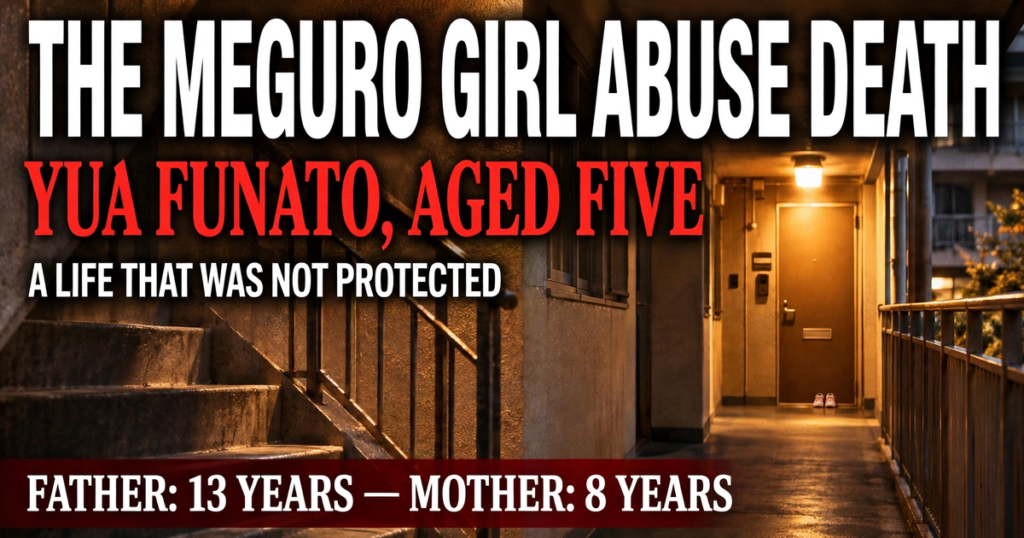
A five-year-old girl died shortly after her family moved to Tokyo
Yua Funato, aged five, died at the family's home in Meguro Ward, Tokyo, on March 2, 2018. The family had moved from Kagawa Prefecture to Tokyo in January. The case revealed a pattern of abuse and severe food restriction in the household, as well as problems in the way child-protection agencies responded when a family crossed a prefectural boundary. Authorities in Kagawa had previously been involved with the family, and Yua had experienced temporary protective custody. The central question after the move was whether the receiving agencies had acted quickly enough to establish her safety.
Child-protection authorities in Kagawa already knew of concerns
Before the move, the child guidance centre in Kagawa had dealt with concerns about Yua's treatment. The child had been temporarily protected, and officials had opportunities to learn about violence and inappropriate care by her stepfather, Yudai Funato. The family then moved to Tokyo in January 2018. Information was passed between the child guidance centres, but the transfer of records did not itself guarantee that Yua would be seen and assessed promptly in her new home. The case later exposed the difference between sending information and acting on it.
Food restriction and violence intensified after the move
The criminal courts found that, after the family settled in Tokyo, Yudai imposed severe restrictions on Yua's food and repeatedly assaulted her. Her physical condition deteriorated over a short period. The court rejected the suggestion that the conduct was ordinary discipline. The restriction of food and the violence were treated as serious abuse, and the stepfather was found to have played the leading role. The case did not concern a single incident on the day of death; it involved an extended course of conduct that progressively weakened the child.
Yua died after becoming severely malnourished and ill
The court findings described Yua's severe weight loss and the failure to obtain medical care as her condition worsened. Her death followed pneumonia and sepsis after her resistance to infection had been weakened by malnutrition and abuse. The court assessed the parents' conduct in relation to the child's deteriorating condition and the failure to secure medical treatment. The translation avoids graphic descriptions and focuses on the facts necessary to understand the criminal findings and the child-protection failures.
The stepfather received 13 years in prison
Yudai Funato, her stepfather, was tried for offences including injury and abandonment by a person responsible for protection resulting in death. The Tokyo District Court found that he had led the violence and the restrictions on food. On October 15, 2019, the court imposed a prison term of 13 years. The sentence was not appealed by the stepfather and became final. The court's assessment of his role included the severity and persistence of the abuse and his failure to obtain medical care despite the child's condition.
The mother's responsibility was assessed separately
Yuri Funato was tried separately from her husband in relation to her own conduct. The court found that she had failed to provide sufficient food and had not taken Yua to medical care despite recognising the child's deteriorating condition. It also considered the psychological domestic abuse she had experienced from her husband. The court did not find that the pressure amounted to such an overpowering control that it removed or substantially eliminated her responsibility. She received an eight-year prison sentence. The Tokyo High Court dismissed her appeal on September 8, 2020, leaving the eight-year term in place.
The judgments did not treat both parents as having identical roles
The stepfather and mother were not convicted on identical facts or given the same sentence. The stepfather was found to have initiated and led the physical abuse and food restrictions. The mother's case concerned her own failure to protect Yua and the assistance or acquiescence identified by the court. The courts examined the domestic relationship, each parent's knowledge and conduct, and the extent to which her husband's control affected the mother's decisions. The difference between the 13-year and eight-year sentences reflects those separate findings; it should not be reduced to a simple comparison of who was more or less responsible.
The move between prefectures exposed a gap in child-protection practice
The transfer from Kagawa to Tokyo was an important part of the case. The authorities had exchanged information, but the receiving agency did not complete a timely, direct safety check at the new home. The case showed that a transfer document is not a substitute for contact with the child and a fresh assessment of the family's circumstances. After the death, attention focused on how receiving agencies should evaluate risk, how quickly they should visit a home and how they should work with police, schools and other services when a child has a known history of abuse.
The case contributed to changes in child-protection policy
The Meguro case and the later Noda child-abuse death accelerated discussion of child-protection systems and parental discipline. In 2019, amendments to the Child Abuse Prevention Act and the Child Welfare Act were enacted, including an explicit prohibition on corporal punishment by parents and guardians. The reforms also addressed child guidance centre capacity and cooperation among agencies. These later legal changes did not decide the criminal cases retrospectively. Their significance lies in the policy response to repeated failures to turn known warning signs into effective protection.
A careful account separates the criminal findings from the administrative review
The criminal proceedings established the parents' individual responsibility for Yua's death. Separate administrative reviews examined the information transfer and safety checks by child-protection agencies. The two processes addressed different questions. The courts determined criminal liability based on the evidence against each parent; the administrative reviews examined whether public institutions had acted properly and what changes were needed. The case remains an important example of the risk that a child may be lost between agencies when a family relocates, even where the authorities already hold information about previous abuse.
Original Japanese record: 目黒女児虐待死事件|船戸結愛ちゃん5歳、香川から東京への児相引き継ぎと父13年・母8年の判決
Last updated:
Related articles

Case record
The Higashinippori Street Stabbing

Case record
The Mitaka Stalking Murder: A Twenty-Two-Year Sentence, a Retrial on Remand and Digital Abuse

Case record
The Roppongi Nightclub Attack: Ryosuke Fujimoto's Death and the Search for Shinichi Mitate

Case record