
The Sakaide Triple Murder: A Grandmother and Two Granddaughters, a Death Sentence and Its Execution
On November 16, 2007, 58-year-old Keiko Miura and her two granddaughters, aged five and three, disappeared from a home in Sakaide, Kagawa Prefecture. Blood traces remained inside. Miura's brother-in-law, Masanori Kawasaki, was arrested on November 27, and the three bodies were found the following day near Sakaide Port. The court found that he had acted out of resentment connected to a financial dispute. He received a death sentence in 2009, which became final in 2012. He was executed on June 26, 2014.
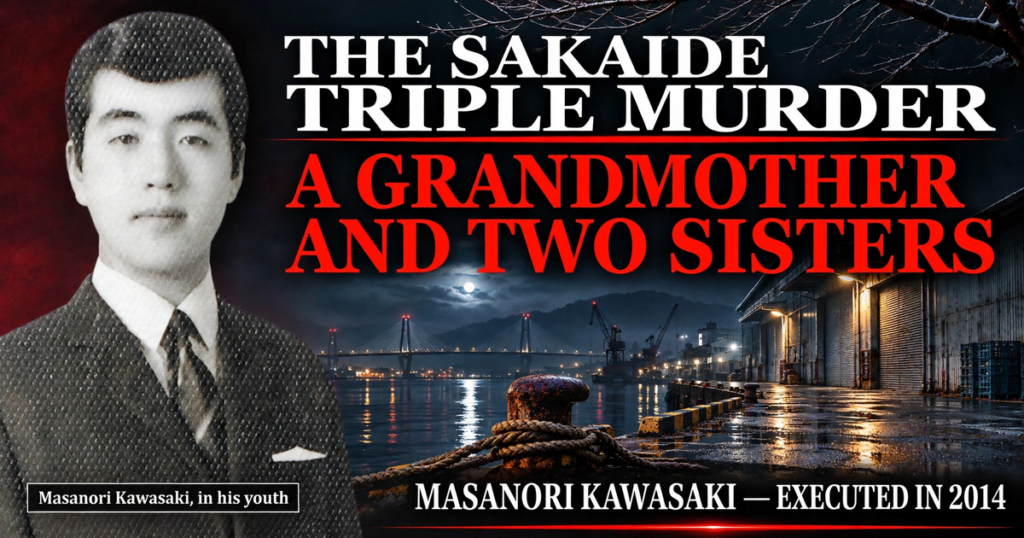
Three family members disappeared from a home in Sakaide
On the morning of November 16, 2007, 58-year-old Keiko Miura and her two granddaughters, Akane Yamashita, five, and Ayana Yamashita, three, were missing from a home in Sakaide, Kagawa Prefecture. The girls had stayed overnight at their grandmother's home. When family members arrived, none of the three was there. Blood traces remained inside the house, and Miura's bicycle and mobile phone were also missing. The first public understanding of the event was a disappearance involving three members of one family.
The missing bicycles and belongings made the scene appear misleading
The absence of Miura's bicycle and other belongings initially made it possible to imagine that she had taken the children somewhere. Police searched the surrounding area and interviewed people who knew the family. The blood traces suggested that something serious had happened inside the home, but the location of the three people was unknown. As the search continued, the missing-person case became a major local news story. The uncertainty also created an environment in which speculation about the family spread before investigators had established what had happened.
Miura's brother-in-law became the focus of the investigation
Police eventually focused on Masanori Kawasaki, Miura's brother-in-law. The court later found that he had developed resentment toward Miura in connection with financial matters involving his late wife. Kawasaki was arrested on November 27, 2007, on suspicion of abandoning a body. During the investigation, he gave information that led police to a materials-storage area near Sakaide Port. The following day, November 28, the bodies of Miura and the two girls were found.
The disappearance was confirmed as a triple murder
The discovery of the bodies changed the nature of the case. The investigation was no longer simply about locating three missing people; it concerned the murder and abandonment of three victims. The court found that Kawasaki had killed Miura and the two children and had taken steps to make it appear that they had left voluntarily. The removal of the bicycle and other belongings was treated as part of the effort to create a false impression about the disappearance. The bodies had been moved and left in a place where they would not be found immediately.
The court found that the resentment was directed at Miura, not the children
The court found that Kawasaki's grievance was directed toward Miura, in connection with a financial dispute. The two young girls had no involvement in that dispute. The court considered the fact that he killed them as well, including the possibility that he wanted to prevent the crime from being discovered. The killing of the children was a particularly grave part of the case. It was not treated as an incidental consequence of the dispute but as a deliberate act that increased the seriousness of the offence.
The trial focused heavily on criminal responsibility
Kawasaki did not substantially dispute the main facts of the killings. The defence raised questions about his mental condition and intellectual ability, arguing that his capacity for criminal responsibility had been reduced. The prosecution pointed to the preparation, the movement of the bodies, the removal of belongings and the attempts to disguise the disappearance. The court examined expert evidence alongside his actions before and after the murders. It concluded that he had retained the capacity to understand the wrongfulness of his conduct and act in accordance with that understanding.
The Takamatsu District Court imposed the death penalty
On March 16, 2009, the Takamatsu District Court sentenced Kawasaki to death. The court found that he had full criminal responsibility and treated the killing of three people, including two very young children, as an exceptionally serious result. The defence appealed. On October 14, 2009, the Takamatsu High Court dismissed the appeal and maintained the death sentence. The case then proceeded to the Supreme Court, where the final question was whether the lower-court judgment should be disturbed.
The Supreme Court made the death sentence final in July 2012
On July 12, 2012, the Supreme Court's First Petty Bench rejected Kawasaki's final appeal. The death sentence therefore became final. A death sentence pronounced by a trial court is not the same as a final death sentence: the appeals process must be completed or waived before execution can proceed. In this case, the first-instance judgment in 2009, the High Court's dismissal in 2009 and the Supreme Court's decision in 2012 were separate procedural stages.
Kawasaki was executed on June 26, 2014
On June 26, 2014, Kawasaki's death sentence was carried out at Osaka Detention House. He was 68 years old. The Ministry of Justice confirmed the execution in a ministerial press-conference record that day. The execution took place almost two years after the sentence became final. The distinction between the death sentence, its finality and its execution is important when describing the legal outcome. The case ended with the execution of the sentence imposed after the trial and appeal process.
The missing-person period also exposed the harm of premature accusations
During the period when Miura and the girls were missing, television programmes and online discussions circulated suspicions about members of the victims' family, including the girls' father. Those claims were not supported by established evidence. The person ultimately convicted was a different relative: Kawasaki. The family was already enduring the disappearance of three loved ones while also being exposed to public suspicion. The case remains a warning about the harm caused when people are treated as suspects based on appearance, demeanour or fragments of media coverage before an investigation has established the facts.
Original Japanese record: 坂出市3人殺害事件|祖母と孫姉妹の失踪から義弟逮捕へ、川崎政則の死刑確定と執行
Last updated:
Related articles

Case record
The Four-Prefecture Four-Murder Case: Twelve Years for the First Killing and Death for Three Later Murders
Case record
The Shodoshima Parents Murder Case
Case record
The Saitagawa Case: A Death Sentence Reconsidered Through a Confession and Trace Blood Evidence

Case record