
The Saitagawa Case: A Death Sentence Reconsidered Through a Confession and Trace Blood Evidence
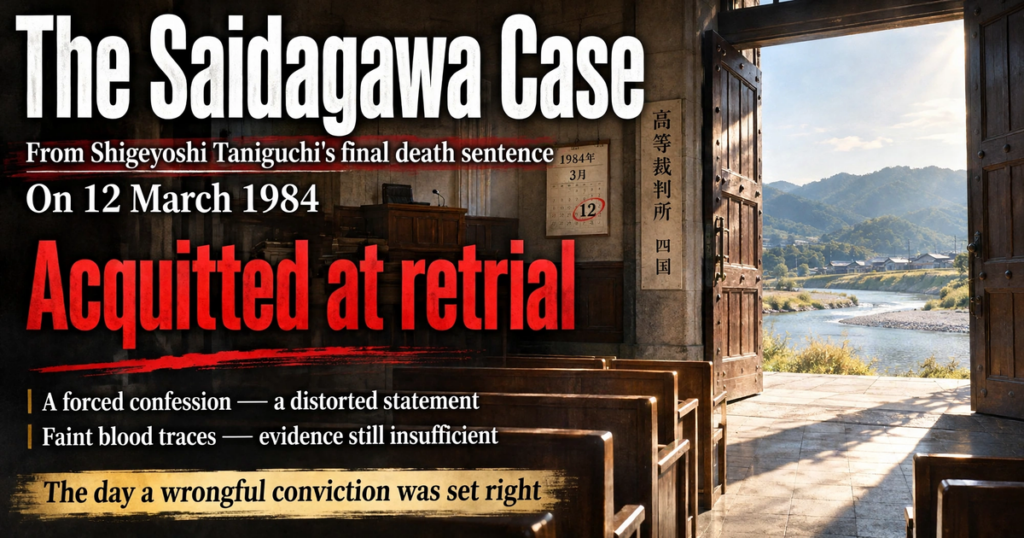
A 1950 robbery-murder conviction rested on a confession and a tiny bloodstain on a pair of trousers. The Supreme Court's 1976 Saitagawa decision clarified how new evidence must be assessed in retrial proceedings. Shigeyoshi Taniguchi was acquitted in 1984.
A robbery-murder in a rural home led to a death sentence
On 28 February 1950, a man living alone in Zaita Village, in Kagawa Prefecture, was attacked in his home. The assailant took money after killing him. The case was prosecuted as a robbery-murder, and the investigation eventually focused on Shigeyoshi Taniguchi, who was 19 when he was arrested in connection with the case. The victim's age is reported differently in some historical accounts, so this account does not rely on an exact age. The central questions became whether Taniguchi's confession was reliable and whether a small trace of blood found on trousers attributed to him genuinely connected him to the crime.
A separate robbery arrest led to questioning about the murder
About a month after the killing, Taniguchi was arrested in connection with another robbery. Investigators then questioned him about the Zaita murder over an extended period. He eventually made statements admitting the crime, but he denied responsibility in court. The prosecution argued that the confession contained details that only the offender could have known. This was described as a revelation of a secret fact, a concept sometimes used to support the reliability of a confession. The defence challenged both the circumstances in which the statements were made and the claim that the information was genuinely unknown to investigators before Taniguchi mentioned it.
The trousers and a tiny blood trace were treated as corroboration
The original conviction did not rest on the confession alone. A pair of khaki-coloured trousers said to have been worn by Taniguchi was presented as physical evidence. A very small blood trace was found on the fabric and was treated as consistent with the victim's blood. The prosecution used this to support the confession and to connect Taniguchi to the scene. But the later retrial proceedings asked several questions that had not been resolved by simply describing the mark as blood: whether the trousers were actually worn by Taniguchi on the night of the crime, whether the garment had been shared or reused, and whether the trace could reliably be attributed to the victim.
The death sentence was upheld before the retrial proceedings began
The Takamatsu District Court's Marugame Branch sentenced Taniguchi to death on 20 February 1952. The Takamatsu High Court dismissed his appeal on 8 June 1956, and the Supreme Court rejected his final appeal on 22 January 1957. The death sentence formally became final on 22 January 1957, according to the government's later account to the Diet. Taniguchi continued to maintain his innocence. His case then entered the separate retrial process, which can reopen a final judgment when new evidence raises a legally significant doubt about the original findings. The distinction matters: a retrial request is not itself a new trial, and an order to begin a retrial does not automatically mean that the applicant has been acquitted.
The 1976 Supreme Court decision changed how retrial evidence was assessed
The case became especially important in Japanese criminal procedure because of a Supreme Court decision issued on 12 October 1976. The Court set aside the lower courts' decisions rejecting the retrial request and sent the matter back to the Takamatsu District Court. The decision is commonly known as the Saitagawa decision. It explained that new evidence should not be assessed in isolation. The court must consider the new material together with all the evidence used in the original trial and ask whether the combined record creates a reasonable doubt about the original finding of guilt. The applicant does not have to prove innocence with certainty before a retrial can be opened. If the original conviction becomes reasonably doubtful, the legal threshold may be met.
Disclosure of investigation records weakened the claim of a secret revelation
During the retrial proceedings, records that had not been presented at the original trial were disclosed in stages. Those materials raised questions about whether the information described in Taniguchi's confession had really been secret. If investigators already possessed the details, or if they could have communicated them during questioning, the confession could not safely be treated as an independent revelation known only to the perpetrator. The proceedings also reconsidered the history of the trousers and the small blood trace. The garment had been used clothing and was reportedly shared within the family. The trace could not be tied conclusively to the victim or to Taniguchi's presence during the crime.
The retrial began in 1979 and ended with an acquittal in 1984
On 7 June 1979, the Takamatsu District Court ordered a retrial. The prosecution appealed, but the Takamatsu High Court dismissed the immediate appeal on 14 March 1981. The retrial then proceeded. The court examined the changing confession, the alleged secret revelations, the trousers and the trace blood evidence as a whole. On 12 March 1984, the Takamatsu District Court acquitted Taniguchi. The prosecution did not appeal, and the acquittal became final. Taniguchi was 19 when arrested and 53 when he was acquitted. The process had taken more than three decades from arrest to exoneration.
The Saitagawa decision remains important beyond this individual case
The legal importance of the Saitagawa Case lies in both the acquittal and the Supreme Court's explanation of the retrial standard. The 1976 decision did not declare Taniguchi innocent; it clarified when a final conviction must be reopened. The 1984 retrial judgment then examined the evidence and found the prosecution had not proved the case. The principle that new and old evidence must be assessed together, with reasonable doubt benefiting the accused, has remained central to Japanese retrial law. Taniguchi's acquittal did not identify another person as the killer. It established that the state could no longer sustain the conviction and death sentence against him.
Original Japanese record: 財田川事件|死刑確定から再審無罪へ、自白と微量血痕を崩した「財田川決定」
Last updated:
Related articles
Case record
The Shodoshima Parents Murder Case

Case record
The Four-Prefecture Four-Murder Case: Twelve Years for the First Killing and Death for Three Later Murders
Case record
The Sakaide Triple Murder: A Grandmother and Two Granddaughters, a Death Sentence and Its Execution
Case record