
The Ikebukuro Runaway-Car Crash: Two Deaths, a Five-Year Sentence and the Driver's Death in Custody
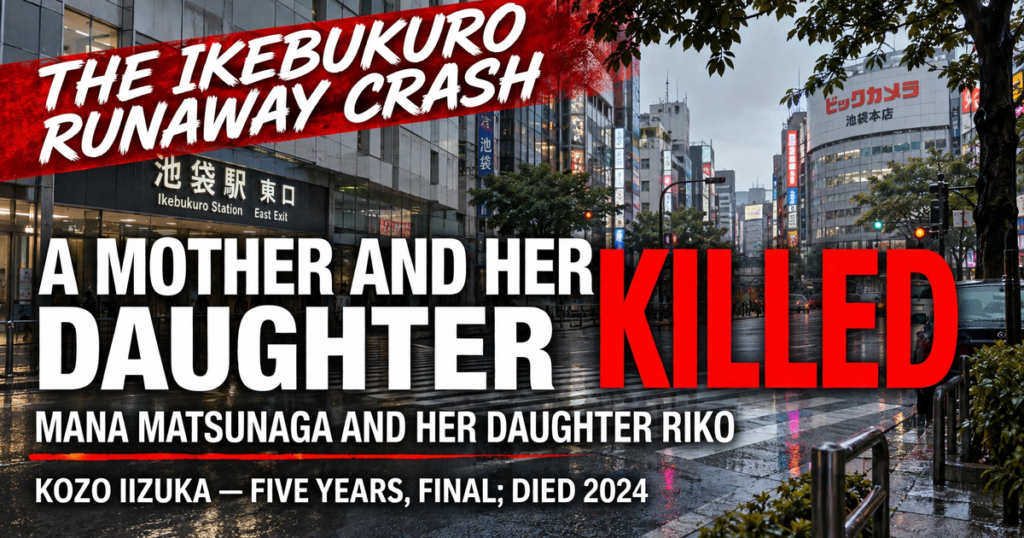
On April 19, 2019, a car driven by Kozo Iizuka accelerated through intersections in Tokyo's Higashi-Ikebukuro district, killing Mana Matsunaga and her three-year-old daughter Riko and injuring nine others. Iizuka argued that a vehicle malfunction had caused the acceleration. The Tokyo District Court rejected that explanation and found that he had mistaken the accelerator for the brake. His five-year sentence became final in September 2021. He served his sentence in a medical correctional facility and died there in October 2024.
A car accelerated through Higashi-Ikebukuro on April 19, 2019
At about 12:25 p.m. on April 19, 2019, a passenger car driven by Kozo Iizuka travelled through the Higashi-Ikebukuro district of Toshima Ward, Tokyo. The vehicle entered intersections against red signals and struck pedestrians and people on bicycles. It continued along the road, hitting several people before finally colliding with a refuse-collection truck. The crash was not a single impact at one crossing; the vehicle travelled through a series of points where people were exposed to danger.
Mana Matsunaga and her three-year-old daughter Riko were killed
Mana Matsunaga, 31, and her daughter Riko, three, were crossing on a bicycle when the car struck them. Both died. Nine other people were injured. The deaths of a mother and her young child, along with the injuries to other pedestrians, made the crash one of the most widely discussed traffic cases in Japan. The family's loss was followed by a long criminal proceeding in which the cause of the car's acceleration became the central disputed issue.
The driver's arrest status became a subject of public debate
Iizuka was taken for medical treatment after the crash, and investigators initially proceeded without arresting him. The decision attracted intense public attention, with criticism that his former government position might have influenced the police response. In criminal procedure, however, arrest is not automatic after every serious crash. Investigators must consider legal grounds such as the risk of flight or destruction of evidence. The fact that he was not immediately arrested did not determine whether he was guilty; that question was later examined in court.
The charge was negligent driving causing death or injury
Prosecutors charged Iizuka under the Act on Punishment of Acts Inflicting Death or Injury by Driving, alleging negligent driving causing death or injury. They did not charge him with dangerous driving causing death or injury. The legal classification depended on the driving conduct and the evidence about his mental state and actions, not simply on the number of people killed or injured. The distinction matters because a severe outcome does not by itself establish every element of the more serious dangerous-driving offence.
Iizuka argued that a mechanical fault caused the car to accelerate
During the trial, Iizuka denied that he had continued pressing the accelerator. He argued that the car might have suffered a malfunction, including a problem with its electronic control system. The defence maintained that a defect could not be ruled out and sought an acquittal. The prosecution relied on the vehicle examination, driving data and the circumstances recorded at the scene. It argued that the car had no defect and that Iizuka had mistaken the accelerator for the brake and continued pressing it.
The Tokyo District Court rejected the vehicle-malfunction explanation
On September 2, 2021, the Tokyo District Court found that the vehicle had not malfunctioned in the way the defence proposed. It concluded that Iizuka had confused the accelerator and brake pedals and had caused the car to accelerate. The court convicted him of negligent driving causing death or injury and imposed five years' imprisonment. The prosecution had sought seven years. The judgment also addressed the effect of Iizuka's continued insistence that the vehicle was defective on the families of the victims.
The five-year sentence became final without an appeal
Iizuka did not appeal the September 2 judgment, and prosecutors did not appeal either. The appeal deadline passed in September 2021, making the five-year sentence final. The finality came from the parties' decision not to pursue an appeal, not from a High Court or Supreme Court review. Iizuka was then taken into custody to serve the sentence. His age did not exempt him from the execution of the final custodial sentence.
A separate civil case addressed compensation for the family
The family of Mana Matsunaga and Riko also pursued a civil damages claim. In October 2023, the Tokyo District Court ordered payment of approximately 140 million yen, and that civil judgment later became final. A civil damages case has a different purpose from a criminal prosecution: it determines responsibility to compensate for loss, rather than imposing punishment on behalf of the state. The criminal sentence and the civil compensation order must therefore be described as separate legal proceedings arising from the same crash.
Iizuka died while serving the sentence in October 2024
After the sentence became final, Iizuka was held at the East Japan Adult Correctional Medical Center. On October 26, 2024, he died there at the age of 93. He died while serving the sentence; he had not completed the five-year term. The fact of his death does not undo the conviction or change the final judgment. The civil damages outcome also remained a separate matter. The case left a continuing public discussion about pedestrian safety, older drivers, responsibility after a fatal crash and how the justice system should respond to victims' families.
Original Japanese record: 池袋暴走事故|松永真菜さん・莉子ちゃん死亡、禁錮5年確定から飯塚幸三の服役中死亡まで
Last updated:
Related articles
Case record
The Tomei Expressway Road-Rage Deaths: Why Kazuho Ishibashi Was Convicted of Dangerous Driving Causing Death or Injury Without Hitting the Victims
Case record
The 1999 Tomei Expressway Drunk-Driving Crash: Two Young Sisters Killed and a Four-Year Sentence
Case record
The Kanuma Crane-Truck Crash: Six Children Killed on Their Way to School and the Limits of the Law
Case record