
The Hijacking of All Nippon Airways Flight 61: A Captain Killed, 517 People Aboard and a Final Life Sentence
On July 23, 1999, All Nippon Airways Flight 61 was hijacked shortly after leaving Haneda for New Chitose. Yuji Nishizawa entered the cockpit, killed Captain Naoyuki Nagashima and took the controls of the Boeing 747-400D. The first officer and other crew members subdued him and returned the aircraft to Haneda. No passenger was injured. Nishizawa was found to have diminished, but not absent, criminal responsibility and received a life sentence on March 23, 2005. He did not appeal.
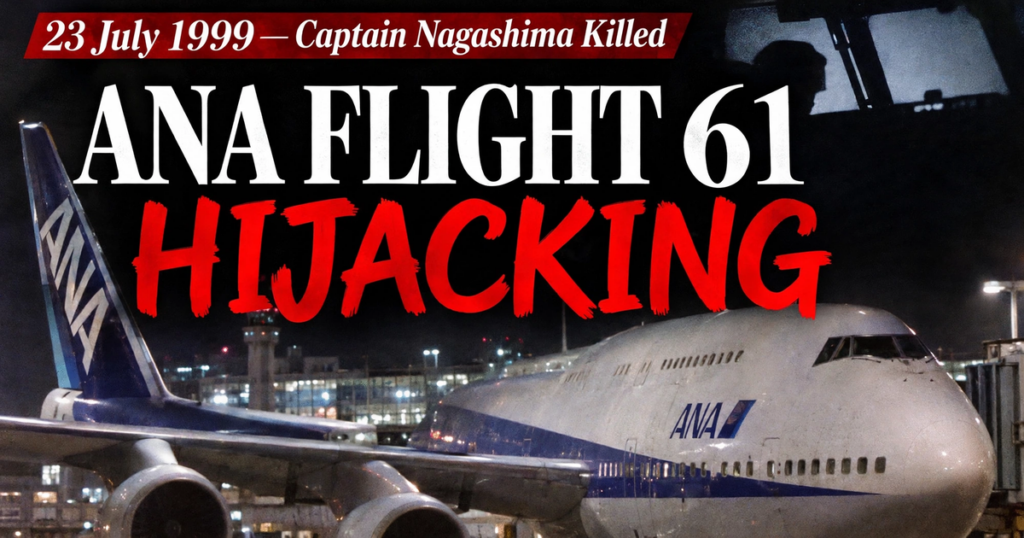
Flight 61 left Haneda for New Chitose
On July 23, 1999, All Nippon Airways Flight 61 departed Tokyo's Haneda Airport for New Chitose Airport in Hokkaido. The aircraft was a Boeing 747-400D carrying 503 passengers and 14 crew members, for a total of 517 people. Shortly after take-off, the flight was seized by Yuji Nishizawa. What began as a domestic passenger journey became a crisis inside the cockpit, where control of a large commercial aircraft was taken away from its trained crew.
Nishizawa forced his way into the cockpit
After boarding, Nishizawa threatened a cabin attendant and gained access to the flight deck. He ordered the first officer out of the cockpit and demanded control of the aircraft from Captain Naoyuki Nagashima. The cockpit was a restricted area, but the hijacker managed to enter it and place the flight crew under direct threat. The incident exposed a weakness in airport security before the aircraft had even left the ground: a person who had bypassed the screening process was able to bring a weapon aboard.
The captain was stabbed and the hijacker took the controls
Nishizawa stabbed Nagashima with a knife, fatally injuring the 51-year-old captain. He then sat in the pilot's seat and operated the aircraft himself. The plane was flying with more than five hundred passengers and crew on board. Any serious error in controlling the aircraft could have endangered everyone aboard and people on the ground. The attack was therefore both a murder and an aircraft hijacking, with an immediate risk extending far beyond the person killed in the cockpit.
The crew regained control and returned the aircraft to Haneda
The first officer and other crew members acted to regain access to the cockpit. They subdued Nishizawa and restored control of the aircraft to the flight crew. The first officer then flew the aircraft back to Haneda, where it landed safely. The archive records that passengers were not injured. The death of the captain was an irreversible loss, but the actions of the remaining crew prevented the hijacking from becoming a mass-casualty crash.
The airport security route used by the hijacker was examined
Investigators and transport authorities examined how Nishizawa had entered the departure area with a knife. The Ministry of Land, Infrastructure, Transport and Tourism later explained that he had moved from the arrival-side baggage-claim area toward the departure area through a route that allowed passengers to move in the wrong direction. He had not passed through the normal security screening in the way departing passengers were expected to. The incident therefore raised questions about the physical separation of arrival and departure flows, not only about the screening equipment itself.
Nishizawa had previously raised concerns about airport security
The Japanese archive records that Nishizawa had sent documents to government agencies, police and media organisations before the hijacking, pointing to weaknesses in airport security. The route he later used was among the weaknesses that came under scrutiny. That history is relevant to understanding how the security breach occurred, but it should not be treated as proof that officials had accepted every warning or that the hijacking was inevitable. The central failure was that a known type of security vulnerability was not adequately closed before it was exploited.
The trial examined whether Nishizawa could be held criminally responsible
Nishizawa was prosecuted for murder and offences including aircraft hijacking resulting in death. His mental condition at the time of the attack became a major issue at trial. The defence raised the possibility that he had been unable to understand or control his actions. The Tokyo District Court considered psychiatric assessments and other evidence and found that his ability to make decisions had been substantially impaired. It did not find that he was completely incapable of criminal responsibility. The legal finding was diminished responsibility, not a finding that he was not responsible at all.
A life sentence was imposed on March 23, 2005
On March 23, 2005, the Tokyo District Court sentenced Nishizawa to life imprisonment. The prosecution had also sought a life sentence. The court considered the killing of the captain and the danger placed upon hundreds of passengers and crew. The sentence was imposed at first instance, and Nishizawa did not appeal. It therefore became final without a High Court or Supreme Court ruling. The case should not be described as having undergone an appellate review of the responsibility finding or the sentence.
The hijacking led to changes in airport security procedures
After the incident, authorities strengthened the separation of arriving and departing passengers and increased security measures. The Ministry of Land, Infrastructure, Transport and Tourism identified measures including staff deployment and facility improvements to prevent passengers from moving back into the departure area, stronger passenger screening, updated metal detectors and more rigorous checks of checked baggage on domestic flights. Procedures for responding to outside reports about security weaknesses were also reviewed. The case became a turning point in the way Japanese airports considered the movement of people through terminals, the screening process and the handling of warnings about vulnerabilities.
Original Japanese record: 全日空61便ハイジャック事件|長島機長を刺殺、乗客503人を乗せたB747と無期懲役確定
Last updated:
Related articles
Case record
The 1995 Tokyo Subway Sarin Attack: Victims, Criminal Trials and a Continuing Legacy
Case record
The Torigoe 2-Chome Murder and Arson: The Killing of an Indian Jewelry Worker and the Search for Diwakar Sethia
Case record
The Ikebukuro Street Attack: Two Women Killed, Six Injured and the Death Sentence for Hiroshi Zoda
Case record