
The Kyoto Gion Runaway Van Crash: Seven Pedestrian Deaths, a Driver's Medical History and Changes to Driving-Licence Rules
On April 12, 2012, a light van struck pedestrians in Kyoto's Gion district after colliding with a taxi and continuing through a busy intersection. Seven pedestrians died. The Japan Epilepsy Association reported 11 injured, while Kyoto City's after-action report and the National Police Agency's chronology record 12; the driver also died after hitting a utility pole. Investigators examined the driver's history of epilepsy, but his death meant there was no criminal trial to establish a judicial finding on the cause. The case became part of the debate that led to changes in medical-condition screening for driving licences and the creation of a new dangerous-driving offence.
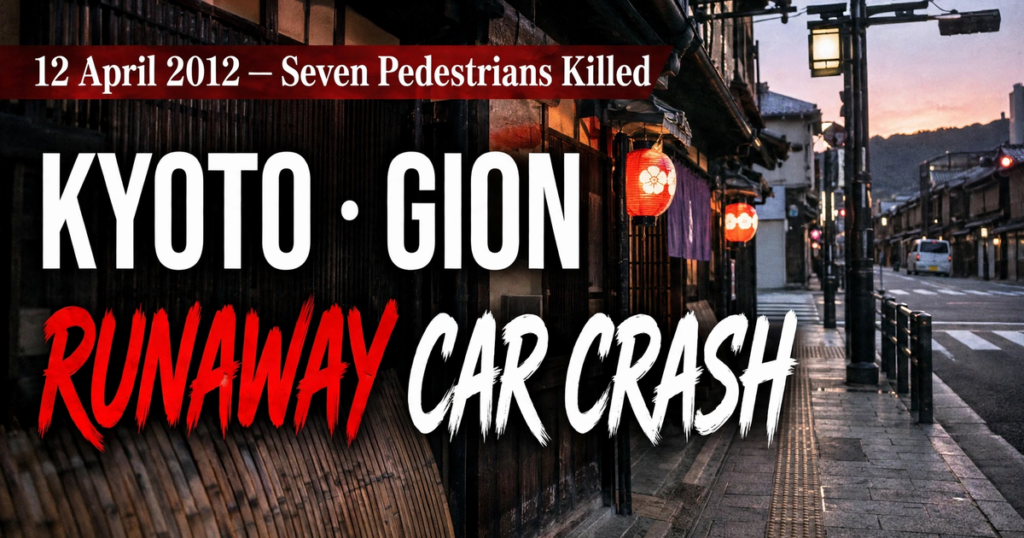
A light van entered the crowded streets of Gion
At about 1 p.m. on April 12, 2012, a light van travelled through the Gion district of Higashiyama Ward, Kyoto, an area busy with pedestrians, shoppers and visitors. The vehicle first came into contact with a taxi near Yamato-Oji Street. Rather than stopping, it continued north toward Shijo Street. At the intersection, it struck pedestrians crossing the road and continued along the street before colliding with a utility pole. The crash took place in the middle of the day, when the surrounding streets were crowded.
The vehicle continued after the initial collision
The first contact with the taxi did not end the vehicle's movement. The van continued through the area and struck people in and around the Shijo Street intersection. It eventually hit a utility pole and came to a stop. The driver was taken to hospital but died. The sequence mattered to investigators because the incident involved more than one point of impact: the taxi collision, the vehicle's continued travel, the pedestrian impacts and the final collision with the pole. The precise medical and mechanical causes could not be tested in a criminal trial.
Seven pedestrians died, and the driver also lost his life
The sources report two injury totals: the Japan Epilepsy Association's statement issued the day after the crash lists eleven injured people, while Kyoto City's after-action medical report and the National Police Agency's chronology list twelve. The seven pedestrian deaths are separate from the driver's death after the pole collision. Kyoto City's after-action medical report records eight deaths among the people handled by emergency services, six injured people transported by ambulance and six people who went to hospital on their own. The eight deaths include the driver as well as the seven pedestrians. The National Police Agency's 2013 chronology lists seven deaths and twelve injuries, while the Japan Epilepsy Association's statement issued the day after the crash reported seven pedestrian deaths and eleven injured people. The sources therefore differ in timing and classification; this account uses the later Kyoto City emergency report and identifies the earlier eleven-person figure rather than concealing the discrepancy.
The driver's epilepsy treatment history became part of the investigation
After the crash, investigators learned that the driver had a history of medical treatment for epilepsy. Police examined whether a seizure or another medical event might have affected his ability to control the van. The existence of a diagnosis or treatment history, however, does not by itself establish what happened at the moment of a particular crash. The driver had died, and there was no adversarial criminal trial in which medical experts, investigators and the defence could test competing explanations. It is therefore important not to present a possible seizure as a judicially established cause.
The driver was investigated, but no criminal trial followed
Police investigated the driver on suspicion of causing death and injury through negligent driving. Because he had died, the case did not proceed to a criminal trial against him. There was consequently no judgment determining criminal guilt or making a final judicial finding about the exact cause of the vehicle's movement. The absence of a trial should not be confused with an acquittal: the proceedings could not continue against a deceased suspect. This distinction is essential when describing the legal status of the case.
The employer's president was also investigated
Investigators also examined whether the president of the driver's employer had allowed him to drive despite knowing of a medical condition that could affect safe driving. The president was referred to prosecutors, but prosecutors did not indict him. The reason reported in the archive was that the evidence was insufficient to establish that he knew of specific symptoms that would interfere with driving. The decision was not a criminal court's finding after a trial. It was a prosecutorial decision based on the evidence available, and it did not establish that every aspect of the employer's safety management had been judicially examined.
The crash became part of a wider review of medical screening for drivers
The Gion crash was discussed alongside other serious crashes involving drivers with medical conditions. In 2013, the Road Traffic Act was amended to strengthen the process used when people applied for or renewed driving licences. The system introduced questionnaires about symptoms associated with certain medical conditions and penalties for false answers. It also provided for doctors to make voluntary reports to public safety commissions in specified circumstances. The framework was not designed to ban every person with a diagnosis from driving; it focused on symptoms and whether they could affect safe driving.
A separate statute addressed dangerous driving affected by illness
The Act on Punishment of Acts Inflicting Death or Injury by Driving was enacted in 2013 and came into force in 2014. It created a dangerous-driving category for certain situations in which a driver, aware of the risk that a specified illness could prevent normal driving, nevertheless drove and then became unable to operate the vehicle normally, causing death or injury. The new offence was not applied retroactively to the 2012 Gion crash. It formed part of the later legal framework for future cases, not a charge decided in this incident.
The legal reforms must be kept separate from the unresolved medical question
The Gion crash influenced public discussion of how licensing authorities should assess medical conditions and how the law should respond when illness affects driving. But the reforms do not prove that a particular seizure caused this particular crash. The driver died before a criminal trial, and the employer's president was not prosecuted because the evidence was considered insufficient. The event is therefore best understood through three distinct elements: the fatal road crash, the investigation that could not be tested at trial, and the later legislative changes intended to reduce similar risks.
Original Japanese record: 京都祇園軽ワゴン車暴走事故|歩行者7人死亡、持病をめぐる捜査と運転免許制度の改正
Last updated:
Related articles

Case record
The JR Uetsu Main Line Derailment: Inaho No. 14 and the Sudden Gust

Case record
The Kanemi Yusho Poisoning: PCB-Contaminated Rice Oil and a Relief System Still Operating Decades Later

Case record
The Fukuchiyama Fireworks Stall Explosion: Three Deaths, Fifty-Six Injured and a Five-Year Sentence
Case record