
The Yachimata Schoolchildren Crash: A Drunk Truck Driver, Two Deaths and the Expansion of Alcohol Checks
On June 28, 2021, a truck struck five primary-school pupils walking home in Yachimata, Chiba Prefecture. Two children died and three were injured. The driver, Hiroshi Umezawa, had consumed alcohol while on a work journey. In March 2022, the Chiba District Court sentenced him to fourteen years in prison for dangerous driving causing death and injury; he did not appeal. The crash also prompted stronger controls on privately operated white-plate vehicles, including staged requirements for visual alcohol checks and, from December 1, 2023, breathalyser checks by designated safety managers.
A truck struck five pupils on their way home
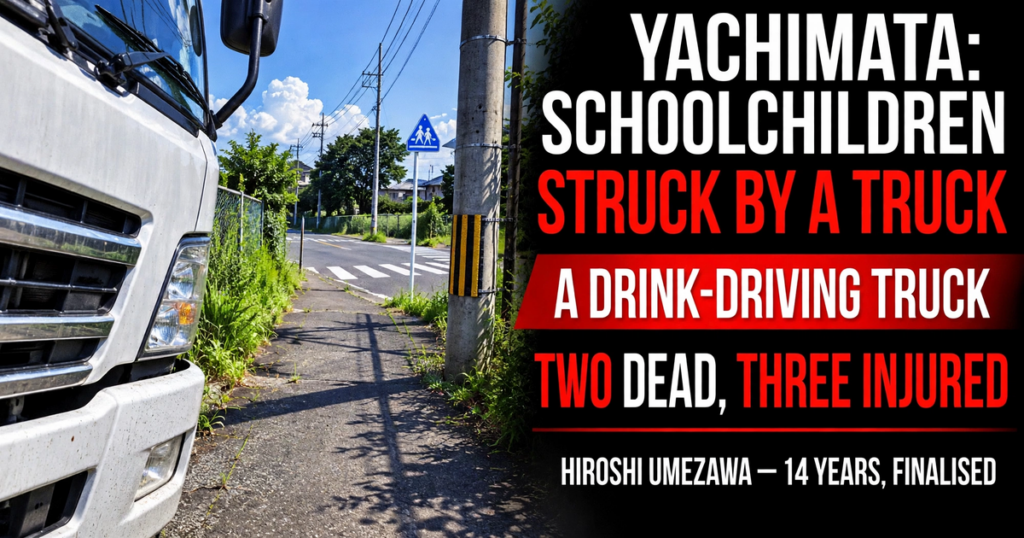
At about 3:23 p.m. on June 28, 2021, a large truck drove into a group of children walking home from school in Yachimata, Chiba Prefecture. The pupils attended Choyo Elementary School. Two boys, Yuto Tanii, aged eight, and Kaito Kawasome, aged seven, died; three other children were injured. The truck had entered a road where the children were walking close to moving traffic, and the crash devastated families and the local community. The immediate investigation focused on the driver's condition and the circumstances in which he had been operating the vehicle during a work assignment.
The driver had alcohol in his system while driving for work
The driver was Hiroshi Umezawa. Police detected alcohol above the legal threshold in his breath. He had been driving a truck as part of his employer's business rather than using a private car for a personal journey. Investigators examined the route, the driver's actions before the collision and whether alcohol had affected his ability to operate the truck safely. The case showed that a serious drink-driving risk could arise in a workplace fleet even when the vehicle was not being used by a licensed freight carrier operating a green-plate vehicle.
The five children were walking along a road with limited pedestrian separation
The crash also raised questions about the road environment. The route did not provide a fully separated pedestrian path at the point where the children were struck. That circumstance did not reduce the driver's responsibility for driving after drinking, but it was relevant to the safety measures considered after the crash. A road can remain dangerous for children even when the direct cause of a collision is clear. Investigators and government agencies therefore examined both drink-driving controls and the condition of school routes, including the need for barriers, markings and speed management.
The charge was changed as evidence of alcohol impairment emerged
The initial investigation developed as police obtained evidence about the driver's alcohol consumption and the way the truck had been operated. The case proceeded under the Act on Punishment of Acts Causing Death or Injury by Driving a Motor Vehicle, with the charge of dangerous driving causing death and injury. At trial, Umezawa admitted the charged conduct and apologised. The prosecution argued that the alcohol-related impairment and the resulting deaths and injuries warranted the maximum term available. The case was not treated as an ordinary traffic accident caused by a momentary lapse.
The Chiba District Court imposed fourteen years in prison
On March 25, 2022, the Chiba District Court sentenced Umezawa to fourteen years in prison. The prosecution had sought fifteen years. The court considered the seriousness of the two deaths, the injuries to three children and the fact that Umezawa had driven a work truck after consuming alcohol. He did not appeal, and the sentence became final. The final fourteen-year term should be distinguished from the prosecution's fifteen-year request and from any later policy changes that followed the crash.
The accident exposed a gap between green-plate and white-plate fleets
Before the crash, commercial transport operators using green-plate vehicles were subject to established alcohol-check procedures, including checks connected with roll calls and the use of breathalysers. By contrast, many businesses used privately registered white-plate vehicles to carry their own goods, tools or employees. These employers were not subject to the same breathalyser requirement in the same form. The distinction meant that a company could operate a fleet for business purposes without an equally strong system for checking drivers before and after work journeys.
Alcohol checks for white-plate vehicles were introduced in stages
Following the crash, the government strengthened the duties of businesses required to appoint a safe-driving manager. From April 1, 2022, those managers had to check whether drivers showed signs of alcohol consumption by visual observation or other methods and keep records. The breathalyser requirement was delayed while equipment supply was addressed. It came into force on December 1, 2023. The two stages must not be collapsed into one date: the initial visual checks and recordkeeping began in April 2022, while the requirement to use an alcohol detector began in December 2023.
The response also included a nationwide school-route review
In August 2021, the government adopted emergency measures for school-route safety and the prevention of drink-driving. Schools, road administrators and police worked together to inspect routes and identify locations where children were exposed to traffic. Measures included considering guardrails, clearer road markings and ways to reduce vehicle speeds. The review recognised that the physical design of a road and the conduct of drivers are separate parts of road safety. The Yachimata crash became a national policy trigger because it connected a driver's alcohol use with the absence of adequate workplace controls and pedestrian protection.
The case changed expectations for employers who operate vehicles
The legal sentence addressed Umezawa's individual criminal responsibility. The regulatory response addressed a different question: how employers should prevent a driver from beginning a work journey after drinking. Businesses that operate white-plate vehicles now have defined duties to check, record and use alcohol-detection equipment where the statutory requirements apply. The crash also remains a reminder that school-route safety requires continuing inspection rather than a one-time response. Two children died and three were injured; the resulting reforms do not undo that loss, but they changed the responsibilities placed on employers and public authorities.
Original Japanese record: 八街市児童5人死傷事故|飲酒トラックで2人死亡、白ナンバーにも広がった酒気確認
Last updated:
Related articles
Case record
The Morinaga Arsenic Milk Poisoning: More Than 12,000 Children Affected and Decades of Continuing Relief
Case record
The Sennichi Department Store Fire: 118 Deaths and the Supreme Court's Ruling on Fire-Management Duties
Case record
The Haneda Airport Runway Collision: Five Coast Guard Crew Killed and 379 Evacuated
Case record