
The Morinaga Arsenic Milk Poisoning: More Than 12,000 Children Affected and Decades of Continuing Relief
In the summer of 1955, infants across western Japan became ill after drinking powdered milk manufactured at Morinaga's Tokushima plant. The milk had been contaminated by arsenic in industrial-grade disodium hydrogen phosphate used during production. Early official counts recorded more than 12,000 patients and about 130 deaths, while later figures vary according to the date and the scope of victim recognition. The criminal case moved from an initial acquittal to a retrial, with a manufacturing manager sentenced to three years in 1973. Long-term support was later organised through the Hikari Association.
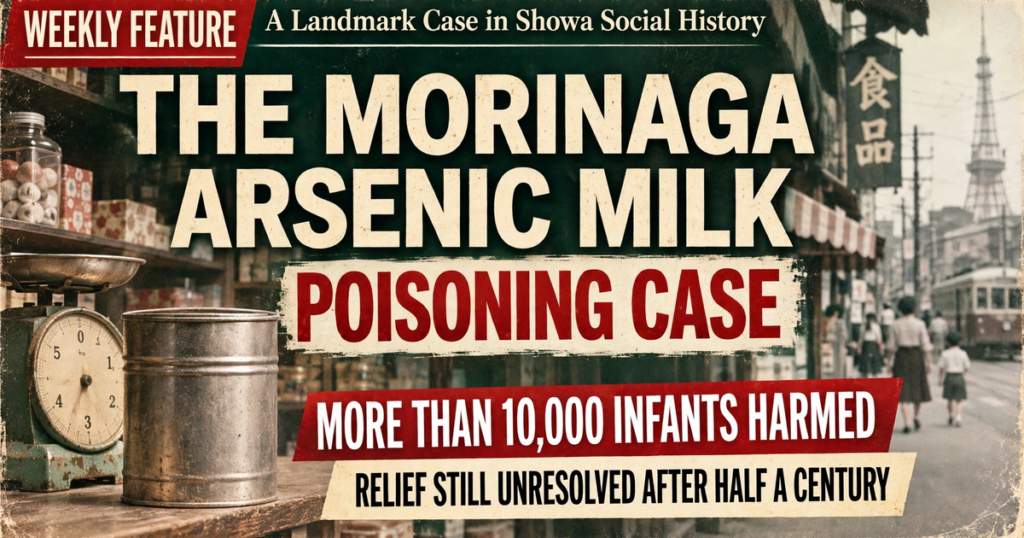
Infants across western Japan began to fall ill in 1955
In the summer of 1955, hospitals in western Japan received increasing numbers of infants with fever, skin symptoms, diarrhoea and other signs of poisoning. A common link emerged: the children had been fed powdered milk manufactured at Morinaga Milk Industry's Tokushima plant. The outbreak affected families across a wide area, not only households close to the factory. Because infants depended on milk as a major source of nutrition, contamination in a product distributed nationally could expose many children before the source was recognised. The event became one of Japan's most serious post-war food-poisoning disasters.
An industrial chemical ingredient carried arsenic into the milk
The Tokushima plant used disodium hydrogen phosphate, also called secondary sodium phosphate, during production to adjust the acidity of dairy products. The material used was an industrial-grade ingredient that contained a high level of arsenic. It was not suitable for use in infant food. The contaminated material entered the powdered milk during manufacturing and was consumed repeatedly by babies. The incident demonstrated that a product could be contaminated not because arsenic had been deliberately added as an ingredient, but because a raw material used in a routine production step had not been adequately checked for food-grade quality.
Official casualty figures differ according to the date of the count
The early official figures were published at different times and should not be treated as one immutable total. A February 1956 Ministry of Health announcement recorded 12,159 patients and 131 deaths. A 1957 Health and Welfare White Paper listed 12,344 patients and 130 deaths. Later victim-support records counted a larger group, reflecting additional recognition and the scope of long-term relief. The Ministry of Health, Labour and Welfare reported 13,463 affected people as of March 31, 2025. These figures describe different stages of investigation and recognition; they are not evidence that one of the earlier counts was necessarily fabricated.
The end of acute symptoms did not mean that every child had recovered
Early official and medical responses tended to focus on the acute poisoning. When symptoms subsided, some children were regarded as having recovered. In 1969, however, follow-up work and reporting fourteen years after the outbreak drew attention to people who continued to experience physical, intellectual and daily-living difficulties. The long-term effects were not captured by counting only those who died or required treatment in 1955. The later findings changed the debate from an emergency response to a question of lifelong medical, educational, employment and welfare support for people who had been exposed as infants.
The first criminal trial ended in acquittals
Two factory officials, including a plant manager and a manufacturing manager, were prosecuted for professional negligence causing death and injury. In 1963, the Tokushima District Court acquitted both defendants. The prosecution appealed, and the appellate court set aside the acquittals and remanded the case. The Supreme Court supported the remand decision. The proceedings were not a simple sequence in which the first judgment immediately became final. The later trial had to reconsider the evidence and the duties of the individuals responsible for the manufacturing process.
The remand court convicted the manufacturing manager in 1973
On November 28, 1973, the Tokushima District Court, hearing the case after remand, found the manufacturing manager criminally responsible and imposed a three-year prison sentence. The plant manager was again acquitted. The distinction matters: the judgment did not convict every person who had held a management position at the factory. The criminal process had taken eighteen years from the outbreak to its principal conclusion. The case showed how difficult it could be to prove which individual had a specific duty to verify raw materials and how that failure contributed to the poisoning.
A three-party agreement created a permanent relief framework
In 1973, representatives of the victims, Morinaga Milk Industry and the Ministry of Health held talks and agreed on a framework for permanent relief. The agreement was intended to go beyond a one-time payment. It recognised the need for continuing medical care, welfare assistance and support as the affected children grew older. In 1974, the Hikari Association was established to carry out relief programmes. Morinaga took on the financial responsibility for the framework, while the government and victims' organisations remained involved in its operation and oversight.
The Hikari Association supports victims across their lives
The Hikari Association's work has included health management, support for daily living and employment, and coordination with welfare services. The needs of people exposed as infants in 1955 changed as they reached adulthood and later middle age. Some required support for long-term health or disabilities that had not been fully understood during the acute phase. The case therefore became an important example of why relief programmes must be able to adapt to a person's changing needs rather than close once the immediate medical emergency has passed.
The case remains a continuing public-health responsibility
The Morinaga arsenic milk poisoning is not only a historical food-safety event. The government continues to coordinate with the victims' organisation, the Hikari Association and Morinaga. The number of people recognised for support depends on the date and the system used, and should be stated with its reference point. The criminal case, the later relief agreement and the ongoing support system are separate parts of the history. Together they show how contamination in a single manufacturing process can affect a generation and create responsibilities that last far beyond the end of a trial.
Original Japanese record: 森永ヒ素ミルク中毒事件|乳幼児1万人超の被害、18年の刑事裁判と続く恒久救済
Last updated:
Related articles
Case record
The Mitsubishi Motors Recall Cover-Up: Hidden Defect Reports, Fatal Truck Accidents and Separate Criminal Convictions
Case record
The Sunagawa Family Crash: Two Drivers, Joint Criminal Liability and Four Deaths
Case record
The HIV Blood-Product Scandal: Non-Heated Clotting Factors, Three Criminal Cases and the 1996 Settlement
Case record