
The Adachi Ward Female Teacher Murder: A 26-Year Disappearance and a Landmark Civil Ruling
Elementary school teacher Chikako Ishikawa, 29, disappeared after going to work in Adachi Ward on August 14, 1978. In 2004, a former school security employee came forward and said he had killed her and buried her under the floor of his former home. The criminal limitation period had already expired, but a 2009 Supreme Court civil ruling restricted the effect of the 20-year time bar because the killer had concealed the death.
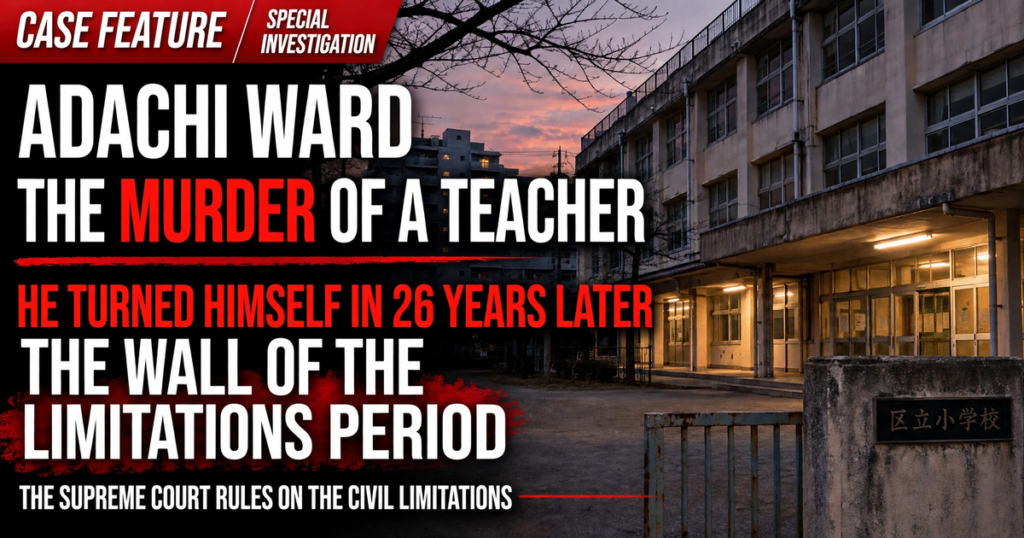
A teacher disappeared after going to her school
On August 14, 1978, Chikako Ishikawa, a 29-year-old art teacher at a public elementary school in Adachi Ward, Tokyo, disappeared. She had gone to her workplace during the summer holiday period, but her family could not find her afterward. Her relatives and police searched for her, including around the school and the apartment where she lived. At that time, there was no body and no direct evidence establishing that she had been killed. The case therefore remained a disappearance for many years, and the family could not know what had happened to her.
The former school security employee came forward 26 years later
On August 21, 2004, a former school security employee who had worked at the same elementary school went to Ayase Police Station and said that he had killed Ishikawa. He stated that he had buried her body beneath the floor of his home. According to the Supreme Court's later account, he came forward after a land readjustment project made it likely that he would have to vacate the property and that the remains would be discovered. The confession transformed a long-running missing-person case into a homicide investigation.
The remains were found and identified by DNA testing
Police searched the former home the following day, August 22, and found skeletal remains buried beneath the floor. DNA testing confirmed on September 29, 2004, that the remains were Ishikawa's. Her family learned that she had died only after the identification. The 26-year gap had not been caused by a lack of concern from the family; the person who had killed her had concealed the body and prevented them from knowing that she was dead. That concealment later became central to the civil case.
The criminal limitation period had already expired
At the time of the 1978 killing, the limitation period for murder was 15 years. By the time the former employee came forward in August 2004, more than 25 years had passed. The limitation period had therefore expired before the remains were found and the confession was made. The police could investigate the statement and the discovery, but the prosecution could not bring a murder case to trial. The case consequently did not produce a criminal conviction or a criminal sentence against the man who admitted the killing.
The family pursued compensation through a civil action
Ishikawa's relatives sought damages from the former employee and Adachi Ward. The civil case raised a different question from the criminal investigation: whether the claim for compensation had been extinguished because more than 20 years had passed since the killing. Under the former Civil Code Article 724, the 20-year period was generally treated as a long-stop exclusion period. The defendant argued that the family's claim had expired even though the family had not known that Ishikawa was dead. The family argued that the defendant could not benefit from the concealment he had deliberately created.
The Supreme Court limited the effect of the 20-year period
On April 28, 2009, the Supreme Court's Third Petty Bench rejected the defendant's appeal. It considered the unusual situation in which a person who killed someone deliberately concealed the death, leaving the heirs unable to become established and unable to exercise their rights. The Court held that, where special circumstances existed, the effect of the 20-year period could be restricted in light of the purpose of the Civil Code rule that protects heirs while inheritance is being determined. In this case, the family learned of the death on September 29, 2004, and filed the civil action on April 11, 2005, within six months after the heirs became established.
The Supreme Court ruling was civil, not a criminal conviction
The 2009 judgment did not reopen the expired murder prosecution and did not impose a criminal sentence. It addressed the civil claim for damages and whether the 20-year time bar could be used by a person who had hidden the victim's body and prevented the family from learning of the death. The distinction between criminal prosecution and civil compensation is essential. The man was not convicted in a criminal trial because the limitation period had already expired, while the civil proceedings allowed the family to pursue compensation despite the passage of more than 20 years.
The 2010 abolition of the murder limitation period did not revive this case
Japan later abolished the limitation period for crimes punishable by death, including murder, through a 2010 amendment. That change did not revive cases in which the limitation period had already expired before the amendment took effect. Ishikawa's case was already time-barred in 2004, so the later reform did not create a new opportunity for a criminal prosecution. The Supreme Court's 2009 civil ruling also did not change the criminal limitation rule. It concerned the separate right to seek damages and the exceptional circumstances created by concealment of the death.
The case exposed the difference between an unknown death and an unknown offender
The legal reasoning depended on the fact that Ishikawa's family did not know she had died. The Supreme Court did not announce that every family may avoid a 20-year period whenever an offender remains unknown. It addressed a narrower situation in which the killer deliberately created the conditions that prevented the heirs from knowing of the death and becoming legally determined. The case therefore remains significant for the relationship between concealment, inheritance and civil limitation periods, while its criminal outcome remains unchanged: no murder trial took place.
Original Japanese record: 足立区女性教師殺人事件|26年後の自首で公訴時効、最高裁が民法724条後段の効果を制限した理由
Last updated:
Related articles
Case record
The Komatsugawa Case: Two Murders, Ri Chin-u's Death Sentence and the Debate That Continued After His Execution
Case record
The Sada Abe Case: A 1936 Murder, a Six-Year Sentence and the Limits of the Historical Record
Case record
The Shibamata Student Murder and Arson: The 1996 Killing of Junko Kobayashi

Case record