
The Sada Abe Case: A 1936 Murder, a Six-Year Sentence and the Limits of the Historical Record
Sada Abe killed Kichizo Ishida in Tokyo in May 1936. Her six-year prison sentence was reduced by a later amnesty.
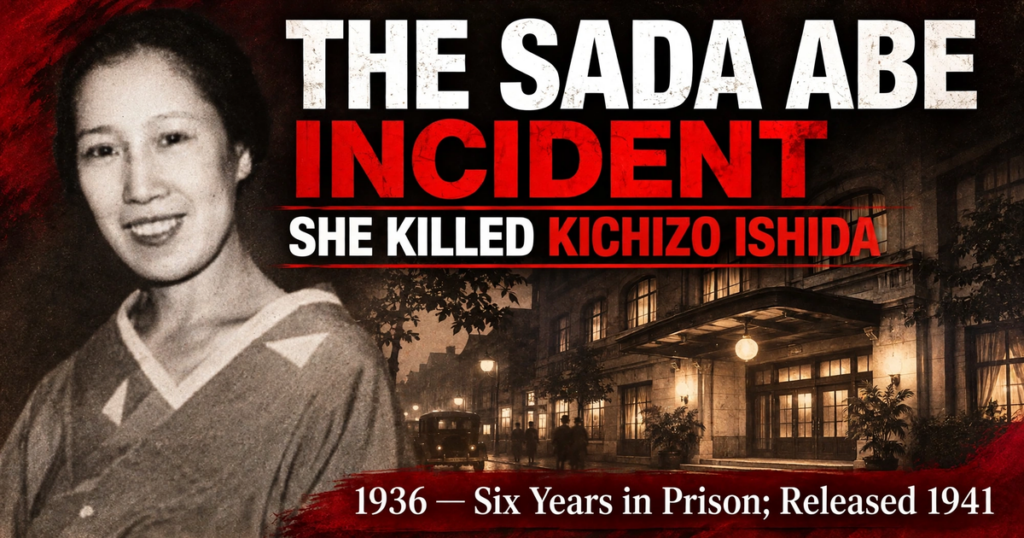
A man was found dead at an inn in Tokyo in May 1936
On May 18, 1936, Kichizo Ishida, aged 42, was found dead in a lodging house known as Masaki in the Ogu area of what was then Tokyo City. Sada Abe, aged 31, had been staying with him and had left the premises. A staff member became concerned when Ishida did not wake and discovered his body that afternoon. Abe had worked at Ishida's restaurant and had been in an intimate relationship with him. Police identified her as the woman who had left the room and began searching for her.
Abe was arrested two days later in a Shinagawa inn
After leaving Masaki, Abe moved through Tokyo, changing her clothing and visiting people she knew. Police received information about her movements and located her at an inn in Shinagawa on the evening of May 20. She was arrested there, two days after Ishida's death. Following her arrest, Abe began describing how she had killed him and what she said had motivated her. Those statements became a major part of the public story. They must nevertheless be treated as Abe's own account rather than as an independently established explanation of every aspect of the relationship or the offence.
The relationship was real, but later accounts often exaggerated it
Ishida was married and had children. He and Abe had been in a close relationship before the killing. Abe's statements described distress over the limits of their relationship and an intention to kill Ishida and then die herself. She did not die; she was arrested and prosecuted. Newspapers placed intense emphasis on sexuality, jealousy and the condition of the body. Some contemporary reports also suggested that other acquaintances had played a role in a supposed romantic triangle. One man who knew Abe was questioned as a reference person but was released, and no evidence established that he had participated in the killing. Later fictional and popular accounts often blended these reports with dramatic interpretation.
The case entered a pretrial examination under the old criminal procedure
On June 13, 1936, Abe was indicted for murder and mutilation of a corpse. The case proceeded through a preliminary judicial examination under the former Code of Criminal Procedure. That procedure allowed a judge to examine the case before deciding whether it should proceed to a full trial; it is not part of Japan's present criminal procedure. During the examination, Abe was questioned about her background, her relationship with Ishida and the events surrounding the killing. When using them, it is necessary to identify them as statements attributed to Abe rather than automatically treating every detail as a judicial finding.
The prosecution sought ten years, but the court imposed six
At trial, prosecutors sought a ten-year prison sentence for murder and mutilation of a corpse. On December 21, 1936, the court sentenced Abe to six years in prison and credited 120 days of pretrial detention toward the term. A major factor was the court's assessment that Abe had been in a state of diminished responsibility at the time of the offence. This was not a finding that she lacked all criminal responsibility. Under the law then in force, diminished responsibility could reduce punishment even though the defendant remained guilty. Abe was convicted of the offences; she was not acquitted or found legally incapable of responsibility.
Abe waived her right to appeal and the judgment became final
After the sentence was announced, the presiding judge explained that Abe could appeal. She indicated that she wished to waive that right, and the judge confirmed her intention. She did not file an appeal. As a result, the six-year sentence became final without review by the Tokyo High Court or the Supreme Court. Abe did not receive a reduced sentence from an appellate court, and no higher court later changed the trial judgment. The final outcome was the first-instance conviction and sentence, which became final through her waiver of appeal.
An amnesty reduced the sentence and Abe was released in 1941
Abe began serving her sentence at Tochigi Women's Prison on December 26, 1936, five days after judgment. In 1940, an amnesty associated with the 2,600th anniversary celebrations of the imperial era reduced her sentence. She was released in May 1941. This explains why the actual period she spent in prison was shorter than the six-year term imposed by the court. A complete account of the sentence therefore needs to include both the original judgment and the later reduction.
A man questioned during the investigation was not convicted
The police investigation also questioned Goro Omiya, a school principal who had known Abe. Some newspapers speculated about a love triangle and gave him a prominent place in the story. He was released on May 21, and no evidence established that he had taken part in Ishida's death. The case demonstrates how quickly a high-profile investigation can turn a reference person into a character in a public narrative. Later accounts should not repeat early newspaper speculation as if a court had confirmed it.
The case became a cultural legend, often at the expense of the legal record
Abe's case inspired books, films, theatre and commentary. The language of 'passion' and 'the bizarre' often overshadowed the fact that a man had been killed and that a court had made a specific finding about criminal responsibility. Abe herself later objected to some publications that used her story, including by bringing a defamation action over portrayals of her and Ishida. The trial was already a media spectacle in 1936, with crowds waiting outside the courtroom and reporters following Abe's appearance.
The established legal history is more restrained than the legend
The facts that can be stated with confidence are that Ishida died on May 18, 1936; Abe was arrested on May 20; she was indicted for murder and mutilation of a corpse; prosecutors sought ten years; and the court imposed six years after considering diminished responsibility. Abe waived appeal, the judgment became final, an amnesty reduced the sentence in 1940 and she was released in May 1941. The case should not be reduced to a story of 'romantic obsession' or sensational post-offence conduct. Its legal record concerns a killing, a conviction and a sentence under the criminal law of prewar Japan.
Original Japanese record: 阿部定事件|石田吉蔵殺害、懲役6年判決と1941年の出所まで
Last updated:
Related articles
Case record
The Shibuya Junior-College Student Dismemberment Case: A Brother's Conviction and the Shift from Seven to Twelve Years
Case record
The Eniwa Office Worker Murder: A Circumstantial-Evidence Conviction and Two Rejected Retrial Requests
Case record
The Osaka Two-Child Starvation Case: Sakurako and Kaede Left Alone for About 50 Days, and Three Reports Failed to Protect Them

Case record