
The Nagasakiya Amagasaki Store Fire: Fifteen Deaths from Smoke on the Fifth Floor
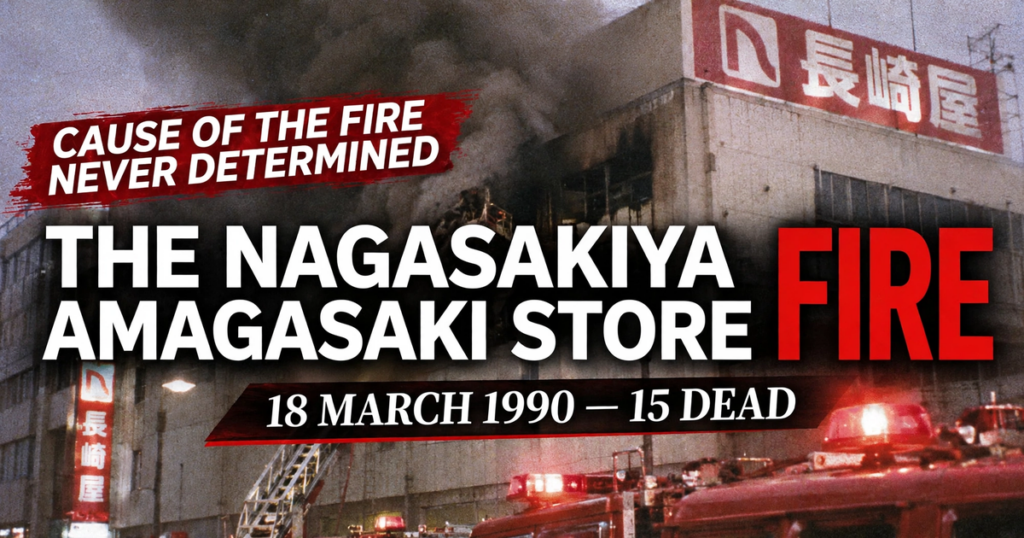
A fire broke out near the fourth-floor interior section of the Nagasakiya Amagasaki store on March 18, 1990. Although the fire itself was concentrated on that floor, smoke spread upward and killed 15 people on the fifth floor: 12 employees and three customers. Six people were injured. Arson was suspected, but the person responsible was never identified.
A Sunday fire broke out at the Nagasakiya store
Shortly after noon on Sunday, March 18, 1990, a fire broke out at the Nagasakiya Amagasaki store in Amagasaki, Hyogo Prefecture. The building had one basement level and five floors above ground. Customers and employees were inside when smoke and flames began to spread near the interior-goods section on the fourth floor. The fire burned approximately 814 square metres of that floor. The most serious loss of life, however, occurred one level above the main fire area. The event became a major commercial-building disaster because smoke reached people who were not in the part of the building where the flames began.
The fire floor and the floor where most victims died were different
People on the fourth floor and on lower levels were able to escape through the stairways. The fifth floor contained an employee cafeteria and a game area, and people who were resting or using those facilities became trapped. The fire did not have to spread directly into every room to create a fatal environment. Smoke and combustion gases travelled upward through internal routes, making the fifth floor dangerous even though the principal burning area was below it. The difference between the evacuation outcomes on the lower floors and the fifth floor became one of the defining features of the disaster.
Smoke, rather than direct flame contact, caused the deaths
Fifteen people died on the fifth floor. The victims were 12 employees and three customers. Six other people were injured. Smoke can incapacitate people before flames reach them: toxic gases reduce the ability to think, move and find an exit, while dense smoke removes visibility and makes familiar corridors difficult to navigate. The fire therefore exposed the danger of treating fire protection as a matter of extinguishing flames alone. Preventing smoke from entering escape routes and protecting the time needed for evacuation are equally important parts of building safety.
Fire doors and evacuation routes became central safety questions
After the disaster, attention turned to the building's fire compartments, the operation of fire doors and the management of escape routes. A door that does not close or seal as intended can allow smoke to move rapidly from one floor to another. A commercial building also contains spaces with different uses: retail areas, storage rooms, staff facilities and recreation areas. An evacuation plan must account for the people who may be in each of those spaces, including workers who are not on the sales floor. The store fire demonstrated how quickly the safety of an upper floor can depend on routine maintenance and management decisions.
Arson was suspected, but no perpetrator was identified
Investigators considered arson to be the likely cause of the fire. Nevertheless, the person who started it was not identified, and the case did not result in a criminal conviction. The large number of deaths cannot be treated as proof of who caused the fire. It is important to distinguish the suspected criminal origin from the separate questions about how smoke spread and why evacuation failed on the fifth floor. The available public record does not establish the identity of an arsonist, and this account does not fill that gap with speculation.
The Ministry of Construction issued a safety notice in 1991
After the fire, the Ministry of Construction established an investigative committee to examine the building and consider preventive measures. On June 28, 1991, the ministry issued a notice concerning the promotion of disaster-prevention measures in retail stores and similar buildings. The notice recorded the toll of 15 deaths and six injuries and asked the relevant authorities to guide building owners and managers in improving safety. It drew on the committee's review and was directed toward prevention. It did not identify the person responsible for the fire or resolve the criminal investigation.
The administrative response addressed the building, not the identity of the arsonist
The 1991 notice treated the disaster as a warning about how stores were designed, used and managed. Fire alarms, the transmission of warnings, the placement and maintenance of fire doors, and the ability to move safely between floors all needed to work together. The government response focused on reducing the chance that another fire would produce the same pattern of smoke-related deaths. That administrative work was a different process from identifying the person who may have set the fire. The two tracks reached different outcomes: the suspected arsonist remained unidentified, while the disaster contributed to formal safety guidance.
The lasting lesson is the need to protect people from smoke
The fifth-floor deaths showed that a fire can kill people far from the point where it starts. Effective protection requires a building-wide view of smoke movement, the use of internal spaces and the time people need to reach safety. It also requires everyday management: doors must be maintained, escape routes kept usable and staff prepared to direct people who may be unfamiliar with the building. The disaster is remembered not only for the unresolved cause but also for the way a fire concentrated on one floor caused catastrophic losses elsewhere in the building.
The unresolved cause and the documented safety response must remain separate
The established facts are that the fire began near the fourth-floor interior-goods section on March 18, 1990, burned about 814 square metres, and led to 15 deaths and six injuries. Twelve of those who died were employees and three were customers, all on the fifth floor. Arson was suspected, but the perpetrator was not identified. The Ministry of Construction's June 28, 1991 notice documented the disaster and promoted improved prevention in retail buildings. The notice is evidence of the administrative response, not proof of the fire's criminal cause.
Original Japanese record: 長崎屋尼崎店火災|15人が犠牲となった5階の煙と、未解決の出火原因
Last updated:
Related articles
Case record
The Shibamata Student Murder and Arson: The 1996 Killing of Junko Kobayashi
Case record
The Toyoake Mother-and-Three-Children Murders: Four Deaths in a House Fire and an Investigation Still Open
Case record
The Sekihotai Attacks: The Murder of an Asahi Shimbun Journalist and Five Unsolved Incidents
Case record