
The Toyokawa House Murder: A 17-Year-Old, Two Psychiatric Assessments and a Juvenile Court Disposition
A 17-year-old high-school student killed a 64-year-old woman in Toyokawa on May 1, 2000, and injured her 67-year-old husband. The boy surrendered the following day. A Family Court sent him to a medical juvenile training school after two psychiatric assessments reached different conclusions. No criminal trial took place, and the court records were later found to have been destroyed.
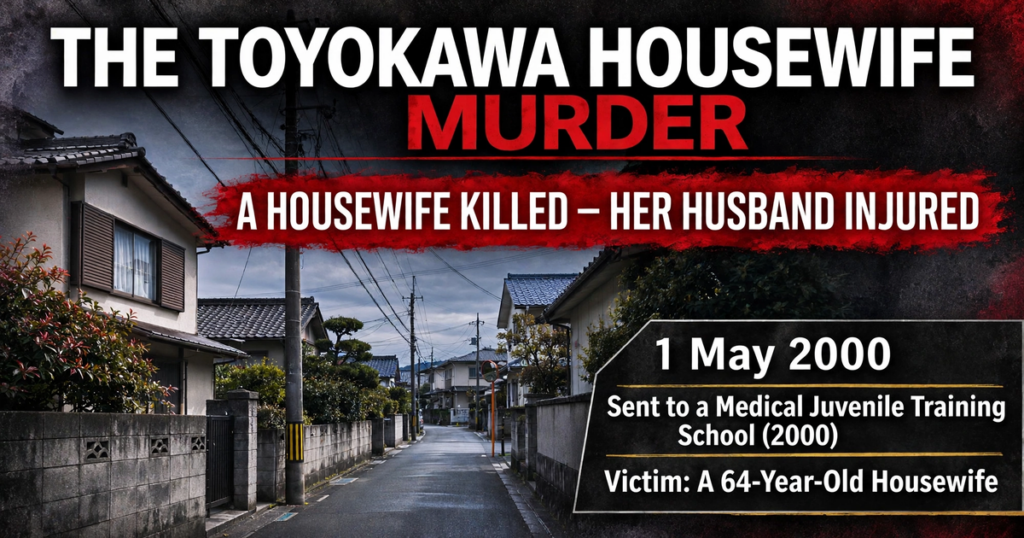
A woman was killed in her home in Toyokawa
At about 6:10 p.m. on May 1, 2000, a 64-year-old woman was attacked inside her home in Kanaya Motomachi, Toyokawa, Aichi Prefecture. The assailant was a 17-year-old boy who attended a nearby high school and was in his third year. He struck the woman with a hammer and then stabbed her repeatedly with a kitchen knife. She died from her injuries. Her 67-year-old husband returned home and encountered the boy as he was leaving. The husband struggled with him and suffered cuts, including injuries to his neck, but survived. He then found his wife lying in blood and called the police. The couple had no known prior relationship with the boy.
The boy's statement described why he chose the house
In his statement, the boy said that he had wanted to try killing someone. He said he avoided targeting someone with a future ahead of them and instead chose an elderly woman. He also described looking at how far the front door was open and at the nameplate before deciding which house to enter. These details are presented as the boy's own explanation of his motive and how he selected the home; they do not establish a prior relationship with the couple, which the investigation did not identify.
The boy changed clothes and spent the night away from home
After leaving the house, the boy went to a bamboo grove about 200 metres to the north, where he changed clothes. He then travelled away from the neighbourhood and spent the night in a public toilet near Naka-Odai Station. The sequence was later described in contemporaneous reporting and in the Japanese case record. These actions were part of the investigation into what happened after the killing, but they do not by themselves explain why the boy selected the house or the victim. The case record does not establish a personal dispute between the boy and the couple. The woman was killed in her own home, while her husband was injured when he returned and confronted the intruder.
He surrendered at a police box the following afternoon
At approximately 5:30 p.m. on May 2, the boy went to the police box outside Nagoya Station, which was under the jurisdiction of Nakamura Police Station, and surrendered. He reportedly said that he was cold and tired. His surrender brought the immediate manhunt to an end, and investigators identified him as the person who had entered the Toyokawa home. He was still a juvenile under Japanese law. The case therefore did not proceed in the same way as an ordinary adult murder prosecution. The boy's age, mental condition and the statutory framework governing serious juvenile offences became central to the legal process that followed.
The case went to Family Court rather than a public criminal trial
The boy was sent to the Nagoya Family Court. Prosecutors expressed the view that criminal disposition was appropriate and submitted the case with an opinion recommending that it be referred for criminal proceedings. That recommendation was not itself a court decision. The Family Court had to examine the boy's circumstances, the evidence and the psychiatric material before deciding what disposition to make. Unlike an adult criminal trial, juvenile proceedings are generally closed to the public and are directed toward deciding the appropriate legal and rehabilitative response to the young person. No public criminal trial followed in this case, and no adult criminal sentence was imposed.
Two psychiatric assessments reached different conclusions
The case became notable for two psychiatric assessments that did not reach the same formulation. The first assessment described the boy as possibly having schizoid personality disorder or schizothymic traits. That terminology should not be confused with a finding of schizophrenia. A later assessment identified Asperger's syndrome and considered that it had produced a state of diminished responsibility at the time of the offence. These were expert assessments made for the juvenile proceedings, not criminal verdicts. The differences between them mattered because the Family Court had to consider the boy's mental development, his capacity and the type of treatment or supervision that would be appropriate.
The Family Court ordered placement in a medical juvenile training school
On December 26, 2000, the Nagoya Family Court decided to send the boy to a medical juvenile training school. This was a protective disposition within the juvenile justice system, not a sentence of imprisonment imposed after a criminal conviction. The distinction is important. The prosecution's recommendation for criminal disposition did not bind the Family Court, and the court chose a medical and rehabilitative placement after considering the psychiatric material. The available public account identifies the date, court and type of disposition, but the underlying juvenile-court file is no longer available for a complete independent reconstruction of every reason considered by the judges.
The 2000 Juvenile Act revision must be placed in its correct timeline
The case is sometimes discussed alongside the 2000 revision of Japan's Juvenile Act. The amendment was passed after the May 2000 offence and came into force on April 1, 2001. The Family Court's disposition in the Toyokawa case was made on December 26, 2000, before that effective date. It would therefore be inaccurate to describe the boy as having been dealt with under the later framework for specified serious juvenile cases. The legislative debate is relevant background, but it should not be used to rewrite the legal basis of a disposition made before the amendment took effect.
The destruction of the court records became known more than two decades later
In 2022, it became known that the records of the juvenile proceedings had been destroyed. The loss meant that the original court materials could not be used to re-examine the evidence, the competing psychiatric assessments or the Family Court's detailed reasoning. The discovery raised questions about how long records of serious juvenile cases should be preserved and which cases warrant special retention. The destruction was not a judicial finding that the case was unimportant, nor did it alter the disposition made in 2000. It did, however, make later historical and legal verification more difficult.
What can and cannot be stated about the legal outcome
The established public record is that a 17-year-old boy killed a 64-year-old woman, injured her 67-year-old husband, surrendered the next day and was dealt with by the Nagoya Family Court. The court ordered medical juvenile training school placement on December 26, 2000. The two psychiatric assessments differed, and prosecutors had recommended criminal disposition, but no adult criminal trial or conviction followed. The boy's identity is not supplied in the public article and is not added here. Because the court records were later destroyed, claims about the precise judicial reasoning must remain limited to what is documented in contemporary reporting and the surviving public account.
Original Japanese record: 豊川市主婦殺人事件|結論が分かれた2度の精神鑑定と医療少年院送致、失われた少年審判の記録
Last updated:
Related articles
Case record
The Kyotanabe Police Officer Murder: A 16-Year-Old Daughter and the Family Court's Decision Not to Transfer
Case record
The Nagasaki Abduction and Killing of a Four-Year-Old Boy: A Twelve-Year-Old Child, Juvenile Protection, and Destroyed Court Records

Case record
The Toyota City High-School Girl Murder: Manami Shimizu, a Missing School Tracksuit and an Unsolved Robbery-Murder

Case record