
The Nagoya Internet Bulletin Board Murder: One Victim, Three Defendants and Different Sentences
Rie Isogai was murdered in 2007 by three men who had met through an online bulletin board. Their legal outcomes differed.
Three men met through an online criminal-recruitment bulletin board
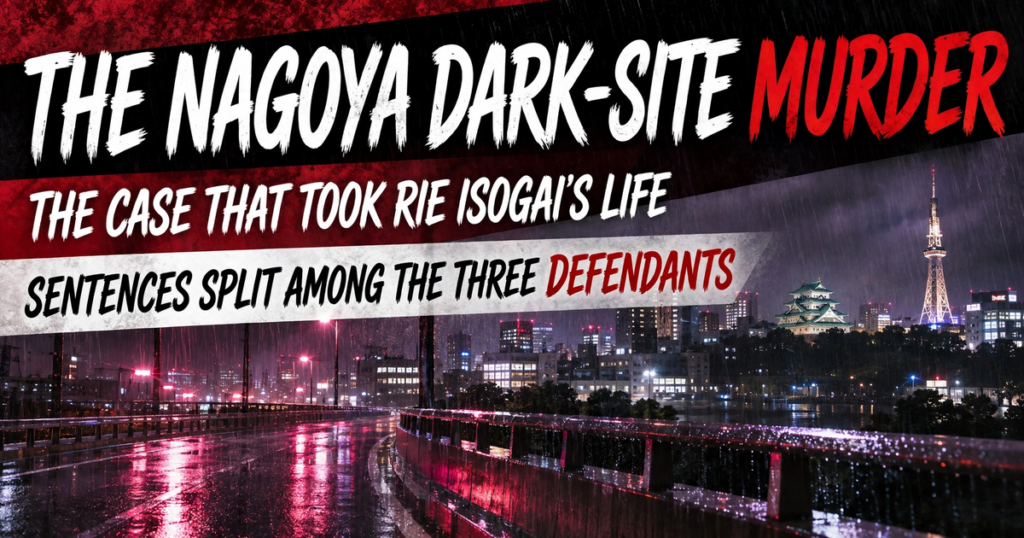
On the night of August 24, 2007, 31-year-old Rie Isogai was abducted in Nagoya while returning home. The three men who took her—Tsukasa Kanda, Yoshisue Hori and Kenji Kawagishi—had met through an internet bulletin board used to recruit people for crimes. They had not been long-standing friends or members of an established criminal organisation. They connected because they wanted to obtain money through robbery. In the days before the attack, they discussed possible offences and prepared items including a hammer and rope. The case became known as the Nagoya Dark Site Murder, but the legal record concerns a planned robbery, abduction, confinement and murder carried out by three individuals whose roles and later sentences differed.
Isogai was abducted and robbed
The three men forced Isogai into a vehicle and held her for an extended period. They demanded cash and her bank card and tried to obtain the card's PIN. According to her mother, Isogai gave a false number rather than the actual PIN. The attempt to withdraw money using the stolen card did not succeed. The men later killed her and left her body in a wooded area in Mizunami, Gifu Prefecture. The charges included commercial kidnapping, unlawful confinement, robbery-murder, abandonment of a body and attempted theft. The offence was not a spontaneous argument that escalated into violence; the court found that the men had discussed obtaining money and prepared for the crime beforehand.
Kawagishi's surrender helped bring the case to light
After the killing, Kawagishi went to police and disclosed his involvement. His surrender gave investigators information that led them to the other participants and the location of the victim's body. The fact that one participant surrendered became important in his sentencing. The prosecution sought the death penalty for all three men, but the courts assessed each defendant's conduct and circumstances separately. A person who takes part in a joint crime does not automatically receive the same sentence as every other participant. The courts examined who had led the plan, what role each man played in the abduction and killing, their prior records and what they did after the offence.
The District Court imposed different sentences
On March 18, 2009, the Nagoya District Court sentenced Kanda and Hori to death and Kawagishi to life imprisonment. The prosecution had sought death for all three. The court regarded the crime as highly serious because the men had planned a robbery, abducted a woman who was travelling home and killed her to obtain money. It nevertheless treated Kawagishi's surrender and his individual circumstances as relevant to punishment. The three defendants did not receive identical sentences simply because they had been present in the same vehicle. The separate outcomes became central to the later appellate proceedings.
Kanda's death sentence became final after he withdrew his appeal
Kanda initially appealed the death sentence but withdrew his appeal on April 13, 2009. His death sentence therefore became final through the withdrawal procedure. There was no High Court or Supreme Court merits judgment reviewing his sentence in this case. Kanda was executed at Nagoya Detention House on June 25, 2015. After the execution, a prisoners' rights organisation stated that later defence counsel had questioned whether the appeal withdrawal reflected Kanda's true intention and had been preparing to challenge its validity. That later dispute should be attributed to counsel and the organisation; it was not a judicial ruling overturning the final sentence.
Hori's death sentence was changed to life imprisonment
Hori pursued an appeal. On April 12, 2011, the Nagoya High Court set aside his death sentence and imposed life imprisonment. The court considered the seriousness of his participation but found that his role and other sentencing factors should not be treated as identical to Kanda's. The prosecution appealed the reduction. On July 11, 2012, the Supreme Court's Second Petty Bench dismissed the prosecution's appeal, leaving Hori's life sentence in this case final. The Supreme Court did not say that Hori's responsibility was minor; it accepted that his responsibility was grave while concluding that the High Court's overall sentencing assessment was not clearly unreasonable.
Hori's later death sentence came from a different case
Hori was later prosecuted for a separate robbery-murder case in Hekinan, Aichi Prefecture, involving crimes committed in 1998. He received a death sentence in that separate proceeding. That later sentence does not change the outcome of the 2007 Isogai murder case, in which his life sentence became final after the Supreme Court's 2012 decision. The two proceedings must not be merged when describing his legal status. Kawagishi's life sentence in the Isogai case also remained distinct from the death sentence imposed on Kanda. The case demonstrates how the same incident can produce different final legal outcomes for different defendants.
The victim's family continued to speak about the case
Isogai's mother, Fumiko, continued to speak publicly about her daughter and the position of crime victims' families. In later interviews and school talks, she discussed the impact of the murder and the need to prevent the case from fading from public memory. The case is often described as a crime committed by three men who met online. The court record, however, shows more than the medium through which they met: it records the preparations, each participant's role, the surrender, the appeal withdrawal and the different sentences. The final legal outcomes were not the same for all three men, and they should be described separately.
Original Japanese record: 名古屋闇サイト殺人事件|磯谷利恵さん殺害、3被告で量刑が分かれた理由
Last updated:
Related articles
Case record
The Toyokawa House Murder: A 17-Year-Old, Two Psychiatric Assessments and a Juvenile Court Disposition

Case record
The Toyota City High-School Girl Murder: Manami Shimizu, a Missing School Tracksuit and an Unsolved Robbery-Murder

Case record
The Kidnapping and Murder of a Female University Student in Nagoya: The Case of Sayuri Toya
Case record