
The Sakamoto Family Murders: A Lawyer Targeted for His Work and Six Years of Uncertainty
Aum Shinrikyo members murdered lawyer Tsutsumi Sakamoto, his wife Satoko and their one-year-old son in November 1989. Their bodies were hidden in three prefectures and were not found until September 1995. The final appeal in the family-murder proceedings ended in 2011.
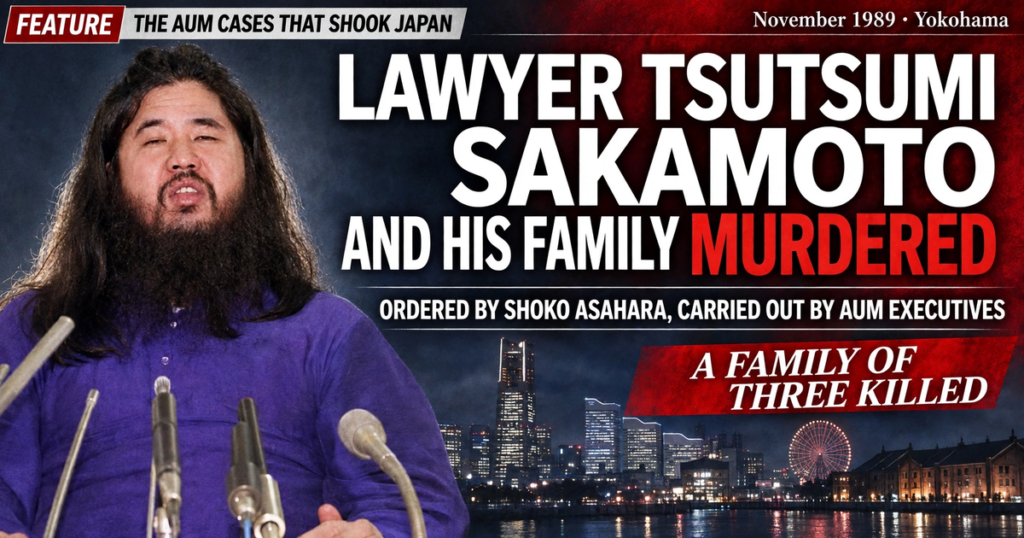
A young lawyer became involved in disputes surrounding Aum Shinrikyo
Tsutsumi Sakamoto was a lawyer at the Yokohama Law Office. He had been practicing for only about two and a half years when the case developed, but he was already working on issues involving children and other people in vulnerable circumstances. From the spring of 1989, he began representing families who wanted relatives, especially children, to leave Aum Shinrikyo and return home. His work included negotiating with the religious organization, seeking the return of children who had entered its residential facilities, and addressing financial disputes involving members and their families. The conflict was therefore not a private quarrel between Sakamoto and an individual believer. His legal representation threatened the organization's ability to control its members and to avoid scrutiny of its practices.
Negotiations failed, and the plan changed from killing Sakamoto to killing his family
On October 31, 1989, several Aum members visited Sakamoto's law office and discussed the organization's activities with him. The meeting did not produce an agreement. According to the investigative account and later court findings, Shoko Asahara regarded Sakamoto as a serious obstacle to the organization and, on the night of November 2, ordered senior members Hideo Murai, Kiyohide Hayakawa, Kazuaki Okazaki, Tomomitsu Niimi and Tomomasa Nakagawa to kill him. Satoru Hashimoto joined the group of six who carried out the operation. The initial plan was to attack Sakamoto away from home. When the group could not find him, the plan changed. After a further instruction from Asahara late on November 3, the members decided to enter the family home and kill his wife and child as well.
Three members of one family were killed in the early hours of November 4
At a little after 3 a.m. on November 4, the six Aum members entered the Sakamoto family's apartment in Yokohama. Tsutsumi Sakamoto was thirty-three, his wife Satoko was twenty-nine, and their son Tatsuhiko was one year and two months old. All three were killed. Their bodies were not left at the apartment. The perpetrators first transported them to an Aum facility in Kamikuishiki, Yamanashi Prefecture, and then concealed them at separate locations in three prefectures: Sakamoto's body in the mountains of Niigata, Satoko's in the mountains of Toyama, and Tatsuhiko's in a wetland area in Nagano. Separating the burial sites made it harder to connect the disappearance of the three family members to one crime and prolonged the uncertainty surrounding their fate.
The disappearance led to a nationwide effort to bring the family home alive
Because no bodies were found and the apartment offered no immediate explanation for the family's disappearance, the case was initially treated as a missing-family incident. The Japan Federation of Bar Associations, local bar associations and the group known as the National Lawyers' Association to Save Lawyer Sakamoto and His Family organized an extensive search and public campaign. The Yokohama Bar Association, where Sakamoto was registered, established a rescue headquarters, held meetings, collected signatures and asked the public for information. The campaign continued for years because colleagues and relatives could not rule out the possibility that the family was alive and being held somewhere. The phrase 'Bring them back alive' reflected the actual purpose of the campaign: rescuing three missing people, not commemorating victims whose deaths had already been confirmed.
The Aum investigation revealed the murders nearly six years later
The investigation changed after the Tokyo subway sarin attack on March 20, 1995, and the large-scale searches of Aum Shinrikyo facilities that followed. Statements by members and other evidence connected the organization to the Sakamoto family's disappearance. On September 6, 1995, investigators found Tsutsumi's remains in the mountains of Nadachi, Niigata Prefecture, and Satoko's remains in the mountains of Uozu, Toyama Prefecture. Tatsuhiko's remains were found on September 10 in a wetland area in Omachi, Nagano Prefecture. The discoveries confirmed that the family had been killed on the night they disappeared. A joint memorial service was held at Yokohama Arena on October 22, 1995, with approximately 26,000 people attending, according to the Kanagawa Bar Association's historical record.
The case became part of the wider criminal proceedings against Aum leaders
The people involved in the family murders were prosecuted within the broader series of criminal cases against Aum Shinrikyo leaders and members. Asahara was sentenced to death by the Tokyo District Court in 2004, and his sentence became final in 2006. Several direct participants were also sentenced to death after trials that included other Aum crimes. One of the final proceedings concerning the Sakamoto family murders ended on November 18, 2011, when the Supreme Court Second Petty Bench dismissed Tomomasa Nakagawa's final appeal. The Kanagawa Bar Association stated that this decision brought all criminal trials concerning defendants in the family-murder case to an end. The proceedings were lengthy because the defendants were tried in separate cases and because many were also charged in other major attacks.
The final appeals and the 2018 executions must be distinguished from the discovery of the bodies
The end of the court proceedings did not occur when the remains were found in 1995. It came only after the final appeals in the criminal cases had been decided. In July 2018, the death sentences of Aum members were carried out in two groups. The five direct participants whose death sentences were final—Hayakawa, Niimi, Nakagawa, Okazaki and Hashimoto—were among those executed. Murai had died in 1995 before he could be tried. Asahara was executed separately as the organization's leader. These later legal outcomes established criminal responsibility for those defendants who were tried; they should not be confused with the earlier investigative discovery of the bodies or with the six-year period during which the family remained missing.
The murders were intended to stop legal advocacy, not simply to settle a personal dispute
The central significance of the case lies in the reason Sakamoto became a target. He was acting as a lawyer for families seeking to recover children and address harms associated with Aum Shinrikyo. The organization treated that lawful advocacy as a threat and used murder to suppress it. The victims were not limited to the lawyer: his wife and infant son were also killed, and their bodies were hidden in distant locations. The long disappearance forced relatives, colleagues and the wider legal community to continue searching for almost six years without knowing whether the family was alive. The Kanagawa Bar Association later treated the case as a defining example of violence against legal work and strengthened measures to protect lawyers from professional obstruction and threats.
Original Japanese record: 坂本堤弁護士一家殺害事件|被害救済活動を狙った組織犯罪、6年後の遺体発見
Last updated:
Related articles
Case record
The Toyama–Nagano Serial Abduction and Murder Case: Two Victims, One Death Sentence and One Acquittal
Case record
The Amagasaki Suspicious Deaths: Eight Lives Lost and the Trials of Seven Co-Defendants

Case record
The Osaka Dog-Lover Serial Murders: Five Victims and the Death Sentence of Yoshinori Ueda

Case record