
The Amagasaki Suspicious Deaths: Eight Lives Lost and the Trials of Seven Co-Defendants
The discovery of a body in a drum in Amagasaki in 2011 exposed a pattern of coercion across several households. Police identified eight deaths. Miyoko Sumida died in custody before trial; seven other defendants were convicted of offences with differing roles and sentences.
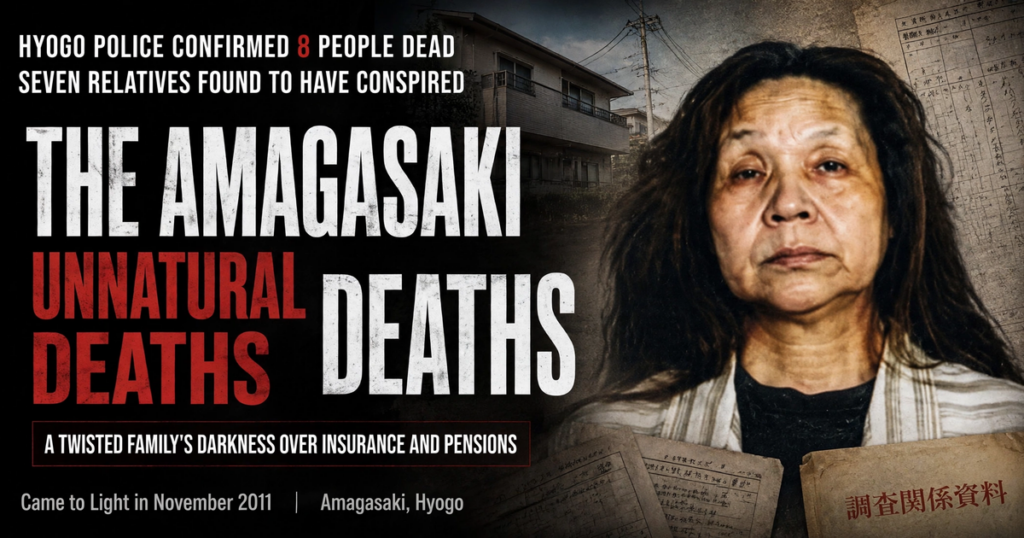
A body in a drum led police to several households
In November 2011, a body was discovered inside a drum at a rented storage facility in Amagasaki, Hyogo Prefecture. The victim was Kazuko Oe, aged 66. The discovery led investigators to examine her movements and the people who had controlled her daily life. As questioning continued, police began to uncover other people who had disappeared or died in circumstances connected with Miyoko Sumida and those around her. Searches in 2012 found additional remains, and the investigation expanded across several households and locations, including connections to Okinawa. What had first appeared to be a single suspicious death developed into a complex case involving confinement, abuse, financial control and multiple deaths.
Eight deaths were identified, but they were not all murder convictions
Hyogo Prefectural Police eventually identified eight deaths connected with the wider case. That number describes the deaths established by the investigation; it does not mean that eight separate murder convictions were entered. The offences adjudicated included murder, injury resulting in death, confinement, assault and abandonment of remains. Some deaths did not lead to charges because the available evidence did not support a prosecution. The Japanese term 'suspicious deaths' reflects the fact that several deaths had initially appeared to be accidents, suicides or illnesses before investigators connected them. Rewriting the case as eight murders would go beyond the findings of the criminal courts. Each death and each defendant's role must be considered separately.
The group used family relationships and money to control people
Sumida and people around her entered the lives of several families through relationships, marriage, adoption and shared living arrangements. The group could make one household appear separate from another, even when the same people were influencing both. Victims were isolated, threatened and subjected to violence. Their money and property were taken or controlled, and some were pressured to leave jobs or give up their homes. Family members were made to monitor one another and, in some circumstances, to participate in assaults. The resulting structure made it difficult for people to seek help. A complaint might appear to be a private family dispute or a disagreement about money when viewed alone, while the wider pattern showed repeated coercion and abuse.
Several deaths involved prolonged confinement and different forms of violence
The case involved distinct episodes. Oe Kazuko's body was found in the drum in 2011. In another case, Hisayoshi Sumida (角田久芳), aged 51, was taken to Okinawa in 2005 after prolonged abuse and died after falling from a cliff; the final judgment against Masanori Li treated the death as murder through a forced suicide. Mariko Nakajima (仲島茉莉子), aged 26, was confined in a storage shed on a condominium balcony in 2008 and died after prolonged confinement, assault and food restriction. Jiro Hashimoto (橋本次郎), aged 53, was confined and abused in 2011, and his body was later disposed of at sea. The courts examined each death separately, including who confined the victim, who assaulted them, who allowed the abuse to continue and who participated in disposing of remains.
Sumida died in police custody before she could be tried
Miyoko Sumida was regarded by investigators as the central figure in the group. On December 12, 2012, she was found dead in a detention facility at Hyogo Prefectural Police Headquarters. She had made statements suggesting suicide, and police had increased monitoring, but her death was not prevented. Because she died before trial, there was no criminal judgment determining her personal guilt. It is therefore inaccurate to say that Sumida was convicted of a specific number of murders. The later trials of other defendants examined whether they had conspired with her and what acts each had committed. The courts reconstructed the role attributed to Sumida through testimony and other evidence, but those findings were made in proceedings against the surviving defendants.
Seven other defendants were tried for their individual participation
After Sumida's death, criminal proceedings continued against seven relatives and associates. The defendants argued in various ways that they had lived under Sumida's strong influence and had not independently decided to commit the offences. Prosecutors responded that they had performed concrete roles, including watching victims, maintaining confinement, committing assaults and disposing of remains. The Kobe District Court found conspiracy with Sumida in relation to the offences adjudicated against all seven. It did not treat shared residence or family ties alone as sufficient. The courts examined what each person knew, what instructions they received and what they actually did. Some defendants had themselves been subjected to violence while also participating in crimes against other people.
Li Masanori received the heaviest sentence
The most severe final sentence was imposed on Masanori Li, a relative by marriage who was found guilty of ten offences, including three murders. The Kobe District Court considered him to have played a particularly important and active role and sentenced him to life imprisonment. The Osaka High Court later refined the comparison between Li and Sumida, saying that he was not entirely equal to her in leadership but had played the next most important role. It maintained the life sentence, and the Supreme Court rejected his appeal in March 2018. Other defendants received fixed-term prison sentences, including terms of 15, 17, 21 and 23 years. Rui Sumida, Sumida's stepdaughter, received a 23-year term in February 2016. These outcomes reflected individual participation and circumstances, not a single collective sentence for all eight deaths.
The case exposed limits in fragmented responses to family violence
The joint investigation headquarters involving police from Hyogo, Kagawa and Okinawa was dissolved in March 2014. Earlier contacts with police and administrative agencies were later criticised because some complaints had been treated as isolated family disputes or financial disagreements. The case showed how a pattern can be missed when reports from different households and jurisdictions are not connected. It also produced unusually long jury trials: in one combined trial, the jury-selection period exceeded 120 days, and the court divided the evidence by offence to make the proceedings manageable. The legal record is now largely settled for the seven defendants, but Sumida herself never stood trial, and not every death received a criminal charge. The case should therefore be understood as a network of coercion and separately adjudicated offences, not simply as eight murders committed by one person.
Original Japanese record: 尼崎連続変死事件|8人の死亡と複数家庭への支配、角田美代子の死後に問われた7人の共謀
Last updated:
Related articles
Same case · Feature
The Amagasaki Serial Deaths: Miyoko Kakuta Made Relatives Turn Against One Another — Eight Deaths and the “Family Meetings” That Became a System of Control
Case record
The Sakamoto Family Murders: A Lawyer Targeted for His Work and Six Years of Uncertainty
Case record
The Murder of a First-Grade Girl in Kobe's Nagata Ward: A Death Sentence Replaced by Life Imprisonment
Case record