
The Toyama–Nagano Serial Abduction and Murder Case: Two Victims, One Death Sentence and One Acquittal
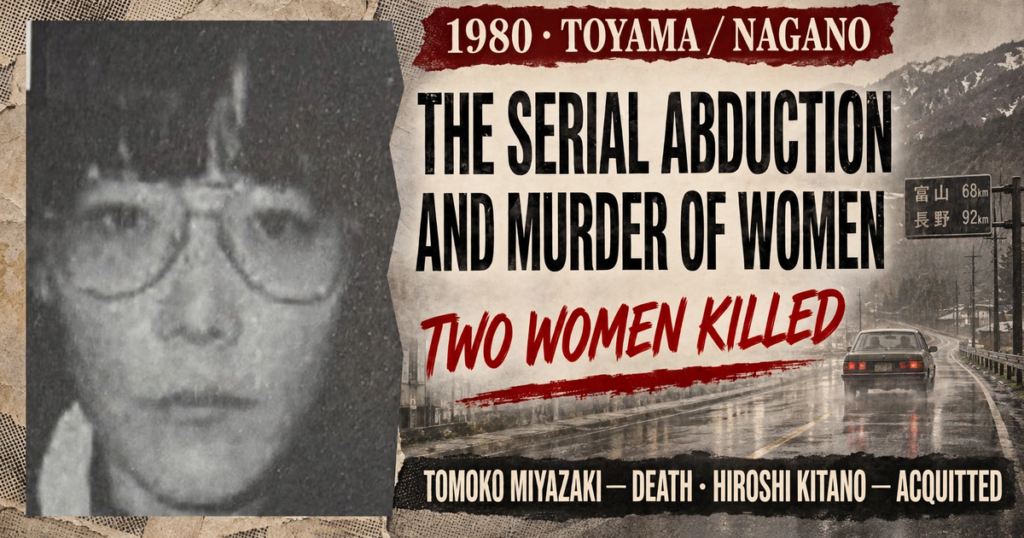
Two young women disappeared in Toyama and Nagano in February and March 1980. Tomoko Miyazaki was convicted and sentenced to death; Hiroshi Kitano, who had been charged as an accomplice, was acquitted and his acquittal became final in 1992.
Two women disappeared in neighbouring prefectures
The Toyama–Nagano Serial Abduction and Murder Case involved two victims: Yoko Nagaoka, an eighteen-year-old high-school student in Toyama, and Yumiko Terasawa, a twenty-year-old office worker in Nagano. Nagaoka disappeared in Toyama City on February 23, 1980. A ransom demand was then made to her family. On March 5, Terasawa was lured away in Nagano City. Both women were killed and their remains were abandoned in mountainous areas. The investigation crossed prefectural boundaries and led to the arrest of Tomoko Miyazaki and Hiroshi Kitano on March 30. Although prosecutors charged them as co-conspirators, the final judgments did not find both defendants guilty.
Nagaoka was approached with an offer of work
According to the Supreme Court judgment, Miyazaki planned to abduct young women and obtain money from their families. She approached Nagaoka, who was on her way home in Toyama City, and spoke to her about a supposedly attractive part-time job. Nagaoka entered Miyazaki's vehicle. The court found that Miyazaki gave her sleeping medication, rendered her unconscious and strangled her with a cord she had prepared. Her body was then abandoned in a mountainous area. The method of approach was significant: the abduction did not begin with a public struggle or an obvious forced seizure. Miyazaki used an offer of employment to gain Nagaoka's trust and persuade her to enter the car.
A ransom demand followed Nagaoka's death
After killing Nagaoka, Miyazaki contacted her family and demanded ransom money. The family was placed in a state of acute uncertainty because they did not know where Nagaoka was or what had happened to her. The Supreme Court's account treated the ransom demand as part of the criminal plan even though Nagaoka had already been killed. The demand was not a separate event unrelated to the murder; it was the financial purpose for which the abduction had been planned. The family did not pay the demand; relatives instead went to Miyazaki's residence while still trying to establish what had happened. The case therefore involved both the killing of the victim and the deliberate use of her disappearance to extract money from relatives.
Terasawa was abducted in Nagano on March 5
The second victim was Terasawa, a twenty-year-old company employee who lived and worked in Nagano City. Miyazaki approached her while she was returning home and persuaded her to enter the vehicle. The Supreme Court found that Miyazaki again used sleeping medication and a prepared cord to kill the victim, and then abandoned her remains in a mountainous area. Miyazaki repeatedly demanded thirty million yen from Terasawa's family. The two cases shared a basic structure: a young woman was approached, taken in a vehicle, rendered unconscious, killed and abandoned, after which her family was contacted for money. The second crime followed the first within days, despite the serious distress already caused to Nagaoka's family.
Miyazaki and Kitano were arrested together
The investigation expanded across Toyama and Nagano because the two disappearances involved similar circumstances and overlapping personal connections. Miyazaki and Kitano were arrested on March 30, 1980. They were close in their work and private lives, and investigators suspected that they had acted together. The prosecution charged them as co-conspirators in the two abductions and murders. That charging decision was not the final judicial conclusion. A relationship between two people, their joint arrest and a prosecutor's theory of a common plan do not by themselves establish that both committed the crimes. The subsequent trial focused on whether the evidence proved Kitano's participation beyond the required criminal standard.
The first court sentenced Miyazaki to death and acquitted Kitano
On February 9, 1988, the Toyama District Court found Miyazaki guilty of the two abductions for ransom, murders and related offences, and sentenced her to death. The court acquitted Kitano. Its factual conclusion was that Miyazaki had carried out both crimes alone, rather than jointly with Kitano. The split outcome was central to the case. Kitano was not a person who had been convicted and later released; he was acquitted at trial. The prosecution's original theory of a two-person criminal partnership was not accepted by the court. This distinction must be maintained whenever the two arrested defendants are mentioned together.
The acquittal became final in 1992; Miyazaki's death sentence became final in 1998
On March 31, 1992, the Nagoya High Court's Kanazawa Branch upheld the first-instance findings: Miyazaki's conviction and death sentence remained, and Kitano's acquittal was affirmed. Kitano's acquittal became final. Miyazaki appealed to the Supreme Court, but on September 4, 1998, the Supreme Court Second Petty Bench dismissed her appeal. Her death sentence therefore became final. The two defendants ended the process with different legal statuses. Miyazaki was a convicted murderer under a final death sentence. Kitano was a person who had been charged as an accomplice but was judicially acquitted. The difference is not a minor technicality; it is the central result of the criminal proceedings.
A fifth retrial request was rejected in 2024
Miyazaki continued to seek a retrial after her death sentence became final. Her fifth retrial application was rejected by the Toyama District Court and the Nagoya High Court's Kanazawa Branch. On November 27, 2024, the Supreme Court First Petty Bench dismissed her special appeal, leaving the final death sentence in place. No execution had been publicly confirmed in the latest located update dated August 26, 2026. The case should therefore be described as one in which Miyazaki's death sentence remains final and retrial proceedings have not succeeded. It should not be described as a joint conviction of Miyazaki and Kitano, nor should Kitano's acquittal be diluted by the fact that he was initially arrested and indicted with her.
Original Japanese record: 富山・長野連続女性誘拐殺人事件|宮崎知子に死刑、共犯起訴された北野宏は無罪
Last updated:
Related articles

Case record
The Sakamoto Family Murders: A Lawyer Targeted for His Work and Six Years of Uncertainty

Case record
The Sakai Couple Murder: A Planned Robbery, Two Deaths and a Final Death Sentence

Case record
The Kidnapping and Murder of a Female University Student in Nagoya: The Case of Sayuri Toya
Case record