
The Osaka Private Video Booth Fire: Sixteen Deaths, a Final Death Sentence and a Second Retrial Denial
A fire at Cats Namba in Osaka on October 1, 2008, killed sixteen customers. Kazuhiro Ogawa was sentenced to death for arson, murder and attempted murder; his second retrial application was rejected in March 2026.
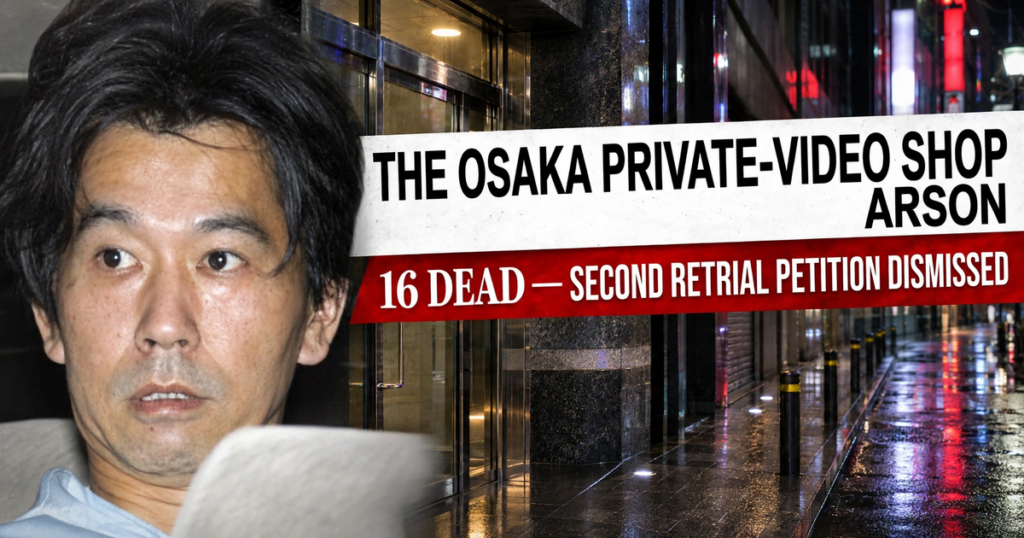
A fire at Cats Namba killed sixteen customers
Shortly before 3:00 a.m. on October 1, 2008, a fire broke out at the private video booth shop Shisha-shitsu Cats Namba in Naniwa Ward, Osaka City. The shop was inside a multi-tenant building and had individual rooms where customers watched videos or rested. Sixteen customers died. In the criminal proceedings, the court also found attempted murder against seven other customers; four of those seven suffered injuries including airway burns. The figures must be kept separate. Sixteen people died, seven people were the victims of attempted murder, and four of those seven actually sustained the injuries described in the judgment. It is inaccurate to collapse these into a single count of sixteen dead and seven injured.
The layout made escape difficult
The Supreme Court described the premises as having narrow passageways and limited exits, making it difficult for customers to escape once the fire spread. Some customers were in private rooms using headphones or sleeping. The fire developed while many people were inside the building and may not have immediately noticed the danger. The judgment treated the layout and the customers' likely condition as important to the question of intent and the seriousness of the offence. The danger was not limited to the room where the fire began. A fire in a confined shop with restricted routes could spread quickly and trap customers who had little time or ability to reach an exit.
The final judgment placed the origin of the fire in Ogawa's room
The person convicted was Kazuhiro Ogawa, who had entered the shop as a customer. The final judgment found that he had brought a suitcase into the private room he was using and set fire to clothing and other items inside it, after deciding impulsively to attempt suicide. The fire spread from the room and destroyed the premises. Ogawa denied setting the fire from the later stage of the investigation onward. The defense has continued to dispute the location of the origin, arguing that the burn patterns and the condition of the recovered suitcase were inconsistent with the prosecution's account. The distinction between the final judgment's finding and the defense's continuing challenge is essential.
The courts found intent even though Ogawa did not foresee exactly sixteen deaths
The Supreme Court did not say that Ogawa had been certain that sixteen people would die. It nevertheless found that he recognized the possibility that other customers could be killed when he set the fire. He had moved around the shop and was familiar with the limited exits and narrow passages. The court concluded that he acted while recognizing the danger to the other customers and without regard for their safety. It therefore upheld the convictions for arson, murder and attempted murder. The legal finding was not that he had selected each victim in advance, but that he knowingly created a lethal fire in a place occupied by other people.
A death sentence was imposed and became final in 2014
The Osaka District Court sentenced Ogawa to death on December 2, 2009. The Osaka High Court dismissed his appeal on July 26, 2011. On March 6, 2014, the Supreme Court First Petty Bench dismissed his final appeal, and the death sentence became final. The Supreme Court considered factors in Ogawa's favour, including that the act began as an impulsive suicide attempt, that he had no prior criminal record and that he had not been certain that a large number of people would die. It nevertheless held that the scale of the deaths, the shop's structure and his awareness of the customers' presence made the criminal responsibility exceptionally serious.
The first retrial request also failed
After the death sentence became final, Ogawa's defense sought a retrial and argued that the fire had started in a different room. The first retrial application was rejected by the Osaka District Court in 2016. The defense pursued an immediate appeal, which was dismissed by the Osaka High Court in October 2018, and a further special appeal was rejected by the Supreme Court in July 2019. The rejection of a retrial application does not mean that a new trial has taken place. It means that the court did not find the submitted evidence sufficient to reopen the final judgment under the legal test for retrial.
The second retrial request focused on a suitcase combustion experiment
A second retrial application was filed in November 2019. The defense submitted further experiments using a similar suitcase and argued that the way the test bag burned, and the amount of material that remained, were inconsistent with the final judgment's finding that the fire began inside Ogawa's room. The defense also relied on opinions from specialists in combustion and fire behaviour. The question for the retrial court was not whether the defense had produced a new theory, but whether the new material, assessed together with the evidence from the original trial, created a clear basis for doubting the conviction. The defense's experiment remained an argument for retrial, not a new judicial finding about the actual origin.
The second request was rejected in March 2026
On March 19, 2026, the Osaka District Court's Twelfth Criminal Division rejected the second retrial application. The Osaka Bar Association issued a statement criticizing the decision and discussing the evidence relied on at the original trial and the new material submitted by the defense. Reports on the decision said the defense intended to file an immediate appeal, but a later appellate ruling was not located for this review. The legal position that can be stated with confidence is that Ogawa's death sentence remains final and the second retrial request was rejected at first instance. The defense's challenge to the fire-origin finding must be described as an ongoing claim, not as an established alternative cause.
Original Japanese record: 大阪個室ビデオ店放火事件|16人死亡、火元認定と第2次再審請求棄却まで
Last updated:
Related articles
Case record
The Maebashi Snack Bar Shooting: Four Killed, Including Three Uninvolved Customers

Case record
The Wakayama Curry Poisoning: Four Deaths, a Final Death Sentence and a Third Retrial Petition
Case record
The Konohana Pachinko Parlor Arson Murders
Case record