
The Roppongi Nightclub Attack: Ryosuke Fujimoto's Death and the Search for Shinichi Mitate
Ryosuke Fujimoto, aged thirty-one, died after a group assault at Studio Flower in Roppongi on September 2, 2012. Several participants were convicted; police continue to seek Shinichi Mitate.
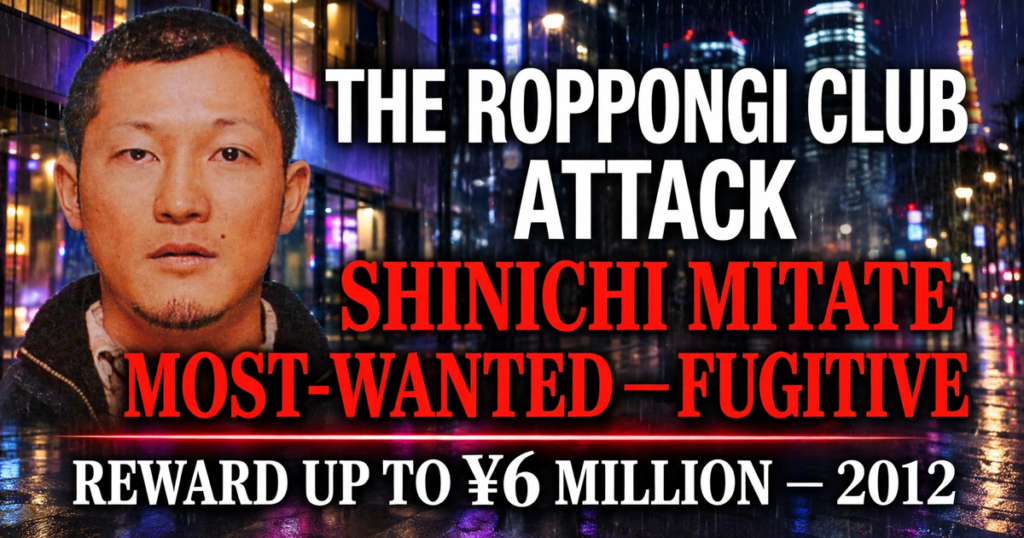
A group attacked a customer at Studio Flower
At approximately 3:43 a.m. on September 2, 2012, several men entered the nightclub Studio Flower on the second floor of the Loa Roppongi Kyodo Building at 5-5-1 Roppongi, Minato Ward, Tokyo. They attacked Ryosuke Fujimoto, a thirty-one-year-old male customer, using metal bats and other blunt weapons. The assault was concentrated on Fujimoto and the group left shortly afterward. He died from the injuries. Other people were in the club, but the police account identifies Fujimoto as the person who was fatally attacked.
Fujimoto was believed to have been mistaken for another man
The investigation and subsequent criminal proceedings examined the possibility that the group had entered the club intending to attack a different person and mistook Fujimoto for that intended target. The mistaken-identity issue became an important feature of the case. Fujimoto was not found by the court to have been involved in the dispute that motivated the attackers. The fact that the group may have intended to assault someone else does not reduce the seriousness of the violence against the man they actually attacked. It explains why a person with no established connection to the underlying conflict became the victim.
The investigation focused on an organized group
The attack was not treated as a spontaneous confrontation between two customers. Police investigated the movements of a group of men, the communications made before the assault and the roles played by people who had entered or left the club. The group was associated in reporting with organized street-gang networks. However, each defendant's conduct and legal responsibility had to be assessed individually. Being connected socially to a group did not by itself prove participation in the fatal assault, and the criminal cases addressed particular acts and alleged agreements.
Taichi Ishimoto was convicted even though he had left the club
Taichi Ishimoto had left the club before the physical attack and was not the person who struck Fujimoto with a bat. Prosecutors nevertheless argued that he had helped coordinate the group and had participated in the common plan. In 2013, a Tokyo District Court lay-judge trial sentenced him to eleven years' imprisonment for offences including injury resulting in death. Both sides challenged aspects of the judgment. In December 2014, the Tokyo High Court set aside the first-instance sentence and imposed fifteen years, finding that Ishimoto's involvement in planning and preparation had been more substantial than the lower court had assessed.
The fifteen-year sentence became final in 2016
Ishimoto appealed to the Supreme Court. On June 15, 2016, the Supreme Court rejected the appeal, leaving the fifteen-year sentence in place. The legal result concerned Ishimoto's own role and the offences for which he had been convicted. It did not mean that every person suspected of involvement had been tried, nor did it resolve the case against the man police continued to seek as the alleged leading figure. Other participants were also prosecuted and convicted for different roles, and their individual outcomes should not be collapsed into a single undifferentiated verdict.
Shinichi Mitate remains a wanted suspect
The Metropolitan Police Department identifies Shinichi Mitate as the principal wanted suspect in the case. He was born on March 16, 1979, and was forty-seven years old in 2026. Police describe him as approximately 167 centimetres tall and of a solid build, and have publicized identifying marks and an updated wanted poster. Police believe that he left Japan after the attack, but the current notice does not treat his location abroad as certain; it also warns that he may have returned and be living in Japan. Mitate has not appeared at a criminal trial, and the allegation against him remains a police suspicion rather than a conviction.
The current reward and its conditions
As of November 1, 2026, the National Police Agency's special reward and a separate private reward offered by a support association each have a maximum of three million yen. The combined maximum is six million yen. The current application period runs from November 1, 2026, through October 31, 2027. The amount is not automatically paid to anyone who submits information. Payment depends on the contribution of the information to the suspect's arrest or resolution of the case, and may be divided among multiple contributors. The Metropolitan Police Department directs information to the special investigation team at Azabu Police Station.
The convictions and the outstanding allegation must remain distinct
The case has two different legal positions. Ishimoto and other participants were tried and convicted for offences based on their proven roles. Mitate remains at large and has not been convicted. Police continue to investigate his whereabouts and alleged leadership role, while the courts have not determined his criminal responsibility. The distinction between a final sentence for one participant and an outstanding warrant for another is essential. The death of Fujimoto is established, but the responsibility of every person named in the investigation must be described according to the actual procedural status of that person.
Original Japanese record: 六本木クラブ襲撃事件|藤本亮介さん死亡、見立真一を手配・懸賞金上限600万円
Last updated:
Related articles
Case record
The Wanted Case of Tsuyoshi Yoshiya: The 1999 Ayase Group Attack
Case record
The Higashi-Ueno 2-chome Condominium Murder
Case record
The Torigoe 2-Chome Murder and Arson: The Killing of an Indian Jewelry Worker and the Search for Diwakar Sethia
Case record