
The Murder of Nagasaki Mayor Iccho Ito: From a Death Sentence to Life Imprisonment
Nagasaki Mayor Iccho Ito was shot outside his campaign office on April 17, 2007, and died the following day. The first-instance court imposed a death sentence, but the Fukuoka High Court replaced it with life imprisonment. The Supreme Court made that sentence final in 2012.
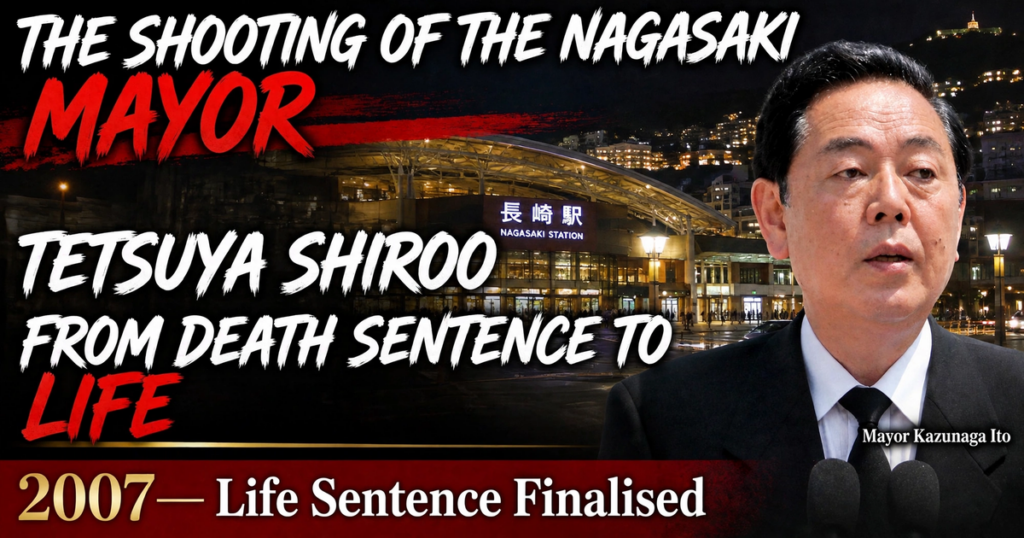
A mayor shot during an election campaign
On the evening of April 17, 2007, five days before the Nagasaki mayoral election, incumbent mayor Iccho Ito was shot from behind outside his campaign office near Nagasaki Station. Two bullets struck his back. Ito was taken to hospital and died in the early hours of April 18, aged sixty-one. He had served three terms, approximately twelve years, and was seeking a fourth term in the election announced on April 15.
The offender's grievance against the city
The dispute between Shiroo and Nagasaki City began in 2003, when a vehicle he was riding in was damaged by a hole in the road surface associated with roadworks. He sought compensation from the city, but the demand was rejected. Contemporary reporting said that he visited city hall more than thirty times over the matter. The dispute continued, and the city maintained its refusal to yield to unreasonable demands from organized crime. As his demands were repeatedly rejected, Shiroo's resentment turned toward Mayor Ito.
Evidence of preparation before the shooting
Shiroo argued at trial that he had not decided to kill Ito in advance and had fired only after seeing him at the scene. The District Court rejected that account. Before the shooting, Shiroo had looked into Ito's movements and waited near the campaign office with a loaded handgun and additional ammunition. When Ito returned, Shiroo approached him and fired twice at close range from behind. The source article gives no precise period for the surveillance. The court treated the preparations and ambush as evidence of a deliberate attack.
The first-instance court imposed the death penalty
On May 26, 2008, Nagasaki District Court sentenced Shiroo to death. It emphasized that the victim was a serving mayor campaigning for re-election, that the attack took place in a public area with a handgun, and that the killing directly affected the freedom of an election. The court considered the fact that one person had been killed, but concluded that the gravity of the offense and its effect on public administration and democratic participation justified capital punishment. The defense appealed immediately.
The Fukuoka High Court replaced death with life imprisonment
On September 29, 2009, the Fukuoka High Court quashed the death sentence and imposed life imprisonment. The High Court did not minimize the seriousness of the killing or its impact on the election. It considered that one person had been killed and that Shiroo had become isolated within his organization. It also took account of his financial hardship and illness, and viewed him as having become desperate and acted in an explosive, impulsive manner after his demands were rejected. The court further considered that the killing was neither motivated by financial gain nor intended to advance a political ideology. In light of the sentencing precedents for capital cases, it concluded that the death penalty should not be selected.
The Supreme Court made the life sentence final
Both the prosecution and the defense appealed the High Court judgment. On January 16, 2012, the Supreme Court dismissed both appeals, leaving the life sentence in force. The case therefore ended with a final life sentence, not a death sentence. Shiroo served that sentence and died in prison in January 2020.
Why the two sentencing judgments differed
The different outcomes did not result from disagreement about whether Shiroo had shot Ito. The courts were assessing the appropriate punishment after the same killing had been established. The first-instance court placed particular weight on the attack against a serving mayor during an election and its threat to democratic processes. The High Court accepted the gravity of those consequences but considered the single death, Shiroo's isolation within his organization, his economic hardship and illness, and the desperate, explosive aspect of his response to the city's refusal. The Supreme Court's dismissal of the appeals made the High Court's life sentence final.
The case should not be reduced to a political assassination alone
The attack took place during an election and killed a sitting mayor, so it had a direct effect on political participation and public safety. The final judicial findings, however, described the principal motive as personal resentment toward the city administration rather than a coherent political program. That distinction matters: the public and democratic consequences of an attack can be severe even when the offender's motive is not an ideological attempt to remove a political opponent. The criminal case concluded in 2012, and the offender's death in 2020 did not change the final sentence.
The attack also violated the freedom of the election
Ito was a candidate in an active mayoral election when he was killed. The courts found that Shiroo intended to prevent Ito's re-election, and the attack therefore affected not only Ito's life but also the freedom of the election. The Japanese source article lists a violation of the Public Offices Election Act among the offences established in the case, alongside murder and firearms-related offences. The election-law violation reflected the purpose and effect of attacking a candidate during the campaign.
Nagasaki had seen another mayoral shooting in 1990
Nagasaki had experienced another attack on a sitting mayor seventeen years earlier. In 1990, Mayor Hitoshi Motoshima was shot by a man associated with a right-wing group. Motoshima was seriously injured but survived. Ito later succeeded him as mayor, winning election in 1995, and was seeking a fourth term when he was attacked in 2007. The two shootings had different motives and backgrounds and should not be treated as the same kind of political violence.
The city pursued anti-violence initiatives after the killing
After Ito's death, the Nagasaki City Council adopted an opinion statement calling for the eradication of violent acts. Donations from across Japan helped fund the construction of the Inochi no Hi memorial, and the Nagasaki Citizens' Council for the Prevention of Violence and Protection of Life was established. These initiatives made the attack part of the city's continuing efforts to reject violence and protect the lives of residents. The city has continued to remember Ito and to present the incident as a warning about violence directed at public administration.
Original Japanese record: 長崎市長射殺事件|伊藤一長市長を選挙中に殺害、死刑から無期懲役へ変わった量刑判断
Last updated:
Related articles
Case record
The Murder of Lindsay Ann Hawker: Police Encounter and Flight on Foot, Arrest 961 Days Later
Case record
The Koto Apartment Murder: A Disappearance Inside a Building and a Final Life Sentence
Case record
The Matsudo Female University Student Murder-Arson: A Death Sentence Replaced by Life Imprisonment
Case record