
The Teigin Bank Poisoning: Twelve Deaths and a Conviction Challenged for Decades
Twelve people died after a poisoning at a Tokyo bank in 1948. Sadamichi Hirasawa's death sentence was never carried out, and posthumous retrial efforts continued until 2025.
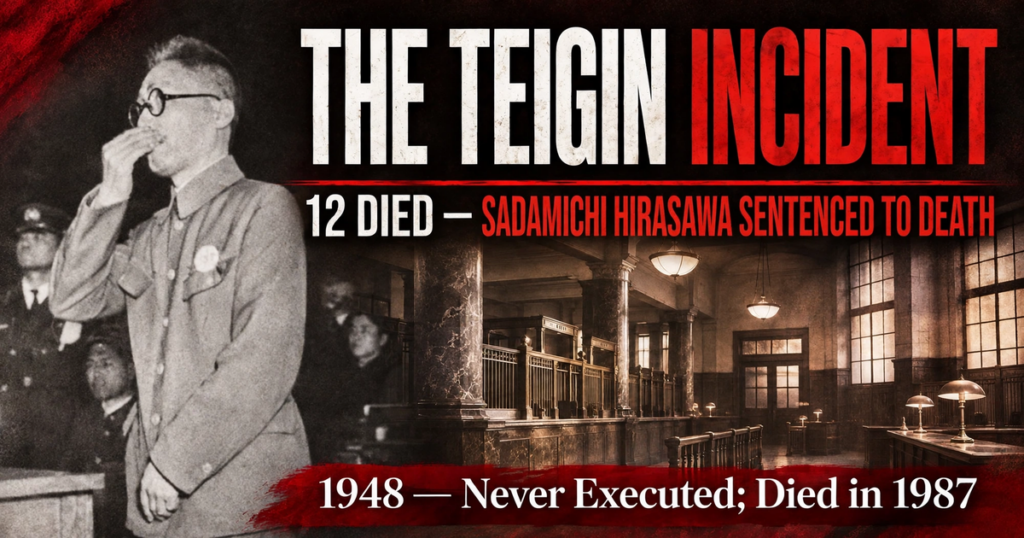
Sixteen people drank the liquid; twelve died
On the afternoon of January 26, 1948, a man entered the Shiinamachi branch of the Imperial Bank in Toshima Ward, Tokyo. He presented himself as a public-health official and said that a dysentery outbreak nearby required bank employees and their families to take preventive medicine. Sixteen people followed his instructions and drank a liquid he supplied. Twelve died; the other four lost consciousness. Once the people inside were incapacitated, the man took cash and cheques and left. The attacker persuaded them to administer the substance to themselves.
Two earlier incidents gave investigators a crucial lead
The Shiinamachi attack was not the first occasion on which a man had used a public-health explanation to make bank employees drink an unfamiliar liquid. On October 14, 1947, a similar incident took place at the Ebara branch of Yasuda Bank. No one died, but the visitor left a business card bearing the name and professional credentials of a real physician, Matsui. A second similar incident occurred at the Nakai branch of Mitsubishi Bank on January 19, 1948. Investigators began treating the three events as potentially connected. The genuine card mattered because it offered a traceable route: police could identify people who had received it and reconstruct how it had circulated.
A search for one hundred business cards led to Hirasawa
A March 1948 parliamentary account stated that one hundred of Matsui's business cards had been printed and that investigators had traced the whereabouts of sixty-six. Police followed the distribution of the cards and interviewed people who had received or passed them on. Through this process, painter Sadamichi Hirasawa came under suspicion. Hirasawa was based in Hokkaido and was 56 at the time of the bank attack. On August 21, 1948, police arrested him in Otaru.
Hirasawa confessed during questioning but denied the crime in court
During police questioning, Hirasawa made statements admitting involvement. At his first court hearing on December 10, 1948, however, he denied the charges and maintained that the confession had not been voluntary. The trial considered more than the confession alone. The prosecution relied on identification evidence from survivors, the business-card trail and other circumstances connecting Hirasawa to the earlier incidents. The defence challenged the reliability of the identification and the circumstances in which the statements had been obtained. These issues did not disappear after the conviction. In later retrial petitions, the defence repeatedly argued that the confession, witness identification and objective circumstances did not fit together.
The courts imposed a death sentence that became final in 1955
The Tokyo District Court sentenced Hirasawa to death on July 24, 1950. The Tokyo High Court dismissed his appeal on September 29, 1951. On April 6, 1955, the Supreme Court dismissed his final appeal, and the sentence became final on May 7. Hirasawa continued to claim that he was innocent and sought a retrial and clemency. The death sentence was never carried out. He died at Hachioji Medical Prison on May 10, 1987, aged 95, with the conviction still in force. The legal position is therefore not that he was acquitted after death or that a court later declared the case a miscarriage of justice.
The poison and the identification evidence remained disputed
The deaths were attributed to cyanide poisoning, but the precise substance and the way it had been prepared became central issues in the investigation and later defence arguments. Because the attacker appeared to handle the liquid confidently, investigators considered whether someone connected with wartime chemical research might have been involved. Former personnel associated with the Noborito research facility and other former military contacts were questioned. Hirasawa himself had no established connection to the former Japanese military's poison research. In later retrial proceedings, the defence submitted new toxicological analysis and psychological examination of the eyewitness identification. A responsible account must distinguish the final conviction from the continuing dispute over how the evidence was evaluated.
Posthumous retrial petitions continued after Hirasawa's death
Japanese criminal procedure permits certain relatives to seek a retrial after a convicted person has died. Hirasawa's family used that procedure to continue challenging the judgment. The nineteenth retrial petition ended after the petitioner, his adopted son, died. A twentieth petition was filed with Tokyo High Court on November 24, 2015. The defence relied on new material concerning witness memory, psychological analysis and the poison. The petition therefore raised substantive questions about the reliability of the old evidence, but the court did not ultimately decide those questions in the twentieth proceeding.
The twentieth petition ended because the petitioner died
Hirasawa's grandson, who was the petitioner in the twentieth case, died on January 1, 2025. The defence argued that the proceedings should continue because counsel had already been appointed and the court could still decide whether a retrial should begin. Tokyo High Court ruled on March 27, 2025 that the proceeding had ended upon the petitioner's death. Counsel filed a special appeal on April 1, but the Supreme Court's Third Petty Bench dismissed it on April 25. This was a procedural termination. It was not a ruling that the new toxicological or psychological evidence had been examined and found insufficient to justify a retrial.
The conviction remains in force, but the evidentiary debate has not vanished
As of November 22, 2026, Hirasawa's 1955 conviction has not been set aside. He died without execution, and the twentieth retrial proceeding ended without a substantive assessment of the new evidence. The Meiji University Peace Education and Noborito Research Institute Museum has explained that another eligible direct-line relative may be able to file a further petition under the Criminal Procedure Code. The Teigin Bank poisoning remains a case in which twelve people died, one man received a final death sentence and died in custody, and the reliability of the evidence has continued to be contested without a judicial acquittal.
Original Japanese record: 帝銀事件|12人毒殺と平沢貞通の死刑確定、第20次再審は実体判断なく終了
Last updated:
Related articles
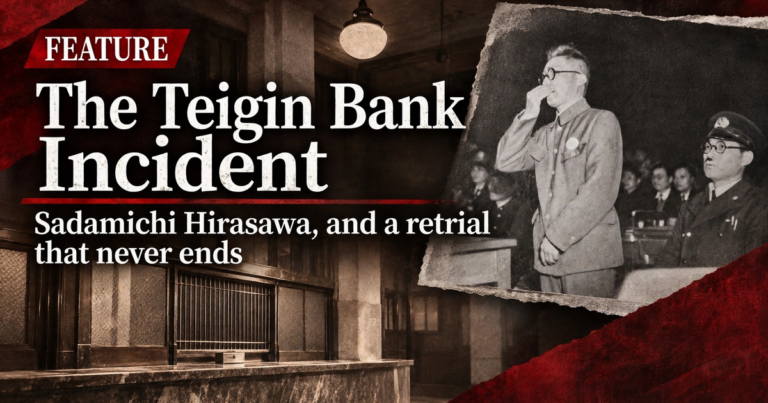
Same case · Feature
The Teigin Bank Incident: Twelve Poisoned at a Bank — Sadamichi Hirasawa, the Death Sentence and a Retrial That Remained Unresolved 77 Years Later
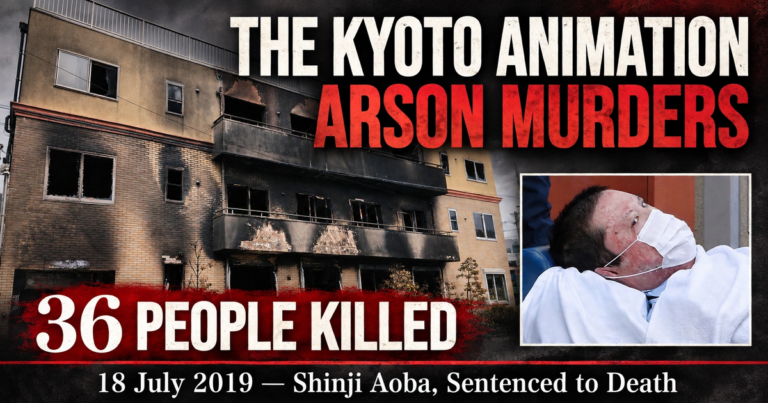
Case record
The Kyoto Animation Arson Attack: 36 Deaths, Criminal Responsibility and the Disputed Appeal Withdrawal
Case record
The Maebashi Snack Bar Shooting: Four Killed, Including Three Uninvolved Customers
Case record