
The Norio Nagayama Case: Four Murders and the Origins of Japan's Death Penalty Sentencing Standard
Four fatal shootings in 1968 led to a landmark Supreme Court ruling on capital punishment in Japan.
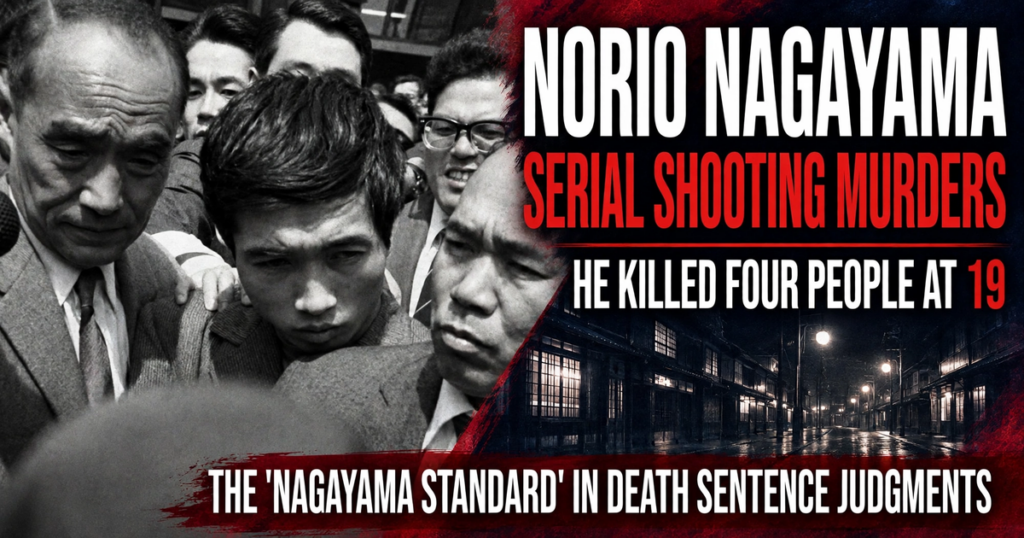
Four shootings in four regions over twenty-six days
Between October 11 and November 5, 1968, four men were shot and killed in separate incidents in Tokyo, Kyoto, Hokkaido and Aichi. Norio Nagayama was 19 years old. The first two victims were security guards: Koki Nakamura at the Tokyo Prince Hotel and Ryujiro Katsumi at Yasaka Shrine in Kyoto. The later victims were taxi drivers, Tetsuhiko Saito near Hakodate and Masaaki Ito in Nagoya. These were not one mass attack or four killings arising from a single encounter. Nagayama travelled between distant cities while carrying the same stolen pistol. The short interval between the shootings, the change in locations and the shift from attacks on guards to robberies of taxi drivers became important in the later sentencing proceedings.
The pistol had been stolen from a U.S. military facility
Before the shootings, Nagayama stole a pistol and ammunition from a U.S. military facility in Yokosuka, Kanagawa Prefecture. He kept the weapon and moved between cities with it. The four victims had no prior personal relationship with him. In the first two incidents, he fired when he was discovered by security personnel. In the later incidents, he targeted taxi drivers and took cash and other property. The sequence therefore included both killings that began as reactions to being found and killings connected with robbery. The prosecution also addressed the theft of the firearm and ammunition, as well as other offences committed during the period. Treating the case only as four murders would leave out the way the weapon was obtained and repeatedly used.
A fifth shooting led police to Nagayama in April 1969
On April 7, 1969, Nagayama entered a school facility in Tokyo and fired at a security guard who had discovered him. The guard was not hit. Police arrested Nagayama soon afterward. Investigators traced the firearm and compared the earlier shootings, linking him to the four murders in different regions. He was prosecuted for murder, robbery-murder, attempted robbery-murder, theft and firearms-related offences. The April shooting was not a fifth fatality in the serial-shooting case, but it was the event that brought the investigation to a decisive point. The arrest also made it possible to examine the sequence of the four earlier killings as one connected series rather than separate local crimes.
The District Court imposed death in 1979
The Tokyo District Court sentenced Nagayama to death on July 10, 1979, after a lengthy trial. The court gave great weight to the four deaths, the use of a stolen firearm across several regions and the robbery-related killings. The defence emphasised that Nagayama had been only 19, had grown up in severe poverty and had experienced an exceptionally difficult childhood. It also pointed to his conduct after arrest, including his efforts to study and write while in detention. The case therefore raised a difficult sentencing question: how should a court weigh the extreme consequences of repeated murder against an offender's youth and background? The first judgment selected the death penalty, but the appellate court later reached a different conclusion.
The Tokyo High Court changed the sentence to life imprisonment
On August 21, 1981, the Tokyo High Court set aside the death sentence and imposed life imprisonment. It considered Nagayama's age, psychological immaturity, poverty and family circumstances, as well as his writing in detention and efforts to send part of his book royalties to some victims' families. The High Court did not minimise the four deaths. It concluded, however, that the possibility of rehabilitation and the circumstances of a 19-year-old offender weighed against the ultimate penalty. Prosecutors appealed to the Supreme Court, arguing that the life sentence did not adequately reflect the seriousness of the crimes. The Supreme Court's response would become influential far beyond Nagayama's own case.
The Supreme Court set out the framework later called the Nagayama standard
On July 8, 1983, the Supreme Court's Second Petty Bench overturned the life sentence and remanded the case to the High Court. It explained that capital sentencing requires an overall assessment of the nature and motive of the offences, the manner of commission, the number and gravity of the consequences, the feelings of bereaved families, social impact, the offender's age, prior record and conduct after the crimes. The ruling is commonly called the Nagayama standard. It is not a points system in which a certain number of factors automatically produces a death sentence. The court must consider all relevant circumstances and decide whether the offender's culpability is so grave that the death penalty is unavoidable in light of proportionality and general deterrence.
The remand proceedings restored the death sentence
After remand, the Tokyo High Court dismissed Nagayama's appeal on March 18, 1987, maintaining the death sentence. The court considered his youth and background but found that they did not outweigh the gravity of four murders committed in a short period with a stolen firearm. On April 17, 1990, the Supreme Court dismissed his final appeal. The defence then sought correction of the judgment; that request was rejected in May 1990, when the sentence became final. The distinction between the date of the Supreme Court judgment and the date of finality matters. The death sentence was not legally final on the day the appeal was dismissed because the correction procedure still had to conclude.
Writing in detention did not undo the final judgment
While detained, Nagayama learned to read and write and published the memoir Muchi no Namida in 1971. The book attracted attention to his childhood and the social conditions in which he had grown up. Royalties were sent to the families of some victims, including the families of Saito and Katsumi, although not every family accepted the money. These actions were discussed as part of his conduct after the crimes, especially when the Tokyo High Court considered life imprisonment. They did not erase the four killings or reverse the final judgment. The case remains difficult because it asks how much weight later personal change can carry when a court assesses the responsibility for grave crimes committed years earlier.
Nagayama was executed in August 1997
Nagayama was executed at Tokyo Detention House on August 1, 1997, aged 48. His execution ended the criminal process against him. The case's legal legacy continued through the sentencing framework established in 1983. Later courts cite the Nagayama standard, which requires a holistic assessment of motive, method, consequences, age, record and post-offence conduct rather than a numerical formula. The case remains important both for the four murders and for its influence on Japanese capital sentencing.
Original Japanese record: 永山則夫連続射殺事件|19歳で4人を殺害、死刑と無期を往復した「永山基準」
Last updated:
Related articles
Case record
The Akira Nishiguchi Case: Five Murders, a Nationwide Manhunt and a Child's Crucial Observation
Case record
The Katsuta Kiyotaka Serial Murders: The Reported 22-Victim Confession, Eight Judicially Established Deaths and the Nationwide No. 113 Investigation

Case record
The Kiso and Nagara River Serial Group-Assault Murders: Four Victims in Eleven Days and Three Final Death Sentences
Case record