
The Glico–Morinaga Case: Kidnapping, Corporate Extortion and an Unsolved National Investigation
Beginning with the abduction of Ezaki Glico’s president in March 1984, a group calling itself the Monster with 21 Faces threatened food companies, demanded money and placed cyanide-tainted confectionery in shops. No member of the group was identified or arrested. The prosecution time limits for the connected crimes had all expired by February 2000.
The abduction of a company president began the campaign
On the night of March 18, 1984, two masked men entered the home of the president of Ezaki Glico in Nishinomiya, Hyogo Prefecture. They restrained his wife and eldest daughter and took the president away while he was bathing. The following morning, a threatening letter was found in a public telephone box in Takatsuki, demanding ¥1 billion in cash and 100 kilograms of gold. The president was held at a warehouse in Ibaraki, Osaka Prefecture, but escaped on his own three days later and was found near a freight station. No ransom was paid. The kidnapping ended with his return, but the threats against the company continued. The perpetrators set fire to Glico facilities and sent messages claiming that poison had been put into the company’s products.
The threats targeted a company’s reputation and the safety of its products
By threatening a major food manufacturer, the offenders attacked public confidence in the company and the safety of ordinary consumer goods. Glico was forced to withdraw products and suspend operations in some areas. Retailers removed goods from their shelves, while the company faced the task of reassuring distributors and customers. From April 1984 onward, letters were sent to newspapers and police under the name Kaijin 21 Menso, usually translated as the Monster with 21 Faces. The letters taunted investigators and announced further actions. Their use of the press allowed the offenders to spread anxiety well beyond the immediate recipients of the threats.
The group moved its demands to other food companies
After announcing that it would stop targeting Glico, the group demanded money from Marudai Food. Employees were instructed to travel by train and follow changing directions about where cash should be handed over. The police placed officers at stations and along roads and arranged for investigators to accompany the employees carrying money. The instructions repeatedly changed, and the handoff locations were shifted at short notice. These episodes showed how the offenders could force companies to move people and money while making it difficult for investigators to predict where the group would appear. The campaign expanded across the food industry, and the identity and number of the people coordinating it remained uncertain.
The Fox-Eyed Man and the man seen on video were never identified
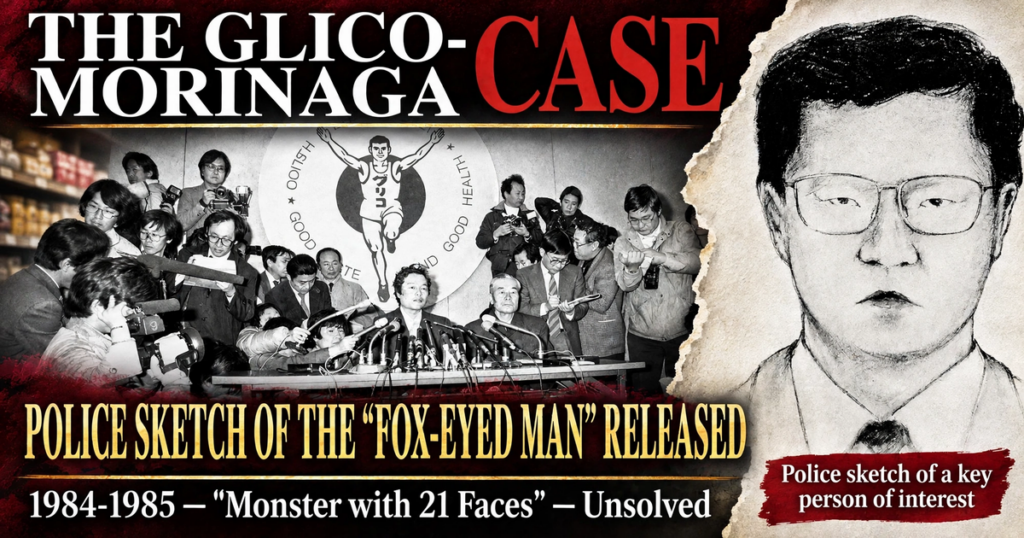
During one attempted cash handoff near Takatsuki Station, a suspicious man was seen watching the police. His distinctive eyes led to the widely used nickname the Fox-Eyed Man, and an artist’s rendering was released publicly. A separate person appeared in surveillance footage associated with a cash-transfer operation and became known as the man in the video. Both images generated public attention and information from witnesses. However, the police never confirmed that either man belonged to the group, and neither was publicly identified as a perpetrator. The group appeared to monitor police deployments and cancelled handoffs before collecting the money. It is important to distinguish a person sought as a possible witness or investigative lead from someone whose participation in a crime has been established.
Cyanide-tainted sweets turned the campaign into a public safety emergency
In the autumn of 1984, the group threatened Morinaga and claimed that sodium cyanide had been placed in its products. Confectionery contaminated with cyanide was in fact found in supermarkets and department stores in Osaka, Hyogo, Kyoto and other areas, including shops in the Kanto and Chubu regions. The packages carried warning notes indicating that poison was inside, and the products were recovered before consumers ate them. No deaths resulted from the contaminated sweets. Nevertheless, the danger was real: a warning could be missed, removed or overlooked, and a child or other customer could have consumed the poison. The investigation therefore involved not only kidnapping and extortion but also attempted murder and threats to the public. Food companies and retailers had to inspect shelves, withdraw products and explain the danger to consumers.
A pursuit in Shiga Prefecture failed to capture a suspect
In November 1984, the group demanded money from House Foods and arranged another complicated handoff in Shiga Prefecture. Police officers monitored the route and pursued a suspicious vehicle. The driver broke through a checkpoint, abandoned the car and escaped. The vehicle was stolen, and investigators reportedly found equipment capable of intercepting radio communications inside it. The pursuit brought the investigation close to a person who might have been connected with the offenders, but officers did not secure the driver. The incident exposed problems in communication and coordination across police jurisdictions. The failure was later examined as an example of the difficulty of coordinating a fast-moving investigation across prefectural boundaries, especially when the suspects were monitoring police activity.
The Shiga police chief’s death and the group’s end declaration
In August 1985, the chief of the Shiga Prefectural Police was found dead at his home. Contemporary reporting connected his death to the pressure he had felt after the failure to capture the suspects during the House Foods operation. Shortly afterward, a message was sent to the press announcing, in effect, that the group would stop harassing food companies. No further acts attributed to the Monster with 21 Faces were confirmed after that declaration. The announcement did not mean that the offenders had been arrested or that their organization had been identified. Police continued examining the kidnapping, threatening letters, poison supply, vehicles and people seen near the attempted handoffs. Many theories about the group’s background were reported, but no theory was established as a judicial finding.
All prosecution time limits had expired by February 2000
The connected offences included kidnapping, attempted extortion, arson and attempted murder. Under the law in force at the time, each offence had its own prosecution limitation period, calculated according to the applicable offence and date. Those periods expired at different times, and by February 2000 all of the relevant prosecution time limits had been completed. The 2010 abolition of the limitation period for murder and certain other serious offences did not revive cases whose time limits had already expired. The group’s members therefore cannot now be prosecuted for the expired offences, even if a person were later identified. In May 2026, the case was again referred to in Diet proceedings as one of the cases among the 24 incidents designated by the National Police Agency in which suspects had not been apprehended. The case was therefore listed as one of the 24 NPA-designated incidents in which suspects had not been apprehended. The group’s membership, the number of participants and the purpose behind the campaign remain unresolved.
Original Japanese record: グリコ・森永事件|かい人21面相による誘拐・企業脅迫と毒入り菓子
Last updated:
Related articles
Same case · Feature
The Glico–Morinaga Case: Seventeen Months Ended by the Perpetrators Themselves — Poisoned Confectionery and the Fate of the Fox-Eyed Man

Case record
The Kochi Serial Insurance Murders
Case record
The Toyota Shoji Chairman Murder: A Consumer Fraud Scandal and a Killing in Front of Television Cameras
Case record