
The Glico–Morinaga Case: Seventeen Months Ended by the Perpetrators Themselves — Poisoned Confectionery and the Fate of the Fox-Eyed Man
The Glico–Morinaga case began with the abduction of a confectionery-company president in March 1984 and expanded into extortion, arson, poisoned products and public challenges to the police. In August 1985, the perpetrators announced that they were ending their campaign. No one was arrested, and the series of offences reached the statute of limitations by February 2000. This feature separates the group's own declaration from an actual resolution of the case.
Introduction: A kidnapping became a campaign against an entire society
In March 1984, two masked men entered the home of the president of Ezaki Glico in Nishinomiya, Hyogo Prefecture, and abducted him while his family was restrained. The president escaped from a storage building three days later, but the people responsible did not stop. They demanded money from companies, set fires, sent threatening letters to news organisations and eventually placed confectionery containing cyanide in shops.
The case came to be known as the Glico–Morinaga case. Its name suggests two companies, but the threats eventually reached more than thirty businesses. The perpetrators used the press as a stage, taunted investigators and turned ordinary food shopping into an act surrounded by fear. The police never arrested the people responsible.
On 12 August 1985, a letter from the group announced that it was ending its campaign. Five days earlier, Shōji Yamamoto, the head of Shiga Prefectural Police, had died by suicide. The timing became a central part of public discussion, but the available evidence does not establish a single motive for his death or prove that it caused the perpetrators to stop.
The distinction at the heart of this case is simple but important: the perpetrators announced that they were finished; the police did not identify them. The campaign ended, but the case was not solved.
The president was abducted from his home in Nishinomiya
At about 9:30 p.m. on 18 March 1984, two masked men entered the home of Ezaki Glico president Katsuhisa Ezaki in Nishinomiya. According to the National Police Agency's 1985 White Paper, they threatened his wife and eldest daughter with what appeared to be firearms, tied their hands and took Ezaki away while he was bathing. A third person drove the getaway car.
The following morning, a typed ransom demand was found after a telephone call directed company employees to it. The group demanded 1 billion yen in cash and 100 kilograms of gold. The scale of the demand was extraordinary, but so was the method: the offenders had entered a private home, restrained family members and forcibly removed the company president.
Three days later, Ezaki escaped by himself from a flood-control storage building in Ibaraki, Osaka Prefecture. Kobe Shimbun reported that he had been held for approximately 65 hours. His return avoided the worst possible outcome, but it did not end the threat.
On 10 April, fires were set in a prototype room at Glico's headquarters and in vehicles at a related company's parking area. On 12 April, the National Police Agency designated the series as Designated Case No. 114. What had begun as the abduction of one executive was becoming a wide-area investigation involving attacks on company facilities, threats and demands for cash.
The group's conduct was not limited to threatening corporate leaders. It disrupted ordinary business operations through arson, demands for money and communications to the media. The target and method changed repeatedly, making the case more difficult to contain.
The message saying that Glico was forgiven did not end the campaign
On the night of 2 June, members of the group attacked a man and a woman travelling in a car near the Yodogawa riverbank. They took the woman hostage and forced the man to drive to a location where cash was to be handed over. The National Police Agency's White Paper records that the plan was to attack a cash-transfer vehicle, but the attempt failed. The perpetrators were prepared to use a hostage to obtain money rather than rely only on written threats.
On 26 June, the group sent Ezaki Glico a message whose meaning was that it would forgive Glico and leave the company alone. The wording appeared to signal a ceasefire. It did not mean that the entire campaign had ended. The threats shifted to other businesses, including Morinaga, Marudai Foods, House Foods and Fujiya. The National Police Agency later described the targets as more than thirty companies.
The threat to Morinaga became particularly serious in September 1984. From 7 October, products containing sodium cyanide were placed in supermarkets and other shops. The National Police Agency's White Paper counted eighteen items placed at sixteen locations. A 2004 report by the Food Safety Commission used a different scope for the period from 7 to 13 October, recording thirteen items found at twelve stores in Osaka, Hyogo, Kyoto and Aichi. The figures should not be merged: the sources describe different periods and counting methods.
On 12 and 13 February 1985, eight more confectionery products containing cyanide were found in Tokyo and Nagoya. No deaths or injuries were reported in the series of poisoned-product incidents, according to the Food Safety Commission's report. That absence of casualties does not make the danger hypothetical. Products in which cyanide was actually detected had reached retail shelves.
The campaign had moved beyond extorting companies. It was exposing ordinary shoppers, including children, to the possibility of poisoning. A packet of confectionery could no longer be treated as an entirely ordinary purchase. The perpetrators had made the act of choosing food part of a nationwide climate of suspicion.
Who was the man known as the Fox-Eyed Man?
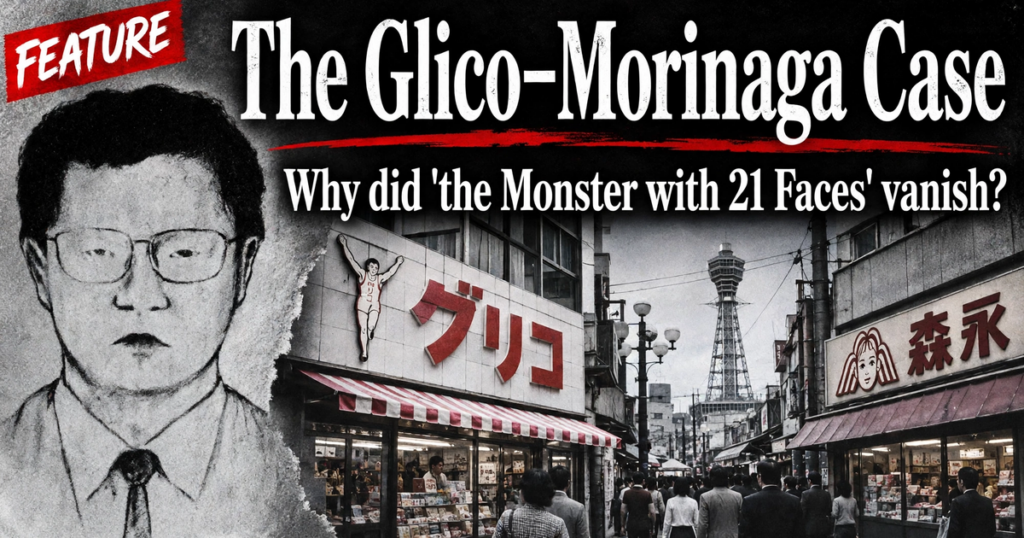
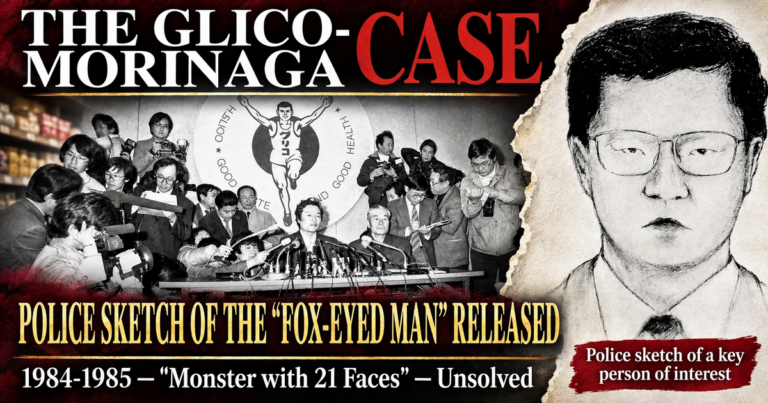
The figure remembered most vividly from the investigation is the man known as the Fox-Eyed Man. During inquiries connected with a cash handover in 1984, investigators reported seeing a suspicious man. On 10 January 1985, police released a composite sketch and appealed for information. News footage from that date also preserved the announcement of the sketch.
The image was a police composite, not a photograph. It was drawn from a witness's memory. A person who resembled the sketch could not therefore be identified as an offender on that basis alone. The man's identity was never officially established, and he was not arrested or charged.
Nor is it possible, from the information made public, to determine exactly what role the man played. He may have been central to the group, may have been watching a cash-transfer operation, or may have had another function. The sketch became famous, but fame is not proof of criminal involvement.
The distinction matters because the image has sometimes been treated as though it were a portrait of the person who directed the entire case. The police released it to generate information, not as a judicial finding of identity. The Fox-Eyed Man remains an unidentified figure in the investigation.
A light van escaped, and the police pursuit became a lasting symbol
On 14 November 1984, a cash handover connected with a threat to House Foods took place. Later reporting described how Osaka Prefectural Police officers posing as company employees drove a vehicle carrying cash along the route specified by the perpetrators. Investigators were watching locations including the Otsu service area. During the operation, an officer reportedly saw the Fox-Eyed Man but was instructed not to stop him for questioning.
That same night, a Shiga Prefectural Police patrol car noticed a suspicious light van near the handover location and pursued it. The van escaped. A later reconstruction of the operation reported that the Shiga officers had not been told that a cash-transfer investigation was underway on the Meishin Expressway.
The episode has often been described as a moment when police were close to catching the perpetrators but let them get away. The available information does not establish that the person seen or the van pursued belonged to the group. A failed pursuit can be examined as an investigative problem without turning every person or vehicle observed into a confirmed offender.
The case also exposed the difficulty of coordinating a large investigation across police jurisdictions. Information held by one unit did not necessarily reach officers who encountered a suspicious vehicle elsewhere. That gap became part of the public criticism of the response.
The police chief's death and the group's final message
On 7 August 1985, Shōji Yamamoto, then chief of Shiga Prefectural Police, died by suicide in the garden of his official residence. Reports about investigative failures were circulating at the time, and his death was widely discussed in connection with the Glico–Morinaga case.
But the motive for Yamamoto's death was not officially established in the information available. A UPI report at the time said that police could not immediately explain why he had taken his life and that there was no decisive information connecting his death to the case. Colleagues reportedly said that he had been distressed by the previous autumn's failure to stop a suspicious vehicle. That recollection is not the same as proof of his motive.
Five days later, on 12 August, a message from the perpetrators reached news organisations. It referred to Yamamoto's death and stated, in substance, that the group would stop threatening food companies. After that, no further campaign under the same name was confirmed.
The ending was unusual. The police did not announce an arrest, the group did not appear in public to explain itself, and no members were brought before a court. The perpetrators simply announced that they were stopping and then fell silent.
Their letter offered their own explanation, but it was not independently verified. It is not possible to establish why they chose that moment to end the campaign, whether Yamamoto's death was decisive, or what happened to the people involved afterwards.
The law changed, but the offenders were not caught
In September 1987, the Act on Special Measures for the Prevention of Poisoning of Distributed Food Products was promulgated. It addressed measures to prevent toxic substances from being introduced into food products in distribution and provided for punishment of acts involving contamination. It was an important part of the legal response to the danger exposed by the case, but it would be too simple to describe the law as an immediate measure enacted solely because of one incident.
The campaign also produced a wave of copycat extortion. The National Police Agency's 1985 White Paper recorded that thirty-two corporate extortion cases imitating the Glico–Morinaga methods had been cleared by the end of 1984. The 1986 White Paper recorded seventy-two imitation cases cleared in 1985. These figures do not mean that the original group committed all those offences. They show how the name and methods of the case were copied by others, adding to the burden on investigators.
The series of offences reached the statute of limitations by February 2000. The National Police Agency's 2000 White Paper records that the series beginning with the abduction of the Glico president had reached that point by then. On 8 May 2026, a National Police Agency government representative told the House of Representatives Committee on Judicial Affairs that two of the twenty-four National Police Agency-designated cases remained without an arrested suspect; the Glico–Morinaga case was one of them.
The group was never identified through a criminal trial. The expiry of the limitation period did not amount to an acquittal, because no defendant had been tried. It changed the legal possibility of prosecution; it did not reveal the perpetrators' names or settle the unanswered questions.
A theatrical crime that used the media as part of its method
The case unfolded through several different kinds of conduct. It began with the abduction of a company president, moved into demands for money and attacks on company facilities, and then expanded to poisoned products that could reach any shopper. Each phase required a different response. The rescue of an abducted person, the protection of a company during a cash handover and the removal of potentially poisoned products from shops are not the same investigative or public-safety task.
The group sent fifteen messages or challenges to news organisations between 7 April and 26 December 1984, according to the National Police Agency's White Paper. The letters mocked the police, publicised the group's actions and sometimes included or referred to cyanide. The perpetrators used the news media to amplify their threats and to shape the public's perception of the investigation.
The use of the media also made it harder to distinguish the original group from copycats. Some later threats were made by people seeking to exploit the fear created by the case. The number of imitation offences cannot be used to infer the size of the original group or to identify its members.
The case is sometimes remembered as a spectacular contest between the police and a clever group of offenders. That framing can obscure the victims: the abducted executive and his family, employees whose workplaces were targeted, and shoppers who faced the risk of poisoned food. The public drama was not the same thing as the harm caused.
The National Police Agency's 1985 White Paper records that the group sent fifteen messages or challenges to news organisations between 7 April and 26 December 1984. The letters publicised the offences, mocked the police investigation and increased the effect of the threats.
The declaration of an ending was not a declaration of resolution
The Glico–Morinaga case left behind a memorable set of images: threatening letters, poisoned confectionery, the composite sketch of the Fox-Eyed Man, failed cash handovers and a final message announcing that the group was finished. Those scenes are easy to retell. They do not, by themselves, explain who committed the crimes or why.
What can be stated is that the president of Ezaki Glico was abducted in March 1984; threats and attacks expanded to other companies; products containing cyanide were found in shops; the perpetrators sent a message ending their campaign in August 1985; and no suspect was arrested in the original series. The limitation period was completed by February 2000.
The group ended its own campaign. The police did not identify its members. Those are different facts, and both must remain visible when the case is recorded.
At a glance
Main period: March 1984 to August 1985. First major offence: the abduction of Ezaki Glico president Katsuhisa Ezaki from his home in Nishinomiya on 18 March 1984. Ransom demand: 1 billion yen and 100 kilograms of gold. The president escaped after approximately 65 hours. The group later threatened more than thirty companies and placed cyanide-containing confectionery in shops. The National Police Agency's 1985 White Paper counted eighteen items at sixteen locations; the Food Safety Commission used a different scope and recorded thirteen items at twelve stores for 7–13 October 1984. No deaths or injuries were reported in the poisoned-product incidents. The Fox-Eyed Man was never officially identified. Shiga Prefectural Police chief Shōji Yamamoto died on 7 August 1985; the cause of his suicide was not established. The group announced that it was ending its campaign on 12 August 1985. The series reached the statute of limitations by February 2000. No suspect was arrested or tried in the original case.
Original Japanese feature: グリコ・森永事件【特集】|犯人が自分で幕を引いた17か月――毒入り菓子と「キツネ目の男」の行方
Last updated:
Related articles
Same case · Case record
The Glico–Morinaga Case: Kidnapping, Corporate Extortion and an Unsolved National Investigation
Case record
The Kochi Serial Insurance Murders
Case record
The Toyota Shoji Chairman Murder: A Consumer Fraud Scandal and a Killing in Front of Television Cameras
Case record