
The Disappearance of Yuri Yoshikawa: Her Home Was Only 400 Metres Away, but Her Trail Ended There — Investigative Records Revisited 23 Years Later
Nine-year-old Yuri Yoshikawa disappeared while walking home from school in Kumatori, Osaka Prefecture, on 20 May 2003. Her last confirmed sighting was about 400 metres from home. In 2026, reporting revealed details from old investigative records and renewed attention to vehicle sightings and witness interviews. A white Crown remains one of several vehicles police have asked the public about; it has not been identified as the abduction vehicle. The case remains unresolved.

Introduction: The final 400 metres remain unexplained
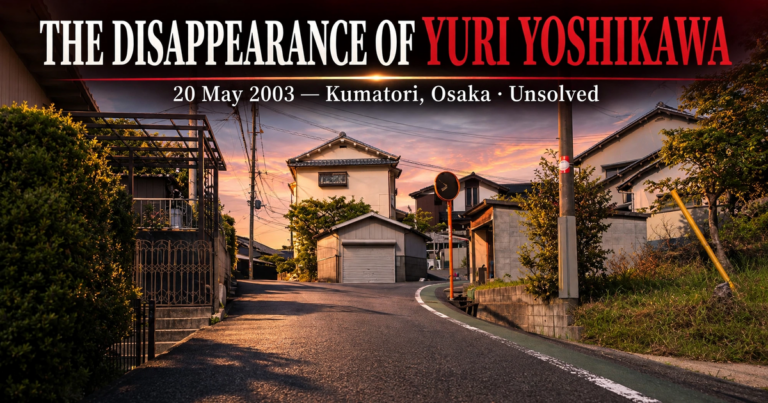
Yuri Yoshikawa was nine years old when she disappeared in Kumatori, Osaka Prefecture, on 20 May 2003. She had finished a school excursion and was walking home with classmates. After separating from her friends, she continued alone along the road towards her house. The last reported sighting was on a slope where she passed another boy.
Her home was approximately 400 metres away, a walk of five or six minutes. She never arrived. The Osaka Prefectural Police have continued to investigate the case as the abduction of a minor. No person has been identified as the offender, and the public information does not establish what route Yuri took after the final sighting.
In May 2026, Kansai Television reported on investigative records and interviews conducted in the early stages of the case. The material showed how widely investigators had sought information from residents, delivery workers and people who regularly travelled through the area. It also renewed attention to several vehicle sightings, including a white Toyota Crown.
The Crown is a witness lead, not a confirmed abduction vehicle. The same applies to the other vehicles publicly listed by police. The central issue is not to create a suspect from a car description, but to establish what happened during the short distance between Yuri's last confirmed sighting and her home.
The last confirmed movements on 20 May 2003
According to the Osaka Prefectural Police, Yuri was born on 31 March 1994. She was nine years old and in the fourth grade at Kumatori Kita Elementary School when she disappeared. The official time is around 3 p.m. on 20 May 2003, and the location is Nanayama in Kumatori Town, Sennan District, Osaka Prefecture.
Kansai Television's 2026 reporting described the route in more detail. After a school excursion, Yuri began walking home with three classmates. At an intersection on the route, she separated from her friends and continued up a slope towards home. Near the top, she passed another boy and exchanged words with him. This was reported as the last confirmed sighting.
The last sighting was about 400 metres from her home. In ordinary circumstances, that distance would take only five or six minutes on foot. But the gap between the last confirmed sighting and the fact that Yuri did not return home has never been filled.
The official police page gives the time as "around 3 p.m." It does not provide a minute-by-minute account of every movement. More detailed descriptions of the separation from classmates and the final sighting come from reporting based on interviews and records, not from a complete official chronology with exact timestamps.
Twenty-three years later, records revealed the scale of the interviews
In May 2026, Kansai Television reported on materials describing the investigation in the early years. The records included basic information such as Yuri's date of birth and blood type, as well as detailed interview notes from the surrounding area.
The interviews were not limited to nearby residents. Reports described records involving delivery contractors, newspaper carriers and milk delivery workers. Investigators sought information from people who might have passed along the road on the day of the disappearance, parked a vehicle nearby or regularly travelled through the neighbourhood as part of their work.
A team leader at the investigation headquarters explained that the old records were being revisited by checking where vehicles and people had travelled, when they had passed and what had happened at those times. The work was not simply a search for one decisive clue. It involved comparing fragments of memory and activity records against time and place.
As of 10 May 2026, 6,378 pieces of information had been received. The cumulative number of investigators assigned was reported as 120,189, and approximately 33,000 investigative inquiries had been conducted. These are figures reported as of that date, not verified totals for 22 November 2026.
The fact that the records were revisited after more than two decades does not mean that the entire investigation had been disclosed. The police have not publicly explained every lead, every interview or the full reason that particular people became subjects of inquiry.
Where was the white Crown seen?
A white or light-coloured Toyota Crown has long been discussed as a possible clue. In 2026, the investigation team leader told Kansai Television that information had been received about a Crown stopped in a way that obstructed traffic on the approximately 400-metre stretch between the last sighting and Yuri's home. A man was said to be in the driver's seat, with a girl in the passenger seat.
That information does not identify the vehicle or the people inside it. The official Osaka Prefectural Police page lists the Crown as one of several vehicle types reported as suspicious before or around the time of the disappearance. A car having been seen in the area is not the same as proof that it was used to abduct Yuri.
The police page also lists a Toyota Camry or Vista, model E-VZV20; a Toyota Crown 130 series; and Nissan Cedric or Gloria models Y32 and Y33. Kansai Television's May 2025 reporting said that a Camry or Vista had been reported near the area on the day of the disappearance. A dark-coloured Cedric or Gloria was linked to information about a man seen looking at schoolchildren from inside a vehicle approximately one month earlier.
These reports concern different vehicles, times and circumstances. Their publication does not establish that all the vehicles belonged to one person, that they were used in the same offence or that several offenders were involved. Police publish model information to help people remember cars they owned, drove, serviced or saw at the time. The information must then be checked against the date, location, colour, shape and occupants.
A vehicle description does not identify its driver
A witness may remember the general shape of a vehicle without being able to identify its model or registration. That is why the police have published model names and reference images. A person who owned a similar car, knew someone who drove one or worked in vehicle sales or maintenance may be able to recall a detail that was not recognised as important at the time.
But a report that someone saw a similar car is only a lead. Investigators must compare the time, location, colour, body shape and people inside the vehicle with other records. A vehicle sighting should not be used to accuse its owner or driver.
The Crown, Camry or Vista, and Cedric or Gloria reports were not all made for the same time and place. The Crown information concerns the final stretch of the route on the day of the disappearance. The Camry or Vista was reported near the area on that day. The Cedric or Gloria information concerned an earlier sighting, about a month before the disappearance. They should not be combined into one narrative of a single convoy or a single offender.
The police are asking people to provide concrete memories and records, not to speculate about who might have been responsible.
The passage of 23 years has changed what can be checked
Kansai Television's 2026 report quoted the investigation team leader as describing the fading of memories and the difficulty of collecting or corroborating physical material as major challenges. In 2003, street cameras and dashboard cameras were not as widespread as they are today. It is not possible to assume that the 400-metre route can be reconstructed from continuous video.
The investigation therefore depends on witness accounts, interviews, vehicle information and records created at the time. As years pass, memories become less precise. Cars are scrapped, sold or re-registered, and it becomes harder to trace their owners. The physical environment also changes, making it difficult to reproduce the conditions that existed in 2003.
Old photographs, vehicle purchase or repair records, diaries, notebooks and work or travel records may nevertheless help someone remember something they did not regard as important at the time. This is not a reason to suspect a particular person or vehicle. It is a reason to provide police with information that can be tied to a specific date and location.
The value of the 2026 reporting is that it revealed part of the old investigative record and the scale of the work. It did not reveal the complete answer or identify the person who took Yuri.
The appeal for information continued in 2026
The number of tips received was reported as 6,378 as of 10 May 2026. A later report gave a figure of 6,424 as of 21 June. Both are figures tied to their publication dates; neither should be presented as the total as of November 2026.
On 2 July 2026, Yuri's parents and investigators distributed leaflets near JR Kumatori Station and appealed for information. The period for the special investigation reward was extended. An advertisement dated 1 July 2026 set the maximum reward at 3 million yen for information leading to resolution of the case, with an application period from 2 July 2026 through 1 July 2027.
The reward is not automatically paid to every person who provides information. It is awarded within the maximum amount according to how much the information contributes to resolving the case. If several people provide useful information, the amount may be divided according to their respective contributions. Anonymous tips can be accepted as investigative information, but payment requires conditions including the ability to identify the recipient.
The investigation headquarters accepts information through Izumisano Police Station. The official contact number is 072-464-1234 and the listed email address is yuri@police.pref.osaka.jp. The police page also provides an online submission form.
What is known, and what remains unknown
Public records and reporting establish that Yuri disappeared while walking home in Nanayama, Kumatori, on 20 May 2003. She was nine years old. The last reported sighting was approximately 400 metres from her home. Osaka Prefectural Police continue to investigate the case as the abduction of a minor and have asked the public for information about several vehicle types.
The public information does not establish the name or number of the person who took her, the specific motive, the route she travelled after the last sighting, whether any of the publicly listed vehicles was actually connected to the offence, whether the vehicle reports relate to the same person or event, or where Yuri is now.
A white Crown sighting does not make its owner a suspect. The publication of several vehicle types does not establish multiple offenders or an organised operation. A witness account, a police-confirmed fact and an investigative hypothesis are different things.
Yuri would be 32 years old in 2026. The police are not asking the public to conduct online suspect searches. They are asking people who actually saw or heard something, or who may have records of a vehicle or journey from the period, to share those details with the investigation headquarters.
The final 400 metres remain unexplained. The task is to compare the remaining records with concrete memories from people who were there, not to fill the gap with an attractive theory.
At a glance
Victim: Yuri Yoshikawa, born 31 March 1994. Age at disappearance: 9. Date: 20 May 2003, around 3 p.m. Location: Nanayama, Kumatori Town, Osaka Prefecture. Last reported sighting: after she separated from three classmates and passed another boy on the slope towards home. Distance from the last sighting to her home: approximately 400 metres, or five to six minutes on foot. Official case classification: abduction of a minor. Vehicle information publicly listed: Toyota Camry/Vista E-VZV20, Toyota Crown 130 series, Nissan Cedric/Gloria Y32 and Y33. Reported tips: 6,378 as of 10 May 2026 and 6,424 as of 21 June 2026. Maximum special reward: 3 million yen; application period 2 July 2026 to 1 July 2027. The vehicles are leads, not confirmed abduction vehicles. The case remains unresolved.
Original Japanese feature: 吉川友梨さん行方不明事件【特集】|家まで400メートル、そこで足取りが消えた――23年後に開いた捜査資料
Last updated:
Related articles
Same case · Case record
The Disappearance of Yuri Yoshikawa: The Unresolved Route Home from School
Case record
The Wanted Case of Katsuyuki Obara and the Death of 17-Year-Old Kozue Sato

Case record
The Muroran High School Girl Disappearance

Case record