
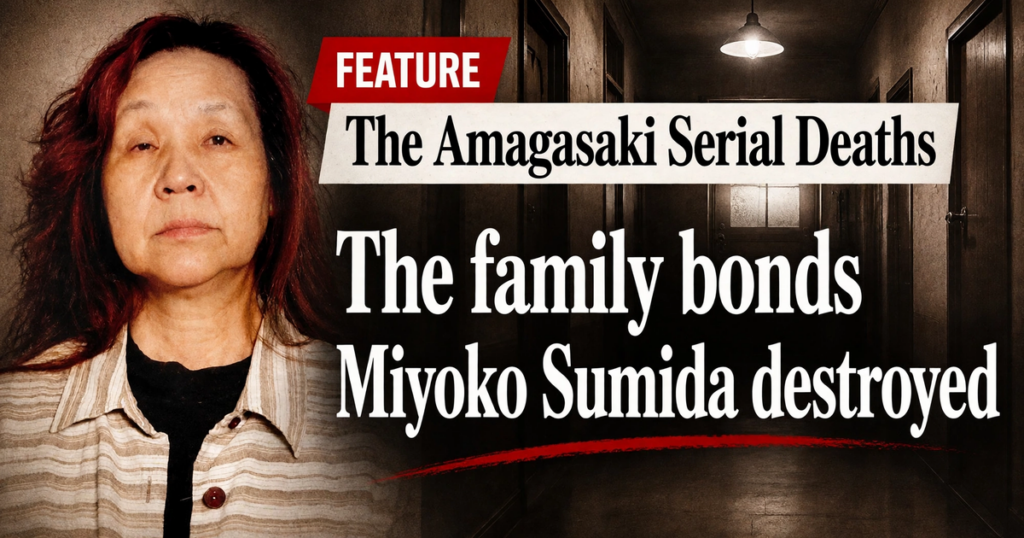
The Amagasaki Serial Deaths: Miyoko Kakuta Made Relatives Turn Against One Another — Eight Deaths and the “Family Meetings” That Became a System of Control
A series of so-called family meetings became a setting in which relatives were made to blame and assault one another. Miyoko Kakuta entered several households, divided family members and gradually shifted acts of violence onto them. Eight deaths were confirmed in the surrounding events, but Kakuta died in police detention before standing trial. Seven relatives were prosecuted, and the courts distinguished their individual roles and responsibility.
Introduction: How did a “family meeting” become a place where relatives were made to use violence?
Why did a “family meeting” intended to resolve disputes among relatives become a setting in which relatives were made to assault one another? The Amagasaki serial deaths case revealed a structure in which Miyoko Kakuta entered households, set family members against one another and gradually shifted acts of abuse onto the family members themselves. A body found inside a drum in 2011 became the starting point for an investigation that confirmed eight deaths in the surrounding circle. But the central figure died in police detention before standing trial. The seven relatives who were prosecuted faced the difficult question of how far the explanation “I obeyed because I was controlled” could go.
The case was not remembered only for the number of people who died. Several households were affected. People whose relationships had been broken were then involved in violence against others. Blood relationships, marriages and other ties became intertwined in a group that was difficult for outsiders to understand.
An outsider's judgement entered the family
The Kobe Shimbun's continuing reporting found that the breakdown of families connected with Kakuta affected at least four households. A recurring pattern emerged: she intervened in a family dispute, brought relatives together for a meeting, made one person the target of blame and encouraged others to join in. When resistance became difficult, the people carrying out the abuse increasingly came from within the family itself.
The phrase “family meeting” would normally suggest a discussion intended to resolve a problem. In this case, the meetings reported during the investigation were gatherings in which the group decided who should be blamed. A family member reprimanded by Kakuta might later be made to reprimand someone else. Protecting a close relative could come to mean disobeying her instructions. Affection and loyalty were turned into tools for pressuring one person to hurt another.
This is not simply a psychological label applied after the fact. Reports from the trials included specific testimony that Kakuta encouraged relatives to use violence during family meetings. The structure that emerges from the testimony and the court's findings is one in which she created conflict and surveillance inside the household, rather than relying only on violence that she personally inflicted.
The Kagawa household: A family dispute became a trap
One part of the investigation into Kakuta's involvement concerned a household in Kagawa Prefecture. At a 2015 trial, Rui Kakuta, the daughter of Hatsuyo Minayoshi, testified about abuse that had occurred at her mother's home in 2003. According to Kobe Shimbun reports from the trial, Kakuta initially entered the household through a dispute among relatives. Meetings were then held repeatedly, relatives were made to blame Hatsuyo and a situation developed in which they assaulted her.
The details described in testimony and the facts ultimately found by a court are not always identical. A witness speaks from a particular position, and other participants may deny parts of the account. This feature does not treat every reported statement as a final judicial finding against Kakuta herself. Even so, the testimony is important for understanding what can happen inside a family when an outsider takes control of the discussion.
A family problem would ordinarily be addressed by the family itself or with help from an outside professional service. But when an outsider takes over the meeting and begins deciding whose account is right and who should be punished, family members can lose confidence in their own judgement. The outside advice “just leave” did not easily apply. Reports described people who left the home being traced through relatives and brought back. Family addresses and contact details, which should have offered security, could become tools for finding and following someone.
Not every household was drawn in through exactly the same steps. The timing and circumstances differed. The common structure must be identified carefully without forcing every person's experience into a single manual.
The woman once seen as ordinary
Kakuta was not initially recognised by everyone around her as a frightening figure. In 2022, the Kobe Shimbun interviewed a lawyer who had represented her in the past and continued visiting her after the case came to light. He recalled that when he first met her, she had seemed like an ordinary woman.
In 2000, Kakuta was prosecuted in a group shoplifting case involving relatives. According to reporting, the prosecution's view that she had led the group was not accepted by the court, and a suspended sentence was imposed. The lawyer later regretted that the position he had taken at the time had turned out to be wrong. This does not mean that he could have predicted everything that happened later. What was proved in the 2000 case must be kept separate from what occurred in the shared households years afterward.
The contrast is nevertheless relevant to how she was perceived. Kakuta could appear polite to people outside her close circle, while reports described her as exercising strong influence through words and violence over people who had become close to her. A simple portrait of a visibly evil person would not explain how she was able to enter ordinary family life.
Inside the “Kakuta family”, victims and perpetrators could change places
People with no blood relationship were connected through adoption, marriage and other ties and lived together in what news reports called the “Kakuta family.” Some had been brought in from other households; some had lived under Kakuta's influence from a young age; and others adapted to the group to preserve their living arrangements. Several were prosecuted for confinement, abuse and acts that led to deaths.
Rui Kakuta's 2015 trial showed how complex an individual's position could be. She was said to have entered the group at age seventeen. The Kobe District Court considered the circumstances in which she came to accept Kakuta's values, but also found that she had participated in the crimes through her own decisions. She was sentenced to 23 years in prison. The judgment reflected two realities: people who have lived for years in a dominating household may find it extremely difficult to resist or escape; but where a person concretely participates in serious violence against someone else, individual responsibility must still be examined.
Explaining everyone with the single word “brainwashed” would erase differences in their decisions and conduct. Declaring that all defendants were the same because they were accomplices would hide who led, who was ordered to act and what each person knew. The trials attempted to distinguish the role and knowledge of each defendant.
The cliff in Okinawa, a balcony storage shed and repeated deaths
Several deaths were examined during the trials. In July 2005, Hisayoshi Kakuta died after falling from a cliff in Okinawa Prefecture. The court found that assaults and psychological pressure from people around him had left him unable to refuse freely and that he had been forced to jump. The purpose of obtaining insurance money was also treated as important in sentencing.
In December 2008, Mariko Nakajima was confined and abused in a storage shed on the balcony of an apartment in Amagasaki and died. In July 2011, Jiro Hashimoto was similarly confined and died. A storage shed is an ordinary part of a home, which makes the fact that it became a place where lives were taken especially disturbing. The court materials described assaults, restrictions on food and drink and confinement that continued as part of daily life rather than a brief argument.
The deaths must not be treated as though they had all occurred in the same way. In its judgment of 16 September 2015, the Kobe District Court found three defendants guilty of murder in relation to the deaths of Hisayoshi and Mariko. In Jiro's case, it found that intent to kill had not been sufficiently proved and convicted the defendants of causing death by injury instead. The result was a death in each case, but the criminal responsibility differed according to what each defendant knew and intended.
The trial examined separately whether defendants knew that someone was being confined, understood the degree of abuse and recognised the risk that the victim might die. The fact that someone died does not mean everyone around them committed the same offence. Conversely, a person does not necessarily escape responsibility merely because they did not personally carry out the final physical act.
The drum in a rented storage unit began to reveal the wider case
In November 2011, a woman's body was found inside a drum in a rented storage unit in Amagasaki. The woman was Kazuko Oe, aged 66. Her discovery became the starting point for an investigation into suspicious deaths and missing persons. In 2012, bodies were also found beneath the floor of another residence, and suspicion widened to several families around Kakuta.
Police ultimately confirmed eight deaths among men and women in the surrounding events. That figure should not be confused with a single count of murders for which one defendant was convicted. The circumstances of death, the charges brought and the findings of guilt differed from case to case. The first body found was both evidence of a completed crime and a clue that opened the way to events in other households.
The question “Why did no one notice earlier?” naturally arises. But the danger was not only that the connection between the households remained hidden. Coercion and violence inside a family can appear from outside as an ordinary dispute among relatives. Individual reports and police responses should not be judged without examining the original records. The possibility of earlier intervention requires separate review of what was reported and how authorities responded.
Kakuta died before she could be tried
Kakuta, regarded as the central figure, was arrested in November 2011 and remained under investigation. On 12 December 2012, she died by suicide in a detention facility at Hyogo Prefectural Police Headquarters. She was 64. Her own criminal trial never reached a conclusion. It is therefore incorrect to say that a conviction against her became final in the same way as the convictions of the relatives.
The opportunity to question Kakuta in court about the series of deaths, and to compare her answers with the testimony and evidence, was lost. That gap remained important in the later proceedings. Her death also raised separate questions about the protection of people held in police detention. In a 2013 statement, the Hyogo Bar Association addressed suicide prevention in detention and the issue of prolonged custody in police facilities. Protecting the life and health of a suspect is a duty that must be examined separately from the seriousness of the alleged crimes.
A lawyer later told the Kobe Shimbun that Kakuta had been concerned after her arrest about the future of people who had lived with her. That testimony does not reveal her entire inner life. It leaves an unresolved contradiction: a woman alleged to have exercised strong control over the group may have regarded that group as her family. The reason she broke other families apart cannot now be fully tested through her own testimony.
What did the trials of the seven remaining relatives establish?
After Kakuta died, criminal trials continued against seven relatives. At the Kobe District Court, the issues included conspiracy in each offence, intent to kill and the extent of each person's participation. The court did not convict people simply because they had lived in the same house. It examined whether they knew about instructions to confine a victim, understood the victim's condition and took part in assaults or concealment of a body.
In September 2015, three defendants—Mieko Kakuta, Kentaro Kakuta and Tei Raitaro (鄭頼太郎)—were each sentenced to 21 years in prison. The judgment considered how difficult it had been to oppose Kakuta's wishes within the group, while finding that the defendants had conspired in serious crimes.
In Li Zhengze's case, the court found that he had played a more important and active role than other relatives and imposed life imprisonment. In March 2017, the Osaka High Court revised the first-instance description that his role was “comparable” to Kakuta's, but maintained life imprisonment because it found that he had played the next most important role. On 9 March 2018, the Supreme Court dismissed his appeal.
The Kobe Shimbun summarised the final sentences for the seven relatives as ranging from fifteen years to life imprisonment. This did not resolve Kakuta's own criminal responsibility. It did establish that the repeated acts were not a series of accidental deaths: the courts recognised specific crimes and individual responsibility among the relatives.
At a glance
Discovery: November 2011, when Kazuko Oe, aged 66, was found inside a drum in a rented storage unit in Amagasaki, Hyogo Prefecture. Deaths: eight people were confirmed in the surrounding events; the circumstances and criminal findings differed by case. Central figure: Miyoko Kakuta, arrested in November 2011, died by suicide in police detention on 12 December 2012 at age 64 and was never tried. Seven relatives were prosecuted. Rui Kakuta was sentenced to 23 years in 2015. On 16 September 2015, three defendants received 21-year sentences; the court found murder in the deaths of Hisayoshi Kakuta and Mariko Nakajima, but injury causing death in the case of Jiro Hashimoto. Li Zhengze's life sentence became final after the Supreme Court dismissed his appeal on 9 March 2018. Final sentences for the seven relatives ranged from 15 years to life imprisonment.
Original Japanese feature: 尼崎連続変死事件【特集】|家族に家族を殴らせた角田美代子――「家族会議」で始まる支配と8人の死
Last updated:
Related articles

Same case · Case record
The Amagasaki Suspicious Deaths: Eight Lives Lost and the Trials of Seven Co-Defendants

Case record
The Sakamoto Family Murders: A Lawyer Targeted for His Work and Six Years of Uncertainty

Case record
The Murder of a First-Grade Girl in Kobe's Nagata Ward: A Death Sentence Replaced by Life Imprisonment

Case record