
The Sasaguri Five-Year-Old Child Death Case: Coercive Control, Neglect, and Two Final Prison Sentences
A five-year-old boy died in Sasaguri, Fukuoka Prefecture, on 18 April 2020 after a prolonged period in which he was not given sufficient food. His mother, Rie Ikari, and her acquaintance Emiko Akahori were convicted of causing death by abandonment by a person responsible for protection. The courts found that Akahori had used false stories and psychological control to dominate the mother’s life. Ikari’s five-year sentence became final in November 2022; Akahori’s 15-year sentence became final in March 2023.
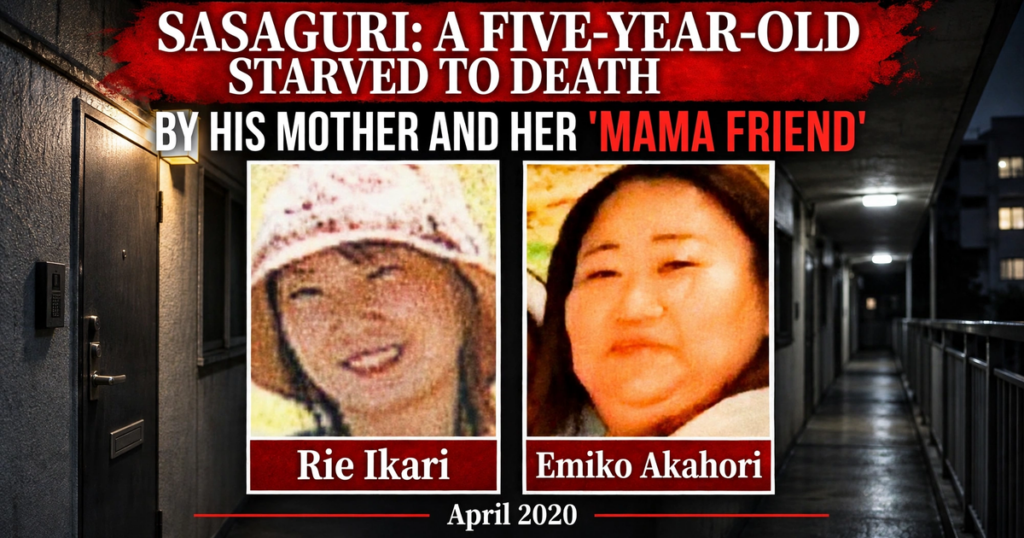
A five-year-old boy died after a prolonged period of food deprivation
On 18 April 2020, the boy, aged five, died at a residence in Sasaguri, Kasuya District, Fukuoka Prefecture. He was in a state of severe malnutrition. The criminal proceedings concerned the prolonged failure to provide him with sufficient food and the roles played by his mother, Rie Ikari, and her acquaintance, Emiko Akahori. The case was not treated as a single moment of neglect. The courts examined the months before the child’s death, the household’s circumstances, and the influence Akahori had over the mother.
The relationship began through the children’s kindergarten
Rie Ikari and Emiko Akahori became acquainted through their children’s kindergarten. What began as a relationship between mothers gradually changed. The courts found that Akahori used repeated false stories about the husband’s alleged infidelity and other supposed people involved in the family’s affairs. She created an atmosphere in which Ikari became increasingly isolated from her husband and people around her. The relationship developed into a pattern of control over decisions about money, family contact, and everyday life.
Invented stories and a supposed investigation were used to obtain money
Akahori told Ikari that money was needed for investigations and other expenses, including matters connected with the husband’s supposed affairs. The court found that these explanations were false and that Akahori obtained approximately two million yen from Ikari through deception. The fraud was part of the wider pattern of control. It was not merely an unrelated financial dispute between acquaintances: the false stories helped isolate Ikari and made her increasingly dependent on Akahori’s account of what was happening in her family.
The court found that Akahori exercised practical control over the household
The prosecution presented communications and financial evidence to show that Akahori influenced the family’s daily decisions even though she did not live in the home. The court found that she had effectively controlled Ikari’s life through instructions, false information, and demands for money. The judgment did not treat the relationship as ordinary friendship or advice. It found that the mother’s choices were constrained by a sustained pattern of psychological pressure. This finding was central to the assessment of Akahori’s responsibility for the child’s prolonged deprivation.
The food restrictions began around August 2019
According to the indictment and trial reporting, the children’s food intake was reduced from around August 2019. the child was five and depended on adults for meals and care. The restrictions continued over many months, and by around March 2020 he had become severely malnourished. The case concerned not simply a lack of food on one day, but a repeated failure to provide adequate nutrition over an extended period. The courts examined how Akahori’s instructions and Ikari’s conduct contributed to that continuing condition.
Shoshiro died on 18 April 2020
the child died on 18 April 2020. The prosecution alleged that the two women had conspired to withhold sufficient food, resulting in his death. The legal charge was causing death by abandonment by a person responsible for protection. The proceedings considered the mother’s direct duty to protect her child and Akahori’s alleged role in directing or sustaining the deprivation. The boy’s death was the result of the prolonged circumstances established in the criminal proceedings, not an isolated event that began on the day he died.
Rie Ikari admitted the charge and received five years
Ikari’s trial began in June 2022. She admitted the charge of causing death by abandonment. The main dispute concerned how much weight should be given to Akahori’s psychological control. Prosecutors sought ten years’ imprisonment, arguing that Ikari had abandoned her duty to protect her son. The defence argued that her freedom of action had been narrowed by Akahori’s manipulation and sought a suspended sentence. On 17 June 2022, the Fukuoka District Court sentenced Ikari to five years’ imprisonment.
The High Court upheld the mother’s sentence in November 2022
Ikari appealed, arguing that the five-year sentence was too severe in light of the psychological control she had experienced. On 9 November 2022, the Fukuoka High Court dismissed the appeal and upheld the sentence. The defence did not appeal to the Supreme Court by the deadline of 24 November, and the five-year sentence became final. The final judgment recognized the influence Akahori had exerted but held that it did not remove the mother’s responsibility to feed and protect her child.
Akahori denied the allegations but received 15 years
Akahori’s jury trial began in August 2022. Unlike Ikari, she denied the charges and maintained that she had not controlled the mother or caused the child’s death. The prosecution argued that she had used lies about the husband’s affairs and fictional people to isolate Ikari, obtain money, and direct the household’s conduct. On 21 September 2022, the Fukuoka District Court sentenced Akahori to 15 years’ imprisonment, the term sought by prosecutors. The judgment also addressed fraud and theft in addition to the child’s death.
Akahori’s 15-year sentence became final in March 2023
Akahori appealed the district-court judgment. On 9 March 2023, the Fukuoka High Court dismissed the appeal, finding no unreasonable point in the first-instance decision. Her defence did not file a further appeal by the deadline of 23 March, and the 15-year sentence became final. The two final outcomes were therefore different: five years for the mother and 15 years for Akahori. Neither sentence was a suspended sentence. Both were terms of imprisonment whose execution was not suspended.
The case requires separate treatment of control and parental responsibility
The judgments recognized that Akahori had exercised significant psychological and practical control over Ikari. They also held that Ikari remained the child’s mother and retained a duty to protect him. The legal outcomes should not be reduced to the statement that one woman controlled the other and therefore bore all responsibility. The courts assessed each defendant’s conduct and legal role separately. Akahori was convicted of the child’s death-related offence as well as fraud and theft; Ikari was convicted of the death-related offence as the parent responsible for care.
Original Japanese record: 福岡県篠栗町5歳児餓死事件|碇翔士郎ちゃんの死亡と母親・赤堀恵美子の実刑確定
Last updated:
Related articles
Case record
The “Itadaki Joshi Riri-chan” Fraud Case: Romance-Based Deception, a Paid Manual, and a Final Sentence of Eight Years and Six Months

Case record
The Nagoya Marriage-Fraud Scheme Using a Dating App

Case record
The Asahikawa High School Student Murder

Case record