
The Shinagawa Noodle Factory Couple Robbery-Murders
In August 2002, Xie Yidi entered a noodle factory and residence in Shinagawa, Tokyo, intending to steal valuables. He killed the couple who operated the business and took cash and jewellery. The Supreme Court upheld his death sentence in 2012. A missing knife became a point of contention, but the missing item was a police-purchased knife of the same type, not the actual weapon used in the killings.
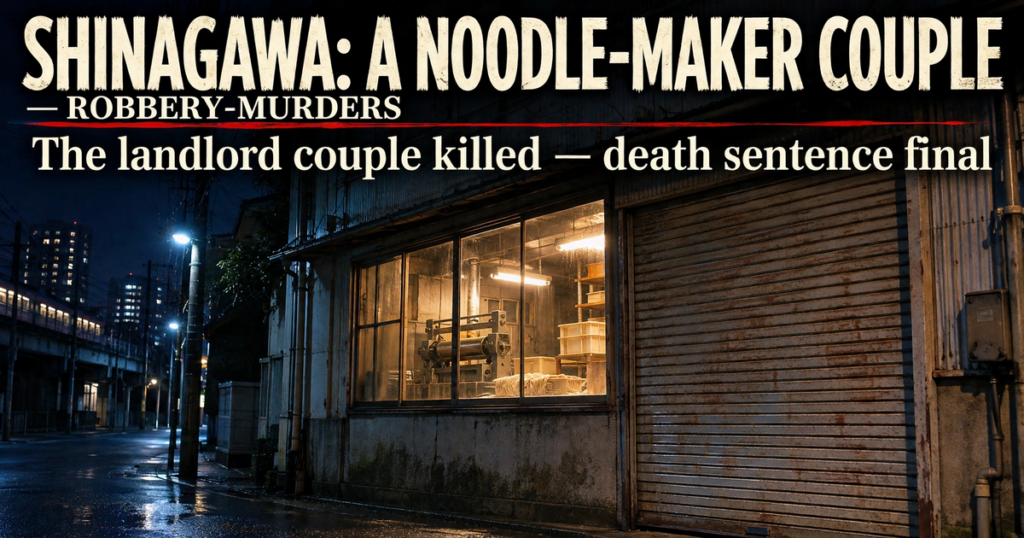
A couple were killed in a noodle factory and residence
Shortly after midnight on 31 August 2002, a man entered a building in Shinagawa Ward, Tokyo, that housed a ramen shop and noodle factory on the first floor and residential rooms on the second and third floors. The couple who operated the business lived there. Both were killed, and wallets, cash and jewellery were taken. The defendant was Xie Yidi, a Chinese national who lived in an apartment for which the victims were the landlords. The Supreme Court judgment anonymized the couple as Victim A and Victim B.
Xie entered the building to steal property
According to the Supreme Court's findings as summarized in the Japanese article, Xie was unlawfully remaining in Japan and had difficulty meeting living and leisure expenses. He decided to enter the premises operated by his landlords and steal valuables. He entered the building and concealed himself in the first-floor noodle factory, waiting for an opportunity. When the husband arrived and noticed him, Xie attacked him with a survival knife. The court found that Xie killed the man when he attempted to escape.
After the first killing, Xie searched the premises and attacked the wife
Xie searched the first floor after killing the husband. He then went upstairs to the second floor, where he attacked and killed the wife. He continued searching the building, including the first and third floors, and took wallets containing money and jewellery. The sequence was significant to the legal analysis. The court did not view the incident simply as an unexpected killing during an ordinary theft. It considered the first attack, the movement through the building, the second killing and the continued search for property as one course of conduct directed toward obtaining valuables.
The prosecution involved robbery-murder and immigration offences
The principal charges included unlawful entry, robbery-murder and violations of Japan's immigration law. The case therefore involved more than two counts of murder considered separately from the theft. Robbery-murder under Japanese law requires a connection between the taking of property and the violence used in the course of the offence. The prosecution's case was that Xie entered to steal and used lethal violence against the couple as he carried out that purpose. The courts assessed the killings and the taking of property within that legal framework.
The Supreme Court assessed intent from the manner of the attacks
The defence contested whether Xie had intended to kill. The Supreme Court considered the nature of the weapon and the locations and number of the injuries. The survival knife was capable of causing fatal injuries, and the attacks included forceful cuts to the front of the neck and repeated stabs to the chest and back. The court concluded that the manner of the attacks demonstrated a firm intent to kill. In Japanese criminal law, intent can be inferred from objective conduct; it is not determined solely by whether a defendant later admits a particular state of mind.
A knife went missing while in court custody
A distinctive issue arose during the appeal proceedings. The defence argued that a survival knife held as evidence had gone missing while in the custody of the Tokyo High Court. It also argued that the High Court had not inspected the physical item and that the loss undermined the finding of intent. The Supreme Court acknowledged that the disappearance of an item held by the court revealed a problem in evidence management. It did not dismiss the concern as unimportant.
The missing item was a comparison knife, not the actual murder weapon
The Japanese article emphasizes a critical distinction. The missing survival knife was not the weapon actually used to kill the couple. It was a same-type item purchased by investigators and submitted as evidence for comparison. Photographs and measurement records documenting its shape had also been admitted. The Supreme Court concluded that the physical loss of that comparison item did not prevent the court from assessing the defendant's intent from the other evidence. It would therefore be misleading to say that the actual murder weapon disappeared and the conviction was upheld regardless.
The courts also considered preparation before the crime
The Supreme Court's sentencing analysis included the preparation of a survival knife and stockings that could be used to cover the face. The preparation supported the conclusion that Xie had contemplated the possibility of killing the occupants rather than entering with no thought of violence. His motive was to obtain money and valuables because he lacked sufficient income. The courts did not treat financial hardship as an excuse for entering the landlords' premises and killing two people. The preparation and the manner of the attacks were important aggravating factors.
The district and High Courts imposed and maintained death
On 2 October 2006, the Tokyo District Court sentenced Xie to death. The Tokyo High Court upheld the sentence on 9 October 2008. In its assessment, the courts considered the two deaths, the use of a knife, the attacks on vital parts of the body, the taking of property and the preparations made before the crime. The courts also considered circumstances favourable to Xie, including his expressed apology to the victims' families and the absence of prior convictions in Japan.
The Supreme Court dismissed the appeal in October 2012
On 19 October 2012, the Supreme Court's Second Petty Bench dismissed Xie's final appeal. It upheld the High Court judgment and the death sentence. The decision addressed the missing comparison knife and concluded that the loss did not make the finding of intent unsustainable. The sentence became final after the Supreme Court decision. The procedural stages should be kept distinct: the district court imposed death, the High Court maintained it, and the Supreme Court dismissed the final appeal.
The victims' identities are anonymized in the Supreme Court judgment
The Supreme Court judgment refers to the couple as Victim A and Victim B rather than publishing their names. The Japanese article identifies their occupation and relationship to the building but does not provide their names in the judicial account. This translation therefore follows the anonymized designation when discussing the Supreme Court's findings. The fact that they operated the ramen shop and noodle factory and rented an apartment to Xie is relevant to the relationship between the defendant and the victims, but it does not lessen the gravity of the two robbery-murders.
Original Japanese record: 品川製麺所夫婦強盗殺人事件|謝依俤の死刑と、紛失した同種ナイフをめぐる最高裁判断
Last updated:
Related articles

Case record
The Hamana Lake Serial Murders: Two Victims, Property Theft, and a Death Sentence Made Final by Withdrawal of Appeal

Case record
The Ginza Wealthy Couple Robbery-Murders

Case record
Police Agency Wide-Area Important Designation Case No. 121: Five Robberies, Three Deaths, and Two Final Death Sentences

Case record