
The Shigaraki Kogen Railway Collision: Forty-Two Deaths, a Red Signal and Shared Railway Responsibility
At about 10:35 a.m. on May 14, 1991, a Shigaraki Kogen Railway local train and a JR West through-service excursion train collided head-on on a single-track section near Onodani signal station in Shiga Prefecture. Forty-two people died. The Ministry of Land, Infrastructure, Transport and Tourism has published casualty figures of both 614 and 628 injured; its victim-support material gives 628. Three Shigaraki Railway-side personnel received suspended prison sentences in March 2000. JR West personnel were not criminally prosecuted, but civil courts recognised the company's responsibility, and the appeal judgment became final in 2003.
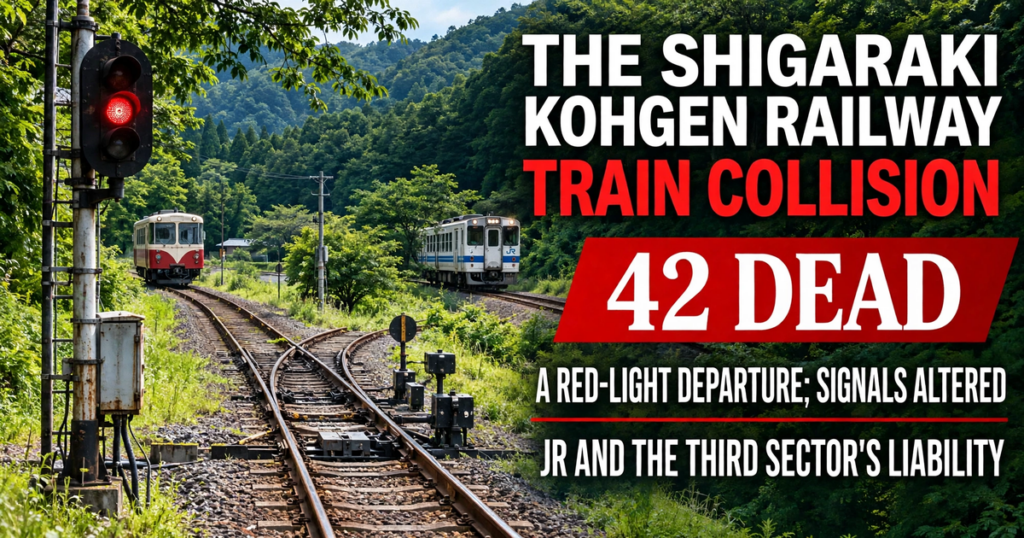
Two trains entered the same single-track section
At about 10:35 a.m. on May 14, 1991, a Shigaraki Kogen Railway local train and a JR West excursion train travelling through to Shigaraki collided head-on near Onodani signal station in Shiga Prefecture. The railway line was single-track, so trains travelling in opposite directions depended on a functioning signalling and block system to prevent them from entering the same section. The collision killed 42 people and injured hundreds. The trains were carrying passengers travelling to the World Ceramic Festival in Shigaraki, which had increased demand on the line.
The local train departed while its signal remained red
The Kibukawa-bound local train was scheduled to depart from Shigaraki Station, but its departure signal did not turn green. When a signal fails, railway operating rules require a substitute block procedure and confirmation that an opposing train is not occupying the section. The local train nevertheless departed using a hand signal without the necessary confirmation and without effective communication with the next signal station. At the same time, the JR West through-service train had entered the single-track route from the opposite direction.
Changes to the signalling system were not adequately shared
The collision was not explained solely by the action of the person who gave the departure signal. Before through-service began, the two railway companies had made changes to signalling equipment. Later investigations and court proceedings examined whether the changes had been properly communicated, tested and understood by both companies. The companies did not share a complete common understanding of how the system would behave in abnormal conditions. The case showed that a change made by one operator can affect the safety of another operator using the same route.
The casualty count is 42 dead, but official injury figures differ
The number of people killed is consistently recorded as 42. The number injured appears as both 614 and 628 in government material. Some Ministry of Land, Infrastructure, Transport and Tourism railway-history and regional transport documents use 614, while its victim-support material gives 628. The difference reflects inconsistent official counting across documents, and should not be concealed by choosing a number without context. This translation uses 628 when citing the Ministry's victim-support material and notes the alternative 614 figure.
Three railway-side personnel were prosecuted
The Otsu District Public Prosecutors Office indicted three people on December 24, 1992: the Shigaraki Railway operations chief who was working as stationmaster on the day of the collision, the company's facilities manager responsible for signalling equipment, and an engineer from the electrical contractor that had worked on the signal system. The charges included professional negligence causing a traffic hazard and professional negligence causing death or injury. The criminal proceedings examined the duties of the individuals responsible for operating rules and signal maintenance.
The Otsu District Court imposed suspended prison sentences in 2000
On March 24, 2000, the Otsu District Court convicted all three defendants. The operations chief received two years and six months' imprisonment, suspended for three years; the facilities manager received two years and two months, also suspended for three years; and the contractor's engineer received two years, suspended for three years. The sentences were not immediate custodial terms. The criminal case did not result in convictions of JR West employees, who were not indicted.
The civil case reached a different conclusion about JR West
Families of nine passengers filed a civil action against JR West and Shigaraki Kogen Railway in October 1993. The Osaka District Court found negligence by employees of both companies and ordered the companies to pay approximately 501.5 million yen in total damages in March 1999. Shigaraki Kogen Railway did not appeal. JR West appealed, but the Osaka High Court dismissed its appeal on December 26, 2002, and the judgment became final on January 10, 2003. Civil liability and criminal liability were assessed under different legal standards.
A later recourse case allocated responsibility between the companies
After the civil judgment, JR West pursued a separate claim seeking contribution from Shigaraki Kogen Railway and its public-sector shareholders. On April 27, 2011, the Osaka District Court allocated responsibility at 70 percent to Shigaraki Kogen Railway and 30 percent to JR West and ordered the railway to pay approximately 1.114 billion yen. The court rejected the claims against Shiga Prefecture and Koka City. This later case concerned allocation between the operators after compensation liability had been addressed; it was not a new criminal trial.
The accident changed how shared railway operations were understood
The collision demonstrated that railway safety depends on more than the skill of an individual driver or station employee. Signal design, changes to equipment, substitute block procedures, through-service agreements and communication between operators must work together. The criminal convictions of three Shigaraki-side personnel and the civil findings against JR West are not contradictory. They reflect different questions: whether particular individuals committed criminal negligence, and whether the companies had civil responsibility for the system and the resulting harm.
Original Japanese record: 信楽高原鐵道列車衝突事故|42人死亡、赤信号発車と信号改変が問うたJR・第三セクターの責任
Last updated:
Related articles
Case record
The 1999 Tomei Expressway Drunk-Driving Crash: Two Young Sisters Killed and a Four-Year Sentence
Case record
The Tokai JCO Criticality Accident: Twenty Hours of Nuclear Fission, Two Deaths and a Breakdown in Safety Management

Case record
The Paloma Water-Heater Deaths: Twenty-Eight Carbon-Monoxide Accidents and a Failure to Act on Warning Signs
Case record