
The China Airlines Flight 140 Crash: 264 Lives Lost Near Nagoya Airport
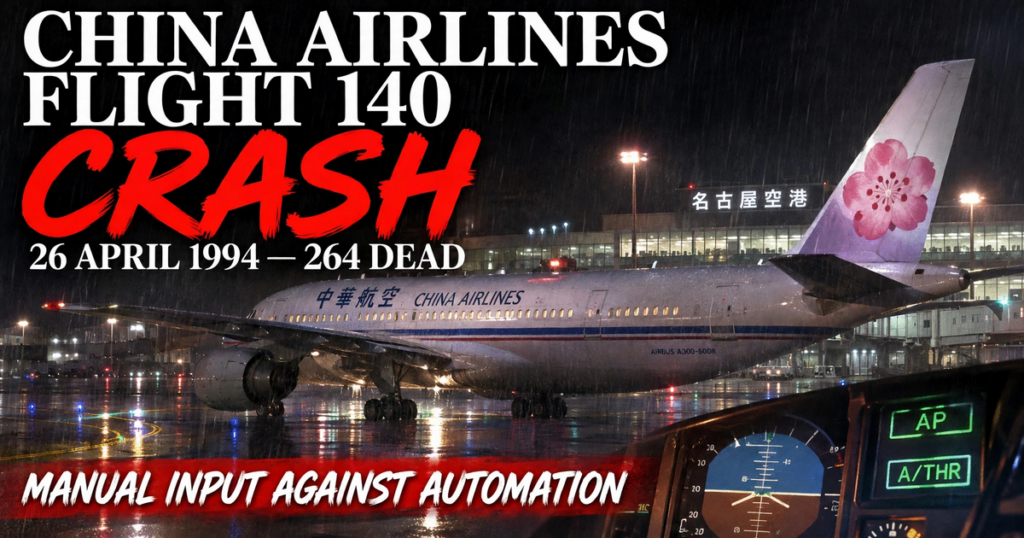
China Airlines Flight 140 crashed near Nagoya Airport on April 26, 1994, while approaching Runway 34. The Airbus A300B4-622R carried 271 people; 264 died and seven passengers survived with serious injuries. The investigation traced the loss of control to a conflict between the go-around mode of the automatic flight system and the pilots' manual inputs, compounded by a recommended modification that had not been installed.
A Taipei–Nagoya flight crashed during its final approach
At about 8:16 p.m. Japan time on April 26, 1994, China Airlines Flight 140 crashed near the landing area at Nagoya Airport in Aichi Prefecture. The aircraft was an Airbus A300B4-622R, registration B-1816, flying from Taipei to Nagoya. It carried 256 passengers and 15 crew members, for a total of 271 people. The aircraft was approaching Runway 34 when the sequence that led to the crash began. The accident destroyed the aircraft and caused one of the largest losses of life in a Japanese aviation disaster.
The go-around lever was activated during the approach
The approach had progressed to the stage at which the first officer was manually flying the aircraft toward the runway. At an altitude of roughly 1,000 feet, the first officer unintentionally operated the go-around lever on the thrust control. This changed the automatic thrust-control system into go-around mode and increased engine power. The aircraft began to deviate from its intended descent path. The captain recognized that the aircraft was too high and instructed the first officer to cancel the mode and return to the approach path.
The automatic system continued to act in go-around mode
The problem did not end when the crew attempted to return to the landing approach. When the first officer engaged the autopilot, the go-around mode remained active. The automatic system continued to move the horizontal stabilizer in a nose-up direction, while the first officer pushed the control column forward in an effort to lower the nose. The manual and automatic controls were therefore working against one another. The crew was faced with an aircraft whose response did not match the control input they believed they were making.
Conflicting control inputs produced an extreme trim condition
The first officer also attempted to use the trim switch on the control column. However, while the autopilot was engaged, that input did not move the horizontal stabilizer in the way the pilot expected. Over roughly 30 seconds, the stabilizer continued moving toward its nose-up limit. Even after the autopilot was disconnected, the stabilizer remained in that extreme position. The crew did not fully recognize how much nose-up force had accumulated. The issue was not simply that one pilot pressed the wrong control; the interaction between the selected mode, the stabilizer and the pilots' actions created a dangerous control condition.
The aircraft climbed, lost speed and stalled
As the crew attempted to recover the approach and then carry out a go-around, the aircraft adopted an increasingly nose-up attitude. It climbed rapidly and lost airspeed. The wings could no longer maintain the lift needed for controlled flight, and the aircraft stalled before striking the ground in the landing area near Nagoya Airport. A fire followed the impact. The final sequence developed over a short period, leaving the crew little time to understand the abnormal trim condition and recover the aircraft.
Two hundred and sixty-four people died
Of the 271 people aboard, 264 died: 249 passengers and all 15 crew members. Seven passengers survived, but all seven suffered serious injuries. These are the final figures recorded in the official accident information, rather than preliminary counts from the immediate aftermath. The fact that seven passengers survived is important to an accurate account; the aircraft was not lost with every person aboard. The scale of the fatalities nevertheless made the accident a defining event in the history of aviation safety in Japan.
The investigation examined both pilot actions and aircraft-system design
Japan's Aircraft Accident Investigation Commission examined the event and published its report on July 19, 1996. The investigation considered the inadvertent operation of the go-around lever, the persistence of the automatic mode, the movement of the horizontal stabilizer and the crew's understanding of the aircraft's configuration. It also examined training and the design of the automatic flight-control system. The report did not treat the crash as a simple case of one pilot making one mistake. It traced how human actions and system behaviour combined to produce a loss of control.
A recommended modification had not been installed on the aircraft
Airbus had issued Service Bulletin A300-22-6021 in June 1993. It recommended a modification that would disconnect the autopilot when a sufficiently strong control-column input was applied during go-around mode above a specified altitude. The recommendation followed earlier reports of conflicts between automatic flight control and pilot inputs. At the time, however, the modification was not mandated by an airworthiness directive. China Airlines deferred the work until a later maintenance opportunity, and the accident aircraft had not received it.
The safety lesson extended beyond individual pilot performance
The crash demonstrated that flight crews need to understand not only what a control does in isolation but also how the aircraft's automatic modes interact. A system must make its active mode and its response understandable to pilots, especially when a mode has been selected unintentionally. Training, warnings, design protections and the process for implementing manufacturer recommendations all matter. The accident therefore raised questions about the communication of technical risks to operators and the speed with which recommended changes are incorporated into aircraft in service.
Original Japanese record: 中華航空140便墜落事故|名古屋空港で264人死亡、操縦操作と自動制御が衝突
Last updated:
Related articles
Case record
The JR Uetsu Main Line Derailment: Inaho No. 14 and the Sudden Gust

Case record
The Kanemi Yusho Poisoning: PCB-Contaminated Rice Oil and a Relief System Still Operating Decades Later
Case record
The Tokai JCO Criticality Accident: Twenty Hours of Nuclear Fission, Two Deaths and a Breakdown in Safety Management
Case record