
The Piano-Noise Murders
On 28 August 1974, Matsuzo Ohama killed a 33-year-old mother and her two young daughters in a housing complex in Hiratsuka, Kanagawa Prefecture. The case became known as the Piano-Noise Murders, although the complaints concerned several kinds of household noise. The death sentence became final after Ohama withdrew his appeal and the Tokyo High Court found the withdrawal valid.
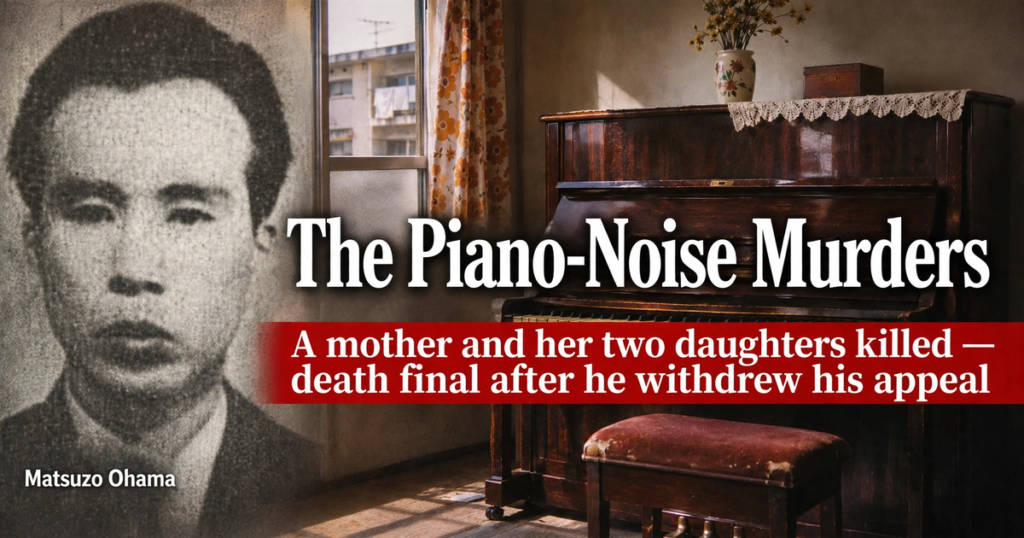
A mother and her two daughters were killed in Hiratsuka
On the morning of 28 August 1974, a 33-year-old mother and her daughters, aged eight and four, were killed inside their home at the Yokouchi Prefectural Housing Complex in Hiratsuka, Kanagawa Prefecture. The accused was Matsuzo Ohama, aged 46, who lived in the apartment directly above the victims. The case became widely known as the Piano-Noise Murders. That name captures one element of the dispute but does not describe the full range of sounds that Ohama had complained about.
The complaints concerned more than piano playing
Ohama had become intensely distressed by sounds from the apartment below. The Japanese article identifies piano playing, children's footsteps, doors opening and closing, and do-it-yourself work among the sounds he complained about. The piano had been purchased by the family in 1973 and became a symbolic focus of the dispute. However, the conflict was not limited to music. It concerned ordinary sounds associated with family life in a shared residential building.
The court examined planning before the attack
The article states that Ohama had prepared a sashimi knife approximately one week before the killings. On the morning of 28 August, he went to the apartment below shortly after 9 a.m., at a time when the victims' husband and father was away at work. The court considered the timing and preparation when assessing whether the attack was planned. These details are relevant to the criminal findings and should not be replaced with a suggestion that the killings were an instantaneous reaction to a single burst of noise.
The eldest daughter was attacked first
Eight-year-old Mayumi was inside the apartment when Ohama entered. He attacked her first. The mother, Yaeko Okumura, aged 33, and the younger daughter, Yoko, aged four, returned afterward and were also killed. The sequence is important because it shows that the victims were attacked at different points during the incident. All three deaths occurred in the same household, but the court considered the order of events and the preparation of the weapon when assessing the offence.
The noise dispute did not justify the killings
The case is sometimes retold as though the victims' piano playing caused the murders. That wording risks making the victims responsible for the offender's decision. The court considered Ohama's complaints and his mental condition, but the existence of a noise dispute did not justify the attack. The victims were engaged in ordinary household activities. The criminal responsibility concerned Ohama's deliberate decision to enter the apartment and kill three people, not a legal finding that the family had committed an offence by making noise.
Responsibility and mental condition were disputed
The trial considered how Ohama's sensitivity to sound affected his mental state and whether he had the ability to understand and control his conduct. The legal question was not simply whether he experienced distress. Under Japanese criminal law, a mental disorder may affect criminal responsibility if it substantially impairs the ability to understand the nature or wrongfulness of an act or to control behaviour. The Yokohama District Court's Odawara Branch found that Ohama retained full criminal responsibility.
The district court imposed the death penalty in 1975
On 20 October 1975, the Odawara Branch of the Yokohama District Court sentenced Ohama to death. The judgment concerned three murders and theft. The court considered the number of victims, the preparation of the weapon, the attack on the children and their mother, and the defendant's mental condition. The death sentence was a first-instance judgment. It was not immediately final because Ohama's defence counsel filed an appeal to the Tokyo High Court.
Ohama personally withdrew the appeal in October 1976
While the defence appeal was pending, Ohama submitted a withdrawal on 5 October 1976. A defendant's withdrawal of an appeal can cause the first-instance judgment to become final, but a death sentence raises a serious question about whether the person has the legal capacity to make that decision. The Tokyo High Court therefore examined whether Ohama understood the procedural consequences and could make a valid decision to end the appeal. The case did not proceed to an ordinary appellate judgment on the merits.
The Tokyo High Court found the withdrawal valid
The Tokyo High Court considered psychiatric evidence and Ohama's statements and conduct. Although the examination identified unusual or delusional tendencies, the court concluded that he retained the litigation capacity needed to decide whether to continue the appeal. On 16 December 1976, the High Court treated the withdrawal as valid. The issue was not whether the murders had been proved again on appeal, but whether Ohama's decision to abandon the appeal was legally effective.
The sentence became final in April 1977 without a Supreme Court merits ruling
The defence challenged the effect of the withdrawal, but the objection was rejected on 11 April 1977. No further special appeal was pursued, and the death sentence became final on 16 April 1977. This was not a case in which the Supreme Court dismissed an appeal after reviewing the evidence and sentence. Finality followed from the defendant's withdrawal, the High Court's finding that he had capacity to withdraw, and the rejection of the subsequent objection.
The legal route to finality is part of the case's significance
The Piano-Noise Murders are remembered for the dispute over household noise, but the legal history is equally distinctive. The district court imposed death in 1975; the defence appealed; Ohama withdrew that appeal in 1976; the Tokyo High Court found the withdrawal valid; and the sentence became final in April 1977. The High Court's ruling concerned litigation capacity, not a fresh determination of guilt after a full appeal hearing. An accurate account must not attribute the final sentence to a Supreme Court merits judgment.
Original Japanese record: ピアノ騒音殺人事件|母娘3人殺害と責任能力、控訴取下げで確定した死刑
Last updated:
Related articles

Case record
The Yokohama–Fukaya Serial Murders
Case record
The Kawasaki Care Home Serial Falls
Case record
The Hokkaido Government Office Bombing: Two Deaths, 95 Injuries and a Fourth Retrial Request
Case record