
The Shiori Ito Civil Sexual-Assault Litigation
Journalist Shiori Ito reported a non-consensual sexual encounter in 2015. Prosecutors declined to indict the former TBS reporter involved, but a civil court later found that the sexual act had occurred without Ito’s consent; the Supreme Court left the civil appellate judgment final in 2022.
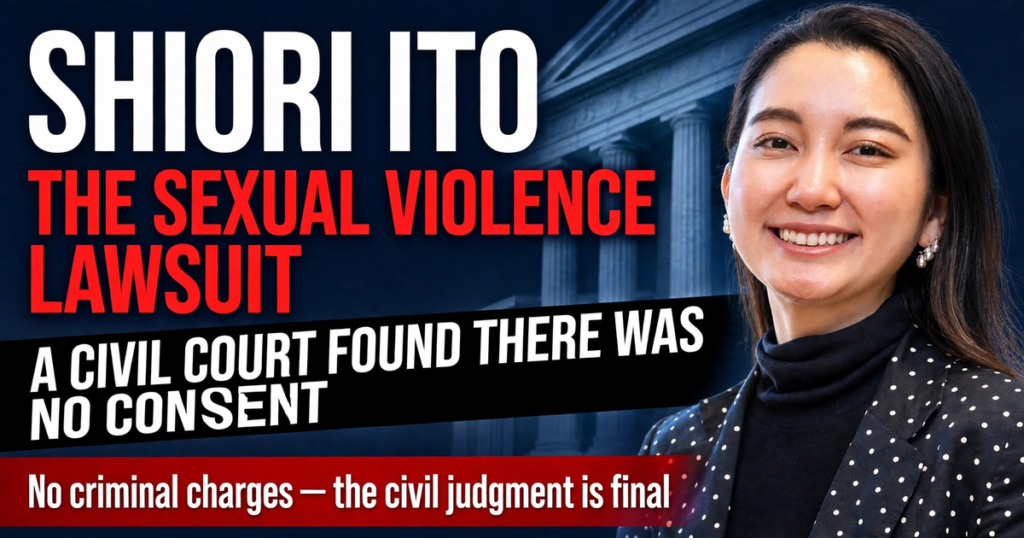
A meeting about work became the subject of legal proceedings
In April 2015, journalist Shiori Ito met Noriyuki Yamaguchi, a former TBS reporter, after seeking advice about employment and work in journalism. The two dined and drank together in Tokyo on 3 April. Ito later said that she became heavily intoxicated, lost parts of her memory, travelled with Yamaguchi by taxi to a hotel, and regained consciousness the following morning while sexual intercourse was taking place. She said that she had not consented. Yamaguchi consistently maintained that the sexual activity was consensual. Their accounts differed on the central issue of consent, and the later proceedings considered their statements and the surrounding records.
The criminal investigation ended without an indictment
Police investigated the allegation under the offence of quasi-forcible sexual intercourse as it was then defined in Japan’s Penal Code. The Tokyo District Public Prosecutors Office decided not to prosecute Yamaguchi in July 2016. In September 2017, the Tokyo Sixth Committee for the Inquest of Prosecution reviewed the decision and concluded that non-prosecution was appropriate. That review did not order prosecutors to bring charges. No criminal trial was held, and there was no criminal conviction or acquittal. A decision not to prosecute is a prosecutorial decision that prevents a criminal case from proceeding to trial; it is not a court’s finding that the alleged conduct did or did not occur.
Ito filed a civil damages action in 2017
In 2017, Ito filed a civil action seeking compensation from Yamaguchi. Civil litigation in Japan serves a different purpose from a criminal prosecution. The court was asked to decide whether a civil wrong had occurred and whether damages were owed, not whether the state should impose a criminal sentence. The parties’ accounts were considered alongside evidence concerning the restaurant, taxi journey, hotel, communications after the incident and medical records. Yamaguchi denied sexual violence and filed a counterclaim, seeking approximately ¥130 million in damages on the basis that Ito’s book and public statements had harmed his reputation. The case therefore involved two questions: whether the sexual act lacked consent and whether particular statements made by Ito were defamatory.
The Tokyo District Court found that the sexual act was not consensual
On 18 December 2019, the Tokyo District Court accepted Ito’s account on the central issue of consent. It considered her statements consistent on important points and compatible with objective material, including her condition after drinking, the taxi and hotel circumstances, her actions the following morning and consultations after the incident. The court found that Yamaguchi had engaged in sexual intercourse without Ito’s consent and ordered him to pay her ¥3.3 million. The first-instance court did not accept Yamaguchi’s counterclaim. Its decision was a civil finding of tort liability; it was not a criminal conviction and did not impose imprisonment or another criminal punishment.
The Tokyo High Court upheld the finding on consent
Both sides appealed. On 25 January 2022, the Tokyo High Court again found that the sexual act had taken place without Ito’s consent and increased the damages payable by Yamaguchi to approximately ¥3.32 million, including related expenses. The court considered the nature of the parties’ relationship before the meeting, their communications, the circumstances of the drinking and hotel visit, and the credibility of their accounts. It did not regard the evidence as showing that the two had been in an intimate relationship in which sexual activity could be assumed. The appellate judgment maintained the central civil finding made at first instance.
A separate finding concerned Ito’s statements about possible drugging
The High Court reached a different conclusion about a portion of Ito’s public statements. Ito had referred in her book and other accounts to the possibility that a drug had been used to render her unconscious. The court held that the available evidence was insufficient to establish that proposition as true. It found that the relevant expression defamed Yamaguchi and ordered Ito to pay him ¥550,000. This ruling concerned the evidentiary basis for a statement about possible drug use. It did not reverse the separate finding that the sexual act had occurred without Ito’s consent. The two damages awards addressed different alleged civil wrongs.
The Supreme Court rejected both appeals on 7 July 2022
Yamaguchi challenged the High Court’s finding of non-consensual sex and the damages awarded to Ito. Ito challenged the part of the judgment that required her to pay damages over the statements about possible drugging. On 7 July 2022, the First Petty Bench of the Supreme Court dismissed both appeals. The Tokyo High Court judgment consequently became final. Yamaguchi was required to pay Ito approximately ¥3.32 million, while Ito was required to pay Yamaguchi ¥550,000. The final civil outcome included both findings: non-consensual sexual intercourse giving rise to Yamaguchi’s liability, and defamation arising from the specific statement about possible drug use.
The criminal and civil outcomes must be described separately
The case is sometimes reduced to a contrast between criminal non-prosecution and a civil judgment. The more precise account is that criminal authorities did not bring charges, while civil courts examined liability under a different procedure and found that the sexual act lacked consent. The civil judgment did not make Yamaguchi a person criminally convicted of sexual assault. Conversely, the earlier non-prosecution did not prevent a civil court from reaching a finding of non-consent. Criminal proceedings may result in punishment; civil proceedings determine private legal responsibility and compensation. The two processes can reach different procedural outcomes without one automatically cancelling the other.
The final judgment contains two distinct legal conclusions
The final appellate judgment did not simply accept every statement made by either party. It upheld the finding about consent after reviewing the evidence surrounding the encounter, while separately finding that one category of public statement about drugging lacked sufficient proof and was defamatory. For readers outside Japan, it is important to distinguish a prosecutorial non-prosecution decision, a civil first-instance judgment, an appellate judgment and a Supreme Court dismissal of appeals. The criminal matter never proceeded to trial. The civil findings became final in July 2022, with separate compensation obligations imposed on both parties.
Original Japanese record: 伊藤詩織氏性暴行訴訟|刑事不起訴と、民事で確定した「同意のない性行為」
Last updated:
Related articles
Case record
The Bucky Video Production Case: Consent, Collective Violence and the Producer's Responsibility
Case record
The JR Shinjuku Station Groping Allegation: The Death of Shinsuke Harada and the Unresolved Criminal Allegation
Case record
The King of Comedy Kenichi Takahashi School-Uniform Theft Case: 182 Items, 25 Victims, and a Suspended Sentence
Case record