
The Oita Midoriso Case: An Acquittal After Hair Evidence and DNA Testing Were Reexamined
An 18-year-old junior-college student was murdered in an Oita apartment in 1981. Koshikake received a life sentence, but the Fukuoka High Court overturned it in 1995 after reconsidering a statement, hair evidence and DNA testing. The murder remains unresolved.
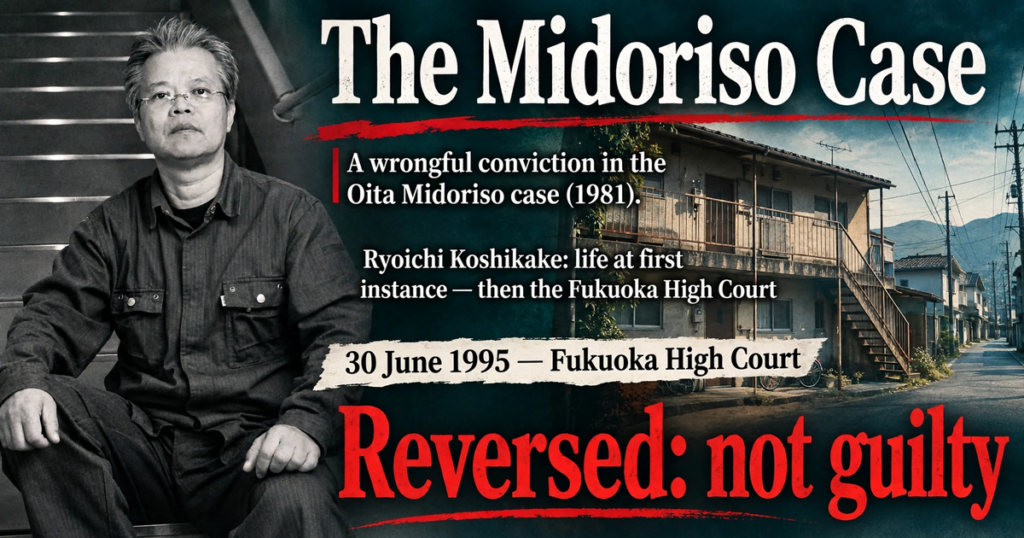
An 18-year-old student was killed in an apartment in June 1981
During the night of 27–28 June 1981, an 18-year-old female junior-college student was sexually assaulted and killed in her apartment in Oita City. The building was known as Midoriso. The investigation examined people living nearby, including Koshikake, who occupied the room next to the victim's. The case became a major wrongful-conviction controversy because Koshikake was arrested, prosecuted and sentenced to life imprisonment before the appellate court later overturned the conviction. The person who killed the student was never identified through a criminal trial. The case therefore has two separate outcomes: Koshikake's acquittal and the unresolved murder of the young woman.
Koshikake was arrested and indicted several months after the crime
Koshikake was 25 at the time of the offence. Police arrested him on 14 January 1982 on suspicion of rape and murder, and prosecutors indicted him on 15 March. He said that he had been drinking and had fallen asleep in his own room on the night of the crime. He also described contact with police and reporters after the death was discovered. During questioning, he made an adverse statement to the effect that he might have been in the victim's room, but he did not provide a clear, detailed confession to the assault and killing. The distinction between an incriminating statement and a full admission became important at trial.
The first trial relied heavily on hair evidence and the statement
The prosecution presented hair collected at the scene and an examination by the National Research Institute of Police Science. The District Court treated the hair analysis as an important link between Koshikake and the crime. It also gave weight to his statement about possibly having been in the victim's room. On 9 March 1989, the Oita District Court sentenced him to life imprisonment. The defence appealed, challenging whether the hair could truly be attributed to Koshikake and how much individual identification the scientific method could support. The case raised a broader evidentiary question: a forensic test may produce a result consistent with a suspect, but the court must still assess the sample, method and limits of the conclusion.
The Fukuoka High Court ordered DNA testing of the preserved material
In 1991, the Fukuoka High Court decided on its own initiative to conduct DNA testing on hair and bodily-fluid material preserved from the scene. It was among the early Japanese criminal cases in which a court itself adopted DNA testing as part of the evidentiary examination. Some of the hair produced a DNA result described as matching Koshikake. But a match did not automatically prove that the hair had come from him at the time of the crime. The defence questioned the hair's physical characteristics, its storage and the process by which the sample had been examined. The High Court concluded that the result was not sufficient to establish that the hair belonged to Koshikake.
The court also reconsidered the statement and the surrounding circumstances
The appellate judges did not evaluate the scientific evidence in isolation. They examined whether Koshikake's adverse statement could have been influenced by information supplied by investigators and whether it reflected an actual memory of being in the victim's room. They also considered the accounts of neighbours who heard sounds and voices, and whether those accounts fitted the prosecution's timeline. When the hair evidence, the statement and the surrounding circumstances were considered together, the prosecution's theory did not establish Koshikake's guilt beyond reasonable doubt. The case illustrates why a forensic label such as DNA match or hair identification cannot replace an examination of the sample's provenance and the limits of the test.
Koshikake was released on bail before the appellate judgment
On 1 August 1994, while the appeal was still pending, the Fukuoka High Court granted Koshikake bail. This was unusual in a serious murder case in which the defendant had already received a life sentence at first instance. By then, more than 12 years had passed since his arrest. Bail did not mean that the conviction had been overturned or that he had been acquitted. The appeal continued, and the court still had to issue its judgment. The distinction is important because a person can be released from detention while a criminal case remains unresolved on appeal.
The Fukuoka High Court overturned the conviction on 30 June 1995
On 30 June 1995, the Fukuoka High Court quashed the life sentence and acquitted Koshikake. It concluded that the statement, hair examination and DNA result did not prove that he had committed the crime. The Fukuoka High Public Prosecutors Office decided not to appeal, and the acquittal became final in July 1995. This was not a judgment that Koshikake was merely suspicious but had escaped conviction because of a technicality. It was a finding that the prosecution's evidence did not establish the charged facts. The court's conclusion concerned the defendant's guilt, not the identity of the actual killer.
The murder remained unsolved and the old limitation period expired
Koshikake's acquittal did not identify another suspect. No different person was indicted for the murder, and the statute of limitations applicable to murder at that time expired in June 1996. The case thus remained unresolved even though the wrongful conviction had been corrected. One lasting consequence was the attention given to early access to legal advice after arrest. The Oita Bar Association began Japan's first duty-attorney system on 14 September 1990, allowing an arrested person or family member to request an initial lawyer visit. The Midoriso Case was not the sole cause of that system, but the wrongful-conviction controversy formed part of the wider local movement to strengthen defence rights at the investigative stage.
Original Japanese record: 大分みどり荘事件|無期懲役を覆した毛髪・DNA鑑定と逆転無罪
Last updated:
Related articles

Case record
The TEPCO Employee Murder: An Acquittal, a Reversed Conviction and DNA Evidence That Led to a Retrial

Case record
The Matsukawa Railway Incident: Twenty Convictions Overturned and Three Deaths Still Unresolved
Case record
The Matsubase Case: A Confession Undone by a Surviving Piece of Cloth

Case record