The Myogi Foothills Serial Murders
Three men died in a sequence of crimes in Gunma Prefecture between December 1990 and July 1991. The final judgment convicted Misao Matsumoto of two murders and one offence of causing death by bodily injury, not three murders. His death sentence became final in 1998. He died of illness at the Tokyo Detention House on 8 April 2026; the sentence was not carried out.
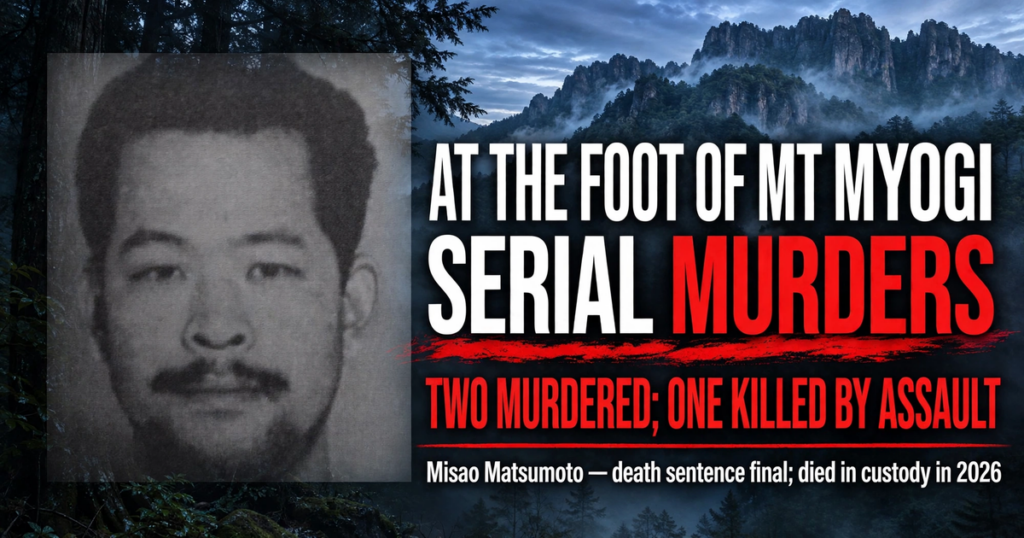
Three deaths occurred over a period of about seven months
The Myogi Foothills Serial Murders involved a series of crimes in Gunma Prefecture between 4 December 1990 and 6 July 1991. Three men died. The defendant, Misao Matsumoto, was convicted of murdering two of them and causing the death of the third through bodily injury. The distinction in the final judgment is important: the case is sometimes described by referring to three deaths, but the courts did not convict Matsumoto of three murders. The two murder counts concerned a man killed in December 1990 and a 28-year-old man killed in July 1991. The father of the latter was the third person who died.
The first killing arose from a dispute involving money
The first incident occurred on 4 December 1990. The victim was a 26-year-old man who had repeatedly asked a member of Matsumoto's group of acquaintances for loans. The Supreme Court judgment stated that Matsumoto and another person killed the man and buried his body in a mountainous area. Matsumoto was not the only person involved in the first killing. The court examined the participation of the other individual and the later concealment of the body as part of the same course of conduct. The remains were hidden in the mountains, delaying the discovery of the crime.
A stolen cash card led to the events involving a father and son
In 1991, Matsumoto stole a cash card belonging to another acquaintance. He and the person involved in the first killing used the card to withdraw 3 million yen from the account. The cardholder's father, aged 54, summoned Matsumoto and questioned him about the theft and the missing money. The Supreme Court treated this financial offence as the starting point for the later violence. The father did not simply disappear in an unrelated incident: he confronted Matsumoto about the stolen money, and the confrontation led to an assault that caused his death.
The father's death was classified as causing death by bodily injury
Matsumoto assaulted the father, striking him and causing injuries from which he died. The final judgment classified this offence as causing death by bodily injury, rather than murder. Under Japanese criminal law, the distinction matters because murder requires proof of intent to kill, while the offence of causing death by bodily injury concerns an assault or injury that results in death without the same finding of murderous intent. The fact that the father died does not change the legal classification used by the court. The case must therefore be described as involving two murders and one death caused by bodily injury.
The son was made to dig a grave and was then killed
The father's 28-year-old son was present during the events. According to the Supreme Court judgment, Matsumoto instructed him to dig a hole in which his father's body could be buried. While the son was digging, Matsumoto killed him with a shovel. The court found that the purpose of this second killing was to silence the son and prevent disclosure of the theft and the father's death. The father and son were buried in the same hole. The Supreme Court considered the killing of the son particularly serious because he was killed while carrying out the instruction to bury his own father.
The three deaths were not treated as three identical murders
The Supreme Court examined the two murder offences separately and treated the father's death as a distinct offence of causing death by bodily injury. The first murder arose from the earlier dispute involving repeated requests for loans. The second murder followed the theft of the cash card and the withdrawal of 3 million yen, when the father confronted Matsumoto and the son witnessed the events. The court did not collapse the three deaths into a single legal category. The difference between the two murders and the father's death was central to an accurate account of the charges and to understanding the judgment's reasoning.
The first-instance court imposed the death penalty
Matsumoto was arrested on 10 September 1991, aged 26. He was prosecuted for murder, causing death by bodily injury, theft and abandonment of bodies, among other offences. On 24 September 1993, the Maebashi District Court's Takasaki Branch sentenced him to death. The court treated the two murders and the overall course of offending as extremely serious, while maintaining the distinction that the father's death was not a murder conviction. The families of the father and son also pursued civil compensation, and a separate civil judgment reportedly ordered Matsumoto to pay 62.5 million yen. That civil proceeding was distinct from the criminal trial.
The Tokyo High Court and Supreme Court upheld the sentence
The Tokyo High Court dismissed Matsumoto's appeal on 29 September 1994. The Supreme Court's Third Petty Bench then reviewed the case. On 1 December 1998, it dismissed the final appeal and upheld the death sentence. The Supreme Court considered the motives, the methods used in the two murders, the fact that three people had died and the feelings of the victims' families. It also considered matters favourable to Matsumoto, including that he had shown remorse by the time of trial, had compensated the victim of the theft and had no previous conviction other than a fine. It nevertheless found his criminal responsibility exceptionally serious.
Matsumoto died in custody in 2026; the sentence was not executed
Matsumoto remained under a final death sentence for more than 27 years. On 8 April 2026, the Ministry of Justice announced that he had died at the Tokyo Detention House at the age of 61. Reports cited in the Japanese article said that he had complained of gastrointestinal bleeding in January and was diagnosed with liver cancer. Kyodo News reported that the illness was metastatic liver cancer and that the death was considered to have been from natural causes. The death sentence was not carried out. His detention ended because he died in custody, not because the sentence was executed or changed to another punishment.
Original Japanese record: 妙義山麓連続殺人事件|2人殺害・1人傷害致死、松本美佐雄の死刑確定と拘置中死亡
Last updated: