
The Murder of Second-Grader Tamao Omomo
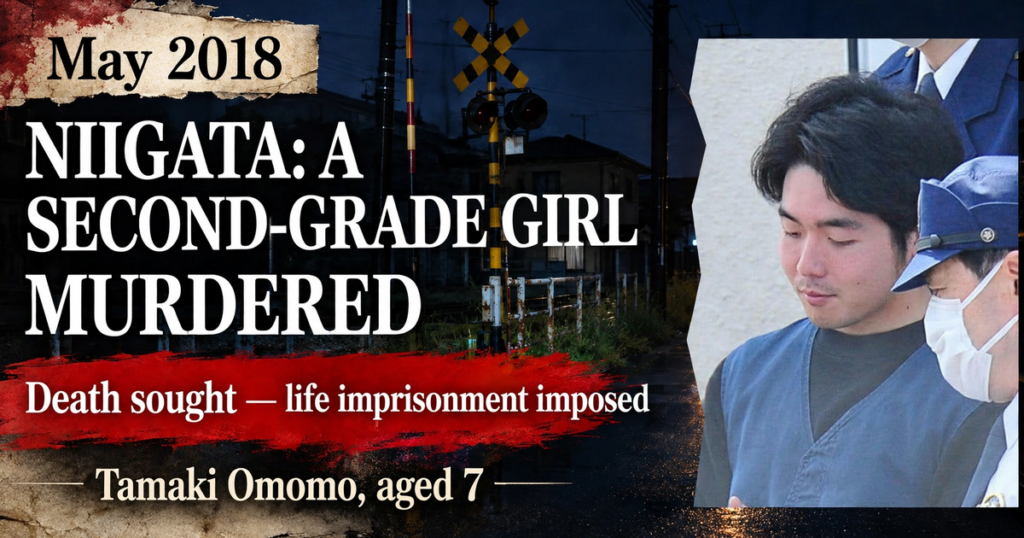
Seven-year-old Tamao Omomo disappeared while walking home from school in Niigata on 7 May 2018. Ryo Kobayashi was convicted of abducting and sexually assaulting her, killing her and placing her body on a railway line. Although prosecutors sought death, the final sentence was life imprisonment, which became final in December 2023.
A second-grade pupil disappeared on her way home
On the evening of 7 May 2018, seven-year-old Tamao Omomo, a second-grade elementary school pupil, disappeared while walking home from school in Nishi Ward, Niigata City. Her body was found later that night on the tracks of the JR Echigo Line. At first, the location of the body raised the possibility of a railway accident. A post-mortem examination and investigation showed that she had died before being struck by a train. The case was therefore treated as a homicide and an investigation began into the events between her disappearance and the discovery of her body.
The prosecution said she was abducted and sexually assaulted
Ryo Kobayashi, aged 23 at the time, lived in the neighbourhood and was identified as the offender. The court found that he encountered Tamao while driving a small passenger vehicle, took her into the car and abducted her for a sexual purpose. He committed a sexual assault in the vehicle and then compressed her neck, causing her death. The central issue at trial was not whether she had been killed, but whether Kobayashi had intended to kill her and how that intent had formed during the sequence of offences.
Her body was moved to the railway line after death
After Tamao died, Kobayashi took her body to his home and later placed it on the JR Echigo Line tracks. A train travelling in the 10 p.m. hour came into contact with the body. The placement exposed railway traffic to danger and formed part of the charges beyond murder. The investigation established that the train had not caused the original death. The body had been placed on the tracks after the fatal assault, so the railway incident was not the cause of death but a separate act that endangered rail operations and damaged the remains.
The first arrest was for disposal and damage to a body
On 14 May 2018, one week after the disappearance, police arrested Kobayashi on suspicion of abandoning and damaging a corpse. The first arrest was not for murder, even though police were already investigating the case as a homicide. He was later rearrested on suspicion of murder in June. The final indictment included several offences: abduction for the purpose of indecent conduct, the then-applicable offence of forcible indecency resulting in death, murder, abandonment and damage of a corpse, and endangering railway traffic. The initial arrest allegation and the final charges must not be treated as identical.
The case was reconstructed through cameras and vehicle information
Investigators examined security-camera footage near the route, witness information and vehicles that had travelled through the area. Kobayashi and his small car emerged as important leads. The fact that Tamao's body was found on the railway line did not mean the train had killed her. The forensic findings, scene examination and surrounding evidence redirected the investigation toward an abduction and homicide. The sequence also explains why the police initially arrested him for the handling of the body and only later added the murder allegation.
The prosecution sought death, while the defence disputed intent to kill
At the lay-judge trial, the prosecution argued that Kobayashi killed Tamao to prevent the sexual offence from being discovered and asked for the death penalty. The defence denied that he had formed an intent to kill, arguing that he had compressed her neck to make her lose consciousness rather than to cause death. The court had to consider whether he knew that the pressure could kill her and whether he accepted that risk. The timing and strength of the intent were especially important because the prosecution was seeking the most severe punishment.
The Niigata District Court imposed life imprisonment
On 4 December 2019, the Niigata District Court sentenced Kobayashi to life imprisonment. It found that he knew that compressing a child's neck carried a high risk of death and therefore had at least an indirect intent to kill. The court considered the victim's age, the abduction for sexual purposes and the placement of her body on the railway tracks. It did not, however, find that he had planned to kill her before the abduction. The killing developed during the course of the offences, and the court concluded that death was not unavoidable under the applicable sentencing principles.
Both the prosecution and defence appealed
Kobayashi appealed the finding of intent and the sentence. The prosecution also appealed because it had sought death and considered life imprisonment too lenient. The Tokyo High Court therefore had to consider both whether the murder conviction should stand and whether the sentence should be increased. A point of dispute was how long Kobayashi had compressed Tamao's neck. The prosecution argued that pressure continued after she lost consciousness and demonstrated a definite intent to kill. The defence argued for a shorter period and maintained that the purpose had been to make her faint.
The Tokyo High Court maintained the murder conviction and life sentence
On 17 March 2022, the Tokyo High Court dismissed both appeals. Based in part on the medical evidence, it found that pressure had been applied to Tamao's neck for at least three minutes. It concluded that Kobayashi had at least accepted the possibility that she would die. That was sufficient for murder, even though the court did not accept the prosecution's claim of a definite intention to kill in order to prevent discovery. The High Court also considered the conduct opportunistic rather than a murder planned from the outset and found that the death penalty was not unavoidable.
The Supreme Court made the life sentence final in December 2023
Kobayashi appealed to the Supreme Court after the High Court ruling. On 20 December 2023, the Supreme Court dismissed his appeal. The life sentence therefore became final. The result was not an acquittal and did not mean the courts had rejected intent to kill. Both levels of court found murder, but concluded that the degree and timing of the intent, the lack of an original plan to kill and the overall circumstances did not require a death sentence. Kobayashi is serving a final life sentence, not a death sentence.
The case also prompted a national school-route safety plan
On 22 June 2018, the government adopted a plan to improve safety for children travelling to and from school. Government materials identify the murder of a child walking home in Niigata in May as one of the events that prompted the plan. Measures included joint inspections of school routes, better information sharing between schools and police, more adults taking part in neighbourhood monitoring and so-called informal or everyday watching by people going about ordinary activities. The plan aimed to reduce gaps in supervision during the afternoon period when children are returning home.
Original Japanese record: 新潟小2女児殺害事件|大桃珠生さん殺害、死刑求刑から無期懲役確定まで
Last updated:
Related articles
Case record
The Kashiwa Serial Street Attacks
Case record
The Sumoto Five-Person Murders: From a Death Sentence to Life Imprisonment

Case record
The Uruma City Murder: Rina Shimabukuro's Killing, a Disputed Intent to Kill and a Life Sentence
Case record