
The Noda City Child Abuse Death: Mia Kurihara's Plea for Help and the Failure to Protect Her
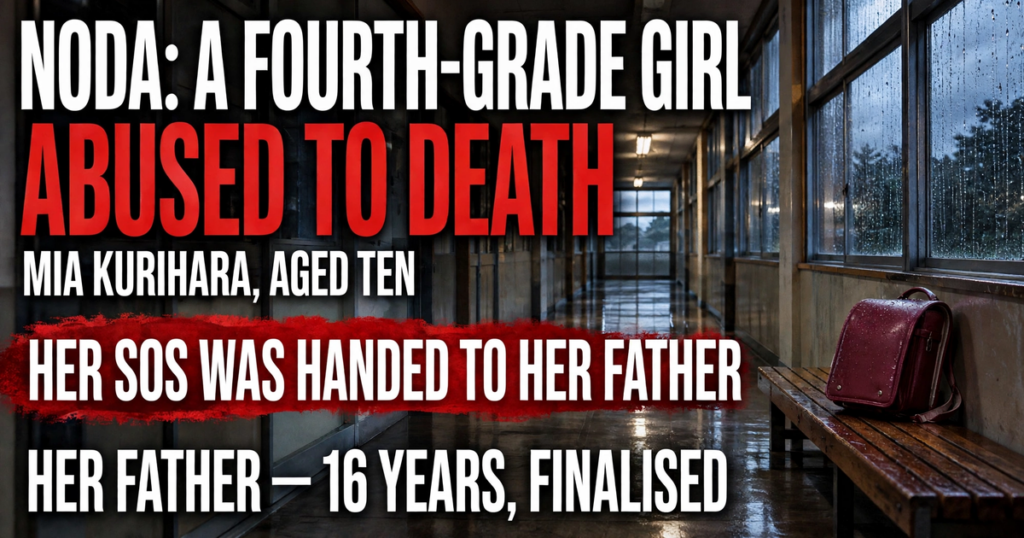
Ten-year-old Mia Kurihara died at her home in Noda, Chiba Prefecture, on January 24, 2019. A school questionnaire had recorded her plea for help, but a copy was handed to her father after he demanded it. The case exposed failures in the handling of information by the school, municipal education board and child-protection agencies. Her father received a 16-year prison sentence, which became final in March 2021; her mother received a separate suspended sentence for aiding the abuse.
A school questionnaire became a plea for protection
In November 2017, ten-year-old Mia Kurihara, a fourth-grade pupil in Noda, Chiba Prefecture, wrote in a school questionnaire that her father was hitting her. She asked a teacher for help. The school treated the response as a serious child-protection concern and passed information to the child guidance authorities. Mia was temporarily placed in protective custody. The questionnaire was intended to give children a safe way to report problems at home. Its value depended on keeping the child's disclosure from reaching the person accused of harming her.
The education board handed a copy to the father
Mia's father, Yuichiro Kurihara, demanded to see the questionnaire. In January 2018, the Noda City Board of Education provided him with a copy. The board later explained that staff had felt pressured by his strong demands and had not adequately checked the legal and child-protection implications before releasing the document. The decision exposed the child to a serious risk: information she had given in confidence to seek help was delivered to the adult she had identified as the source of violence. The later municipal review treated this disclosure as one of the central failures in the case.
Temporary protection did not end the need for monitoring
Mia was returned to her family after the temporary protective placement. That return did not establish that the risk had disappeared. The family situation, her father's response to professionals and the information held by the school and child-protection agencies still required careful assessment. As the family moved through school changes and periods of absence, direct checks on Mia's safety were not sustained at a level that matched the warning signs. The case later showed how a decision to return a child home must be accompanied by continuing contact, reassessment and a clear plan for responding if new concerns arise.
Abuse continued inside the home
The criminal proceedings later established that Mia had been subjected to repeated violence and controlling treatment. The abuse included physical assaults, prolonged periods of standing, and restrictions on food and sleep. These were not isolated disciplinary incidents. They formed a continuing pattern that affected her physical condition and her ability to seek help. Her mother, Nagisa Kurihara, was also in the household, but the court assessed her conduct separately from the father's role. The facts established in court, rather than speculation about what every family member knew at every moment, are the proper basis for describing the abuse.
Mia died on January 24, 2019
Mia died at the family home in Noda on January 24, 2019, aged ten. The death prompted criminal investigations and an examination of how several public institutions had handled earlier warnings. Noda's mayor issued an apology on January 30, saying that the city had failed to save her life. The city then began an independent review of the case. That review examined not only the actions of individual teachers and officials but also how information moved between the school, the municipal education board, the child guidance centre and other agencies responsible for protecting children.
The father received a 16-year prison sentence
Yuichiro Kurihara was prosecuted for causing injury resulting in death and related offences arising from the abuse. The Chiba District Court imposed a prison term of 16 years. He appealed, challenging the use of the school questionnaire and the credibility of evidence, as well as arguing that the sentence was excessive. On March 4, 2021, the Tokyo High Court dismissed the appeal and upheld the sentence. Neither side pursued a further appeal, and the 16-year term became final on March 19, 2021. This is the final criminal outcome for the father.
The mother's case was legally distinct
Nagisa Kurihara was not sentenced as though she had carried out the same acts as the father. Her case concerned aiding the injury inflicted by him. The court imposed a term of two years and six months, suspended for five years, with probation. The distinction matters: the father's conviction and 16-year term were based on his direct and leading role in the abuse, while the mother's liability was assessed under the separate offence and evidence relating to her conduct. The two outcomes should not be merged into a single sentence or described as identical findings of responsibility.
The administrative review examined how information was handled
The municipal review identified problems in the way the school questionnaire was disclosed, how officials responded to the father's demands and how the agencies shared information after Mia returned home. The issue was not simply that one office lacked knowledge. Different organisations held pieces of information, but those warnings were not brought together into a sufficiently clear assessment of immediate danger. The review also considered whether staff had a reliable escalation route when a parent challenged them aggressively. A child-protection system must not leave a frontline employee to make a high-risk disclosure decision alone.
The case became a warning about inter-agency responsibility
The Noda case, together with other child-abuse deaths, contributed to national discussion about protecting children whose families move between municipalities and about the authority of child-protection agencies. The 2019 amendments to the Child Abuse Prevention Act and the Child Welfare Act included a statutory prohibition on corporal punishment by parents and guardians, alongside measures intended to strengthen child guidance services and cooperation. The legal changes did not decide the facts of Mia's case retroactively. Their relevance is that the case exposed weaknesses in the practical protection of children, especially the need to keep disclosures confidential and to act on accumulated risk information.
Original Japanese record: 野田市小4女児虐待死事件|栗原心愛さんのSOSを父へ渡した行政対応、懲役16年確定まで
Last updated:
Related articles
Case record
The Murder of Le Thi Nhat Linh: A Nine-Year-Old Student, a Community Volunteer and a Life Sentence
Case record
The Kashiwa Serial Street Attacks
Case record
The Murder of 18-Year-Old Manae Noguchi
Case record