
The Kotobuki Maternity Home Case: 84 Suspected Deaths, 27 Murder Charges and Five Judicial Findings
The Kotobuki Maternity Home case came to light in Tokyo in January 1948, when police inquiries into the transport of infant remains led investigators to a facility that had taken in babies during and after the war. The numbers often repeated about the case refer to different stages of investigation and proof: 169 infants were reported as untraced, police considered 84 to have died, prosecutors charged 27 deaths as murder, and the Tokyo District Court found murder proved in five cases. The court convicted operator Miyuki Ishikawa and her husband Takeshi, but acquitted a female assistant. The first-instance sentences of eight and four years were reduced by the Tokyo High Court on April 28, 1952, to four and two years.
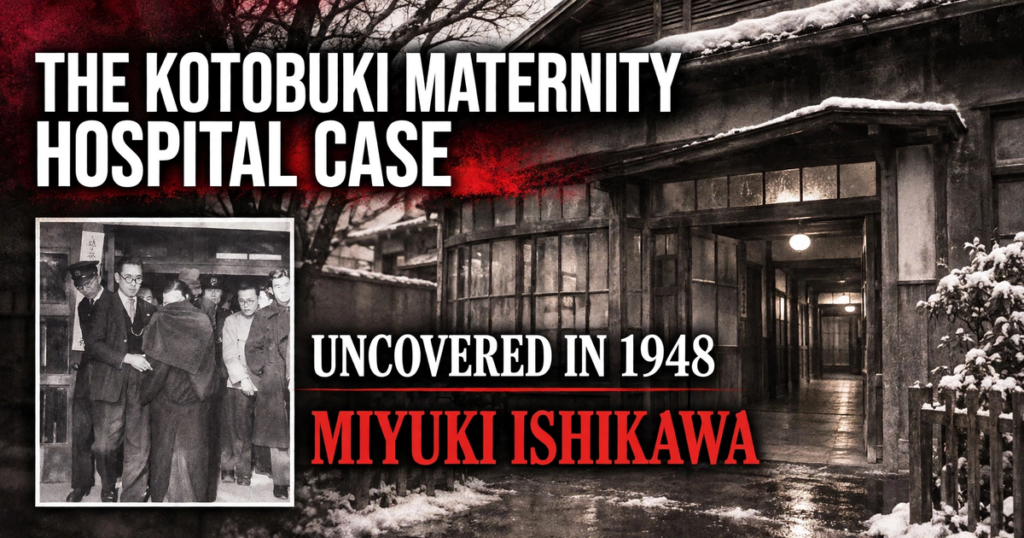
The facility was established to receive babies whose mothers could not raise them
Kotobuki Maternity Home was opened in 1943 as a “special maternity home,” a type of facility permitted under the system then in place. During the war and the difficult years after Japan's defeat, some mothers could not raise a baby themselves. The facility said that it would take infants into care and find homes for them. Reports described payments from mothers for childcare, with amounts ranging from 2,000 to 10,000 yen, and payments from people seeking to take in a child. Public child-welfare services were limited at the time, and demand for private infant-care facilities was high.
The first signs emerged from the transport of infant remains
The case became public in January 1948. Police questioned people involved in transporting infant remains and began investigating repeated deaths among babies who had been placed at Kotobuki. Later reporting described five infant bodies found in wooden boxes in the vehicle of a funeral-related worker who had been stopped on the road. The discovery did not begin with a complete list of all missing babies. Instead, one incident involving the movement of remains led police to examine the facility's wider history and the conditions in which infants had been kept.
Some infants were still alive when police inspected the facility
When investigators examined the maternity home, seven infants were reportedly still alive, although some were in a seriously malnourished condition. Two of those children later died. Reports described shortages of milk and food, as well as inadequate medical attention for babies who were ill or becoming weak. The issue was not confined to deaths that had occurred in the past. The children still inside the facility were also at immediate risk. Police therefore had to investigate both the history of deaths and the conditions of the infants who remained in care.
The numbers 169, 84, 27 and five describe different things
The case is often described through several large numbers, but they must not be treated as interchangeable. Reports referred to 169 infants whose whereabouts could not be traced. Police estimated that 84 had died. Prosecutors brought murder charges concerning 27 infants. The Tokyo District Court found murder proved in only five of those cases. It is inaccurate to say that 169 babies were murdered or that the court established 84 murders. The first figure concerns missing or untraced children, the second is a police estimate of deaths, the third is the number of deaths charged as murder and the fourth is the number judicially established as murder at first instance.
The prosecution alleged that inadequate care caused infants to die
The prosecution's case covered deaths between April 1946 and January 1948. It argued that the Ishikawa couple had accepted responsibility for infants but failed to provide sufficient nutrition and medical attention. The issue was not a series of direct assaults. It was whether caregivers who had a duty to protect the babies deliberately withheld essential care while recognising that the infants could die. Prosecutors sought fifteen years for Miyuki and seven years for Takeshi. The case required the court to examine the condition and circumstances of each infant separately rather than assume that every death at the facility had the same cause.
The Tokyo District Court found murder in five cases
The trial began at the Tokyo District Court on June 2, 1948. On October 11, the court did not accept the murder charge in all 27 cases. It found that the evidence was insufficient to establish murder in 22, but held that five infants had died after the couple failed to provide necessary care, including adequate nutrition. The court treated the failure to act as murder in those five cases. The legal issue was therefore one of omission: people responsible for protecting a life may incur criminal responsibility when they intentionally fail to provide essential care and that failure causes death.
A female assistant was acquitted because her role was different
A female assistant who worked at the facility was also tried. The Tokyo District Court acquitted her. Reports indicated that she had asked for more milk to be given to the infants and had taken steps intended to improve their condition. The court did not treat everyone who had worked at the maternity home as equally responsible. It examined who made decisions about the babies' care, who understood the danger and how each person acted. The assistant's acquittal is an important part of the record and should not be omitted when describing the trial.
The first-instance sentences were eight years and four years
For the five murders it found proved, the Tokyo District Court sentenced Miyuki Ishikawa to eight years in prison and Takeshi Ishikawa to four years. Those sentences were substantially below the prosecution's requests of fifteen and seven years. The difference between the 27 charges and the five murders proved was reflected in the court's assessment of the scope of criminal responsibility and punishment. The judgment did not establish that every infant who had disappeared from the facility had been killed by the defendants.
The Tokyo High Court reduced the sentences on April 28, 1952
On April 28, 1952, the Tokyo High Court reduced Miyuki's sentence to four years and Takeshi's to two years. The appellate judgment was maintained at the later appeal stage, and those became the final terms. The final outcome must therefore be distinguished from the first-instance sentences. The case is remembered for the shocking scale of infant deaths, but the criminal record is more specific: a police estimate of 84 deaths, 27 murder charges, five murders found proved at trial, an acquittal for the assistant and final prison terms of four and two years for the Ishikawa couple.
The case exposed the gap between social harm and what a criminal court could prove
Kotobuki Maternity Home illustrates the difficulty of investigating deaths among infants when records are incomplete and medical causes are hard to establish. The reported number of missing children and the police estimate of deaths conveyed the scale of the crisis, but the prosecution still had to prove criminal responsibility for each charged death. The five convictions did not mean that the other deaths were harmless or that the facility had provided adequate care. They meant that the court found the legal elements of murder proved in five cases. That distinction is essential to a reliable account of the case.
Original Japanese record: 寿産院事件|警察推計84人・起訴27人・裁判認定5人の違い
Last updated:
Related articles
Case record
The Meguro Child Abuse Death: Yua Funato, the Move from Kagawa and the Parents' Sentences

Case record
The Keio Line Stabbing and Train Fire: A Planned Mass Attack and Eleven Attempted-Murder Findings

Case record
The Mitaka Stalking Murder: A Twenty-Two-Year Sentence, a Retrial on Remand and Digital Abuse

Case record