
The Kochi White Police Motorcycle Collision: One Retrial Rejected, a Second in Preparation
On March 3, 2006, a police motorcycle collided with a school bus carrying 22 junior-high-school students and three teachers on National Route 56 in Haruno, Kochi Prefecture. The 26-year-old motorcycle officer later died. Bus driver Haruhiko Kataoka, aged 52, was prosecuted for professional negligence resulting in death. He maintained that the bus had stopped in the middle of the road and that the motorcycle struck it, while the prosecution argued that the bus was moving across the road. Kataoka received a prison sentence of one year and four months, which became final in 2008. His first retrial request was rejected through the Supreme Court in 2018; a second retrial was being prepared as of August 2026.
A school trip ended in a collision on National Route 56
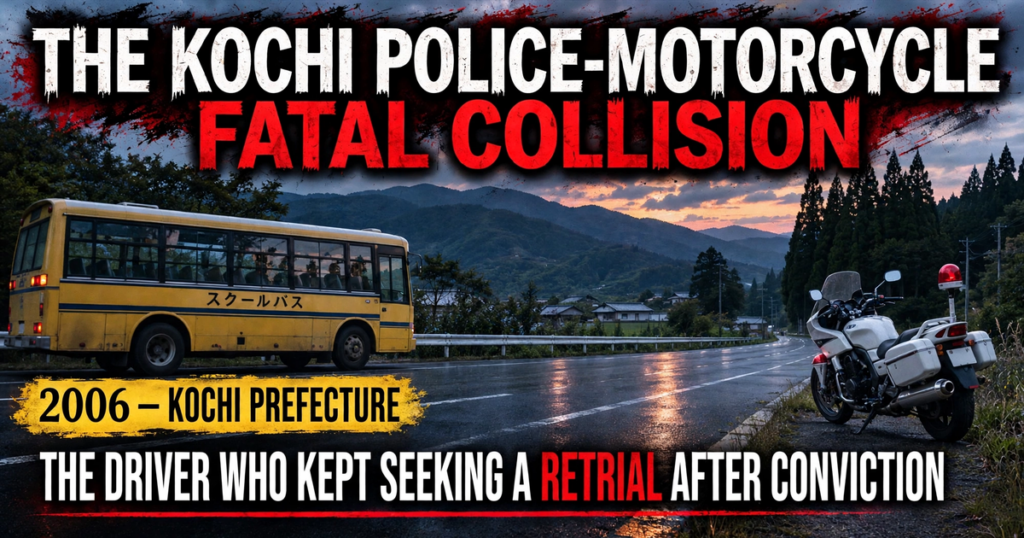
At about 2:34 p.m. on March 3, 2006, a school bus and a police motorcycle collided on National Route 56 in Hirooka-naka, in what was then Haruno Town, Kochi Prefecture. The bus was carrying 22 third-year students from a junior-high school in Niyodogawa Town, three teachers and the driver. The group was returning from a graduation excursion and was attempting to turn right out of a roadside facility's parking area. The motorcycle officer, a 26-year-old sergeant in the Kochi Prefectural Police Traffic Mobile Unit, suffered serious chest injuries and later died. No one on the bus was injured.
The prosecution said the bus crossed the road while moving
The prosecution argued that driver Haruhiko Kataoka had failed to check traffic approaching from his right before entering the national highway. It said the bus was travelling at approximately five to ten kilometres per hour while crossing the road when it struck the motorcycle. The Kochi District Court accepted the prosecution's account. It relied on tyre marks on the road, damage to the vehicles and the testimony of another motorcycle officer who said he had seen the bus moving. The court concluded that Kataoka had breached his duty to check for traffic from the right.
Kataoka consistently said the bus had stopped
Kataoka maintained that the bus had crossed the near lane and stopped around the centre of the road to allow traffic from the opposite direction to pass. In his account, the motorcycle then collided with the stationary bus. Students and teachers who were on the bus gave evidence to the effect that the vehicle had stopped before impact. A school-related witness travelling behind the bus also described it as stationary. The defence argued that these accounts should be weighed alongside the physical evidence rather than dismissed simply because they differed from the prosecution's reconstruction.
The tyre marks became a central point of dispute
One of the most important pieces of physical evidence was a dark tyre mark extending from near the bus's front wheel. Investigators said it was a braking mark produced when Kataoka applied the brakes after the collision. If the mark had been created during the accident, it supported the conclusion that the bus had been moving. Kataoka's defence questioned when and how the mark had appeared, arguing that it was not clearly visible immediately after the collision and that its appearance did not fit the alleged low speed. Experts later examined photographs, negatives and the physical characteristics of the mark.
Claims of fabricated evidence were allegations, not judicial findings
Kataoka's supporters and defence team argued that the tyre mark or photographs might have been altered or created after the collision. They submitted expert opinions and challenged the handling of the evidence. The courts, however, did not find that police officers had fabricated the mark or falsified photographs. In the first retrial proceedings, the Kochi District Court concluded that the new materials did not create a reasonable doubt that investigators had manufactured evidence. It is therefore necessary to describe the fabrication theory as a defence allegation, not as an established fact or a judicial finding of police misconduct.
The district court imposed a one-year-four-month prison sentence
On June 7, 2007, the Kochi District Court sentenced Kataoka to one year and four months in prison for professional negligence resulting in death. The prosecution had requested one year and eight months. Kataoka appealed, continuing to maintain that the bus was stationary. On October 30, 2007, the Takamatsu High Court dismissed the appeal. On August 20, 2008, the Supreme Court Second Petty Bench dismissed the final appeal, and the conviction became final. The Supreme Court proceeding did not reconstruct the entire accident as a new factual trial; its dismissal nevertheless left the lower courts' conviction in force.
Kataoka served the sentence and was released in February 2010
Kataoka entered prison on October 23, 2008, and served his sentence at Kakogawa Prison. He continued to deny that he had caused the collision. He was released after completing the sentence on February 23, 2010, after serving 488 days in custody according to the Japanese article. Completion of the sentence did not erase the conviction. Kataoka then pursued a retrial, arguing that new expert analysis and documentary evidence undermined the finding that the bus had been moving at the time of impact.
The first retrial request was rejected at all three levels
Kataoka filed his first retrial request at the Kochi District Court on October 18, 2010. The defence submitted new opinions about the formation of the tyre marks, the photographs and the movement of the bus. On December 16, 2014, the district court rejected the request. The Takamatsu High Court dismissed the immediate appeal on October 18, 2016, and the Supreme Court Third Petty Bench dismissed the special appeal on May 7, 2018. The first retrial proceedings therefore ended without a new trial, and the original conviction remained legally effective.
A rejected retrial request is not a new full trial of every disputed fact
The legal question in a retrial application is whether new evidence creates a sufficient basis to reopen a final judgment. The rejection of Kataoka's first application did not mean that a court had conducted a fresh, comprehensive reconstruction of the accident and declared every defence argument false. It meant that the courts did not find the new evidence sufficient to meet the legal threshold for a retrial. At the same time, the final conviction remains valid unless and until a retrial is granted and the judgment is changed. Both points must be stated together.
The second retrial was still being prepared in 2026
The Japanese article, updated on August 28, 2026, reported that Kataoka and his supporters were preparing a second retrial application. They were examining new technical opinions and materials with assistance from legal and engineering specialists. No second retrial commencement decision had been announced as of August 26, 2026. The present legal position recorded by the source is therefore that the conviction remains in force, while the defence continues to seek a new examination. The article does not establish that the skid marks were fabricated, that Kataoka was acquitted or that a second retrial had begun.
Original Japanese record: 高知白バイ衝突死事故|「バスは停止していた」主張とブレーキ痕、再審棄却後も続く検証
Last updated:
Related articles
Case record
The Uminonakamichi Bridge Crash: Three Children Killed and a 20-Year Sentence
Case record
The Expo Land Roller-Coaster Crash: A Fatigue-Cracked Axle, a Missed Inspection and Criminal Liability
Case record
The Ikebukuro Runaway-Car Crash: Two Deaths, a Five-Year Sentence and the Driver's Death in Custody
Case record