
The Kitami Wealthy Couple Murders
A 61-year-old man and his 56-year-old wife were killed at their home in Kitami, Hokkaido, on 21 October 1988. Their insurance agent, Yuji Kubota, staged an apparent suicide and evaded arrest for about 13 years before DNA evidence helped lead to his arrest. His death sentence became final, but he died in custody in 2023 without being executed.
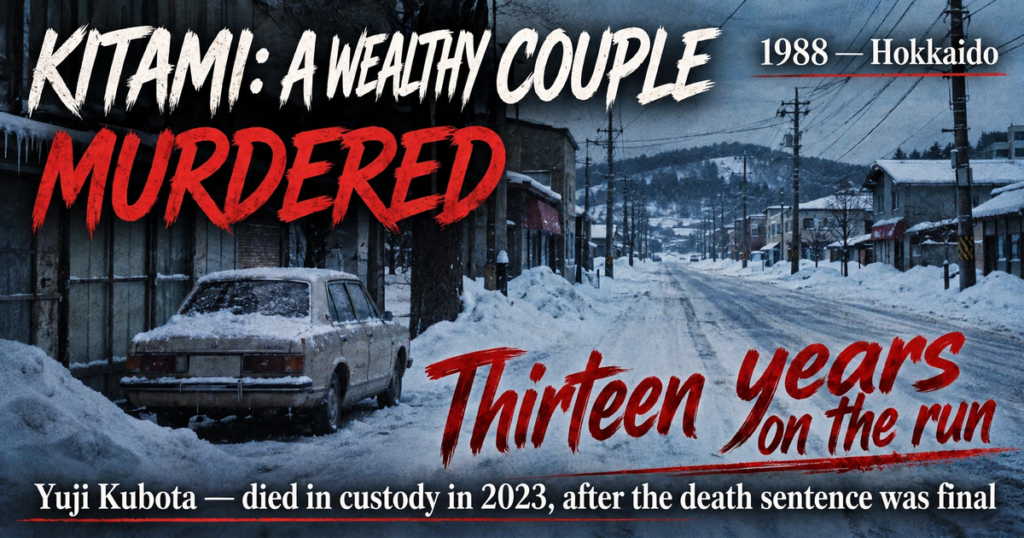
A client couple were killed by the insurance agent who handled their policies
On 21 October 1988, a 61-year-old man and his 56-year-old wife were killed at their home in Kitami, Hokkaido. The offender was not an unknown intruder. Yuji Kubota, then 43, worked as an insurance agent and handled the couple's policies. The Supreme Court later found that he had used false explanations to persuade the couple to enter into insurance contracts for which he expected substantial commissions. The husband had raised the possibility of cancelling a policy on the day before the murders. Kubota feared that the false explanations would be exposed and that earlier misconduct, including the misuse of premium money, would also come to light.
The court found that the murders were intended to silence the couple
The Supreme Court described Kubota's motive as preventing the discovery of insurance-related fraud and protecting his financial position. He had allegedly created fictitious insurance contracts to improve his sales results and had repeatedly misused premiums to keep the arrangements going. The couple's questions about their policy threatened to expose the scheme. The court found that Kubota decided to kill them to prevent that disclosure. The case was therefore not treated as a robbery by a stranger who happened upon a wealthy household. It involved a person who had access to the victims through a professional relationship and who sought to silence clients who might reveal his misconduct.
The victims were attacked with a screwdriver and a kitchen knife
The Japanese source identifies a flat-head screwdriver and a kitchen knife as the principal weapons. The wife sustained more than 60 stab and cut wounds, while the husband sustained approximately 20. The Supreme Court described the attacks as persistent and brutal. Kubota had selected a time when the husband was likely to be resting and brought a screwdriver with him when he visited. The court regarded these circumstances as evidence of planning. The number and nature of the wounds were relevant to the court's assessment of the seriousness of the murders and the appropriateness of the death sentence.
A blood trace became important after DNA technology advanced
Blood evidence remained at the scene. At the time of the murders, investigators did not immediately identify Kubota as the offender, although he was questioned voluntarily because of his connection with the couple. Years later, the preserved blood evidence was re-examined using DNA technology. Investigators compared the sample with material obtained from Kubota's relatives and strengthened their suspicion that the blood belonged to him. Material that could not provide a decisive answer with the methods available in 1988 acquired greater value as forensic techniques improved.
Kubota staged his own death and disappeared for about 13 years
In 1989, about a year after the murders, Kubota's car was found after it had gone into the water at Abashiri New Port. The scene appeared consistent with a suicide by driving into the sea, but no body was recovered. The Supreme Court later found that Kubota had staged his death and gone into hiding. He left Hokkaido, concealed his identity and lived under a different name. He eventually worked at a construction site in Yokohama. The period of flight is often described as approximately 13 years, measured from the staged disappearance in 1989 to his arrest in December 2002.
He was arrested in Yokohama shortly before the limitation period expired
By 2002, the investigation was approaching the then-applicable limitation period for murder. The source says that approximately ten months remained before the limitation period would expire. Hokkaido police re-examined the preserved evidence, obtained an arrest warrant in autumn 2002 and circulated Kubota as a wanted suspect. Public appeals for information were made through media coverage. A report from Yokohama suggested that a man resembling Kubota was working at a construction site. Police arrested him in Yokohama on 18 December 2002, about 14 years after the murders. The arrest followed both the forensic re-examination and information supplied by members of the public.
Kubota initially confessed but later claimed the case had been fabricated
After his arrest, Kubota initially admitted the crimes and accepted the charges at the opening of his first trial. During the proceedings, however, he changed his position and denied responsibility. He claimed that police had fabricated the case and had planted his blood at the scene, arguing that a sample taken from him at a hospital had been used. The courts rejected this account. They considered the blood evidence, the consistency between his statements and the scene, and his staged disappearance and prolonged flight. The Kushiro District Court's Kitami branch found him guilty and sentenced him to death on 2 March 2004.
The High Court and Supreme Court maintained the death sentence
On 1 December 2005, the Sapporo High Court dismissed Kubota's appeal and maintained the first-instance judgment. Kubota continued to deny the crimes and appealed to the Supreme Court. On 4 December 2009, the Supreme Court's Second Petty Bench dismissed the appeal. It found that the murders were planned to preserve economic benefits and prevent the discovery of fraud. The court also considered the time selected for the visit, the weapon carried and the extensive injuries inflicted on the couple. The death sentence became final. This was an appellate merits decision, not a sentence that became final through withdrawal of an appeal.
Original Japanese record: 北見市資産家夫婦殺人事件|窪田勇次の13年逃亡、死刑確定から収容中死亡まで
Last updated:
Related articles
Case record
The Hokkaido Government Office Bombing: Two Deaths, 95 Injuries and a Fourth Retrial Request
Case record
The Toyama–Nagano Serial Abduction and Murder Case: Two Victims, One Death Sentence and One Acquittal
Case record
The Tateyama Family Arson Murders
Case record