
The Attack on Prime Minister Kishida: A Homemade Explosive at a Campaign Event and a Final Ten-Year Sentence
A homemade explosive was thrown near Prime Minister Fumio Kishida during a campaign speech at Saikazaki Fishing Port in Wakayama on April 15, 2023. Kishida was unharmed, but a security officer and a member of the public were injured. Ryuji Kimura was convicted of attempted murder and related offences. The Supreme Court rejected his appeal on March 27, 2026, making his ten-year prison sentence final.
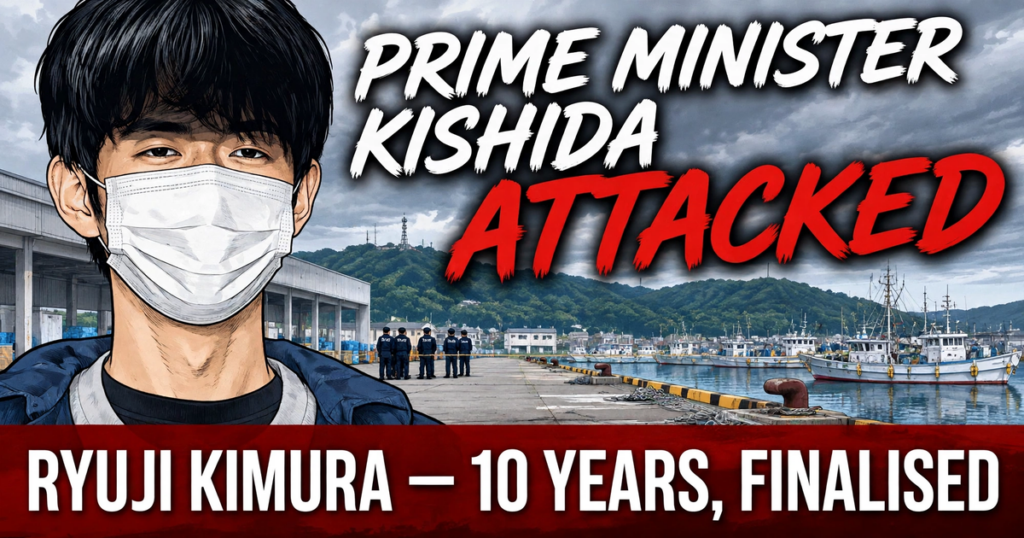
An explosive device was thrown at a campaign event
On April 15, 2023, an explosive device was thrown near Fumio Kishida, who was serving as Japan's prime minister, during a campaign speech at Saikazaki Fishing Port in Wakayama City. Kishida had travelled to the venue to support a candidate in a House of Representatives by-election. The device detonated after it was thrown into the area where the prime minister and members of the public had gathered. Kishida was moved away from the scene and was not injured. The explosion nevertheless injured a security officer and a member of the public. The absence of a fatality did not make the incident a minor offence: the device was used in a crowded public place, and the danger extended beyond the intended political target.
The scene was a public election venue, not a private confrontation
The event brought together politicians, campaign staff, police officers, journalists and members of the public. People had gathered to hear a speech as part of the by-election campaign. The attack therefore created an immediate risk to a group of people who had come to take part in an ordinary political activity. The fact that the target was a serving prime minister attracted national attention, but the injuries to people around him are also part of the record. The incident should not be described as though Kishida himself had been wounded, nor should the absence of a death obscure the risk created by detonating an explosive in the crowd.
Ryuji Kimura was restrained at the scene
Ryuji Kimura was restrained at the venue and arrested. Investigators examined the device, the circumstances in which it had been brought to the event and the way it was thrown. Kimura was later prosecuted for attempted murder and offences under the Explosives Control Punishment Act, among other charges. The case was not limited to the question of whether he had unlawfully possessed or used an explosive. The attempted-murder charge required the court to consider whether the act had been carried out with an awareness that it could cause death. The prosecution and defence disputed how the device's destructive capability and Kimura's understanding of that danger should be evaluated.
The trial examined the device's capacity to kill
The court considered the explosive's capacity to cause fatal injuries and the circumstances in which it was used. A person need not succeed in killing someone for attempted murder to be established. The relevant question included whether the defendant recognised that death could result and nevertheless carried out the act. This is often described in Japanese criminal law as dolus eventualis, or an acceptance of the possibility of death. The court concluded that Kimura understood that people near the device, including Kishida, could be killed. The judgment therefore treated the conduct as more than an attempt to frighten or disrupt a political meeting.
The Wakayama District Court imposed ten years in prison
In February 2025, the Wakayama District Court sentenced Kimura to ten years in prison. It accepted that the device had the potential to kill and that Kimura had acted with the necessary awareness of that possibility. The court also considered the anxiety and disruption caused by an attack at a public political event. The judgment did not determine whether Kimura's political views were right or wrong. It assessed the criminal conduct: bringing an explosive device to a campaign venue and throwing it into an area where people were present. The ten-year term was the first-instance sentence, and the defence challenged it.
The Osaka High Court upheld the first-instance judgment
In September 2025, the Osaka High Court rejected Kimura's appeal and upheld the ten-year sentence. The appellate court did not reduce the term or overturn the finding of attempted murder. At that point, however, the judgment was not yet final. Kimura's defence filed a further appeal to the Supreme Court, so the case continued beyond the second-instance decision. It is important to distinguish an appellate court's decision to maintain a sentence from the point at which the ordinary appeal process has ended.
The Supreme Court rejected the appeal in March 2026
The Supreme Court's Third Petty Bench rejected Kimura's appeal in a decision dated March 27, 2026. The decision was reported on March 30, and the ten-year prison sentence became final. The procedural sequence is therefore clear: ten years imposed by the Wakayama District Court in February 2025, upheld by the Osaka High Court in September 2025, and left in place when the Supreme Court rejected the appeal in March 2026. The sentence should not be described as merely pending or as a provisional first-instance outcome.
The injuries and the final sentence must be recorded accurately
Kishida escaped without injury, while one security officer and one member of the public were injured. No one was killed. Kimura was convicted of attempted murder and related explosives offences, and his ten-year sentence is final. These facts should remain distinct: the political importance of the target does not replace the evidence about the people actually injured, and the lack of a fatality does not negate the court's finding that the device was used with awareness of a lethal risk. The case is a serious attack on a public campaign event, with a final criminal judgment rather than an unresolved investigation.
The case concerns public safety as well as political security
Campaign events are designed to bring candidates and voters into close contact. Their openness is part of democratic participation, but it also creates a responsibility to protect people who attend. The attack demonstrated that a device thrown toward a political figure can endanger security personnel and bystanders at the same time. The criminal proceedings focused on the defendant's conduct and state of mind, not on the merits of any political position. A careful account therefore records the setting, the injuries, the legal findings and the final sentence without speculating about motives that were not established in court.
Original Japanese record: 岸田首相襲撃事件|和歌山の爆発物投げ込み、木村隆二の懲役10年確定まで
Last updated:
Related articles
Case record
The Shooting of Nagasaki Mayor Hitoshi Motoshima: A Political Assassination Attempt and a 12-Year Sentence
Case record
The Mishima Incident: A Balcony Appeal for Constitutional Change and the Trial of Three Tatenokai Members
Case record
The 1995 Tokyo Subway Sarin Attack: Victims, Criminal Trials and a Continuing Legacy
Case record