
The Shiratori Case: From a Police Inspector's Killing to the Landmark Retrial Decision 23 Years Later
In 1952, Sapporo police inspector Kazuo Shiratori was fatally shot. Kuniji Murakami's 20-year prison sentence became final in 1963. Although the Supreme Court rejected his retrial appeal in 1975, its Shiratori Decision established a reasonable-doubt standard that reshaped Japanese retrial practice.
Introduction: A conviction and a landmark retrial decision
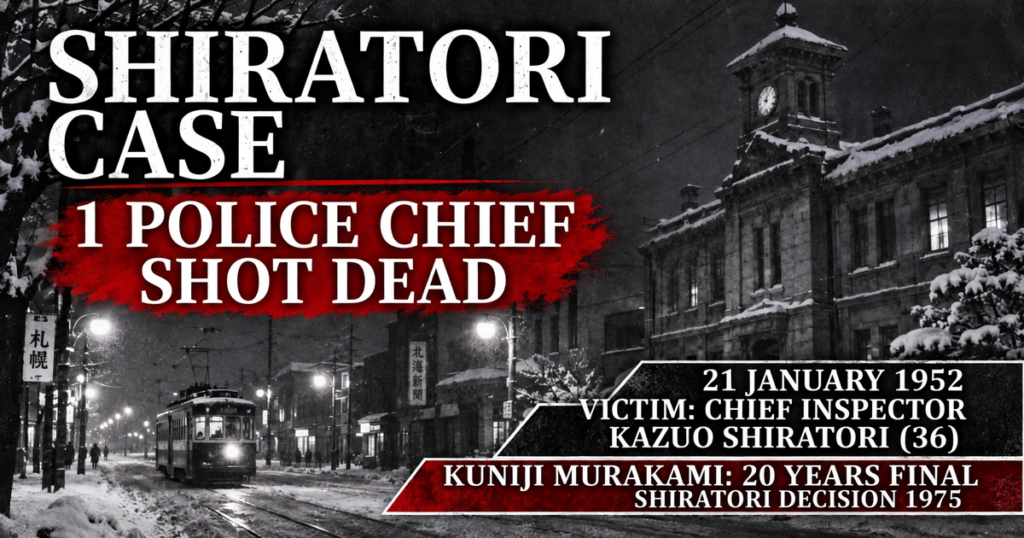
On the evening of 21 January 1952, Police Inspector Kazuo Shiratori, aged 36, was fatally shot on a street in Sapporo. The investigation turned toward the Sapporo organization of the Japanese Communist Party (JCP), which was then pursuing a policy of armed struggle. Kuniji Murakami, chairman of its city committee, was indicted for murder as a co-principal by conspiracy. A 20-year prison sentence ultimately became final, but Murakami maintained his innocence and continued to seek a retrial. The examination of bullets reportedly recovered from a site used for shooting practice became a central controversy over the basis for his conviction.
In 1975, 23 years after the killing, the Supreme Court dismissed Murakami's special appeal but explicitly held that the principle of resolving doubt in the defendant's favor also applied to retrial proceedings. Known as the Shiratori Decision, that ruling transformed subsequent retrial practice without overturning Murakami's own conviction.
The 1951 Programme and the Communist Party's turn to armed struggle
In October 1951, before the killing, the Japanese Communist Party adopted the so-called 1951 Programme and an armed military policy at its Fifth National Conference. The party was pursuing a course of armed struggle. In the Sapporo committee, chairman Kuniji Murakami and vice-chairman S formulated a military policy and organized a group known as the Core Self-Defense Corps (Chukaku Jieitai), composed principally of students from Hokkaido University and others. Incidents in Sapporo included the Red Lamp Incident, which disrupted railway operations, and the throwing of stones at the homes of a prosecutor and the mayor. Adoption of an armed policy did not, in itself, establish involvement in a particular killing. Evidence supporting Murakami's specific intentions and conduct was required.
Police Inspector Shiratori was killed on his way home at the age of 36
Kazuo Shiratori was born in Memuro, Hokkaido. After graduating from Obihiro Middle School, he became a police constable in the Hokkaido prefectural administration in 1937. In March 1948, he was appointed chief of the Security Section of the Sapporo Municipal Police and was involved in the arrest of Communist Party members. He had also halted an exhibition of the Hiroshima Panels, known in Japanese as Genbaku no Zu, at the Marui Imai department store, further deepening tensions with people associated with the party. Threatening letters had reached him before the incident.
On the evening of 21 January 1952, Shiratori was cycling home when a man approaching from behind on another bicycle shot him on a street in South 6 West 16, Sapporo. The bullet struck his heart, and he died from severe blood loss. The man fled on a bicycle. Examination of the bullet recovered from Shiratori's body and a cartridge case found at the scene led investigators to identify the probable weapon as a .32-caliber Browning pistol, although the firearm itself was never recovered. Later proceedings scrutinized the evidence by which investigators linked instructions within the organization to the actions alleged to have followed.
Leaflets distributed after the killing increased suspicion of party involvement
Soon after the incident, leaflets issued in the name of the JCP Sapporo Committee circulated in the city. Known as tenchu leaflets, invoking the idea of punishment from heaven, they sought to justify and praise Shiratori's death in political terms. On 23 January, M, a member of the party's Hokkaido regional committee, issued a statement denying involvement. A statement on 24 January, by contrast, praised the act while leaving the party's involvement ambiguous.
In his policy address on 22 January, Prime Minister Shigeru Yoshida referred to subversive activities by communist elements. The Subversive Activities Prevention Act was passed on 3 July and promulgated and brought into force on 21 July 1952 as Act No. 240 of 1952. The law provides for controls on organizations involved in violent subversive activities and related criminal provisions. In the 25th general election for the House of Representatives in October of the same year, the JCP lost all its seats.
Statements by vice-chairman S and others directed the investigation toward Murakami
S, the Sapporo committee's vice-chairman, was arrested on 28 August 1952 and began making statements on 28 November. He described chairman Murakami as the underground organization's highest leader and identified a man known as Hiro, from the Maruyama party cell, as the alleged perpetrator. Hiro was identified as such in the investigation; that designation did not constitute a judicial determination of his own actions. Murakami had already been arrested on 1 October 1952 while campaigning in the street during the election.
Yasuyoshi Oidaira was arrested on 9 April 1953, and his written account of his statements was treated as material supporting the investigators' theory. T, another alleged participant, was arrested on 9 June 1953. After persuasion by prosecutor Haruo Abe, T renounced his former political allegiance on 11 July. T stated that seven people, including Murakami, had gathered and conspired to kill Inspector Shiratori.
Prosecutors combined statements from several people to construct a case that Murakami had led the planning, although someone else was alleged to have carried out the shooting. Murakami maintained his innocence. The central question under the Japanese doctrine of co-principal liability by conspiracy was therefore not whether he had fired the shot himself, but whether he could be found to have known of the plan and shared the criminal intent of the other participants. Under that doctrine, a person may be liable as a principal for a jointly agreed crime even without personally performing its physical act.
A letter from prison formed part of the case for conspiracy-based co-principal liability
On 23 June 1953, Murakami, then in custody, reportedly sent a written communication through a lawyer instructing that members of the alleged perpetrator group be sent abroad. Police authorities seized the document on 8 July. Investigators and the courts treated it as material indicating the movements of people connected with the case after the killing.
On 16 August 1955, prosecutors indicted Murakami for murder as a co-principal by conspiracy and two other defendants for aiding and abetting murder. The prosecution's principal allegation was that Murakami and others had undertaken shooting practice in connection with armed activities and had conspired to kill Shiratori. No firearm had been recovered at the scene, and the man identified in the investigation as Hiro did not appear before the court. Statements by people associated with the case and forensic examination of the bullets consequently became the main pillars of the prosecution's case.
Bullets Nos. 207 and 208 from Horomi Pass were treated as a link to the killing
Two bullets, numbered 207 and 208, were emphasized at trial as direct physical evidence. They were described as remnants of shooting practice allegedly conducted at Horomi Pass. The examination compared the striations, or fine surface marks left by a firearm, on those bullets with the marks on bullet No. 206, which had been removed from Shiratori's body.
For the prosecution, the significance of the comparison lay in establishing a physical link between the killing in Sapporo and the alleged practice site at Horomi Pass. Without a sufficiently established connection, statements about shooting practice would provide less support for the proposition that a firearm used there had also been used to kill Shiratori. As the firearm itself had not been found, the comparison served an important evidentiary function for the prosecution, while the limits of the examinations also directly affected its case.
The official forensic examinations and the prosecution's expert report reached different conclusions
A forensic report dated 4 September 1953, issued by the Scientific Investigation Research Institute (firearms examination report No. 759), concluded that the bullets compared could not immediately be determined to have been fired from the same firearm. Another report, dated 30 July 1954 (firearms examination report No. 979), recorded that the examiners had not found sufficiently similar firing-mark characteristics to establish a common firearm. Thus the official forensic examinations had not established that the bullets came from the same weapon.
In contrast, an expert report dated 1 November 1955, submitted by the prosecution under the name of University of Tokyo professor Takashi Isobe, argued that the probability of matching striations would be extremely small if the bullets had been fired from different firearms. At trial, this report was used as scientific material supporting the statements.
During questioning on 21 November 1967, however, Isobe testified that he was not a specialist in bullet examination and that he had entrusted the examination to Sergeant Major G of the U.S. military's Far East Criminal Investigation Laboratory. The discrepancy between the person named on the report and the person who actually conducted the work directly affected the extent to which the examination procedures and grounds for its conclusions could be verified.
A life sentence was reduced to 20 years and became final at the Supreme Court
On 7 May 1957, the Sapporo District Court found that a joint conspiracy had been established. It sentenced Murakami to life imprisonment and another defendant to five years' imprisonment, suspended for five years. T, whose proceedings had been separated, was sentenced on 8 May to three years' imprisonment, suspended for three years; that judgment became final. A suspended sentence in Japan permits the prison term not to be enforced if the relevant legal conditions are met during the suspension period.
In 1960, the Sapporo High Court reduced Murakami's sentence to 20 years' imprisonment and dismissed the other defendant's appeal. On 17 October 1963, the First Petty Bench of the Supreme Court dismissed the final appeal, making Murakami's 20-year sentence final. The judgment is recorded as case 1960 (A) No. 1378 (Showa 35 (a) No. 1378), in Keishu, the Supreme Court's published criminal case reports, volume 17, number 10, page 1795.
The ordinary three-level court process had ended, but Murakami continued to maintain his innocence. Doubts about the bullet examination alone did not necessarily invalidate the entire finding of guilt. Conversely, reduced reliability of the physical evidence that was thought to corroborate statements provided grounds for reconsidering the weight given to those statements. This relationship became a central issue in the retrial proceedings.
The retrial proceedings acknowledged a substantial decline in the bullets' evidentiary value
Murakami filed a petition for retrial with the Sapporo High Court on 21 October 1965. A retrial is an extraordinary procedure for reopening a criminal case after its judgment has become final. The Japanese Communist Party collected signatures calling for a retrial at the Supreme Court, reaching 1.1 million signatories. The petition focused on the reliability of the bullet examinations and the statements that had supported the final judgment.
On 18 June 1969, the Sapporo High Court acknowledged that the evidentiary value of the bullets had substantially diminished but dismissed the petition, finding, among other things, that the evidence still clearly established facts connecting Murakami to the case. The court distinguished a reduction in the weight of particular physical evidence from the question of whether the finding of guilt could be sustained on the evidence as a whole. Its acceptance of part of the argument concerning the bullets did not lead to the opening of a retrial.
Murakami's side lodged an objection, which was also rejected, and proceeded to a special appeal to the Supreme Court. Meanwhile, on 14 November 1969, Murakami was released on parole, with nearly half of his prison term remaining. Parole means conditional release before the completion of a sentence; it does not invalidate the conviction. The evidentiary threshold for reopening a case in which a guilty judgment had become final was left for the Supreme Court to address.
The 1975 Shiratori Decision applied the principle of reasonable doubt to retrial proceedings
On 20 May 1975, the First Petty Bench of the Supreme Court unanimously dismissed Murakami's special appeal, an extraordinary challenge to a court ruling rather than another ordinary appeal against conviction. The presiding justice was Yasuo Kishigami; the other justices were Ekizo Fujibayashi, Takeso Shimoda, Seiichi Kishi and Shigemitsu Dando. The decision is recorded as 1971 (Shi) No. 67 (Showa 46 (shi) No. 67), Keishu, volume 29, number 5, page 177. It did not authorize a retrial for Murakami or set aside his final guilty judgment.
The Supreme Court nevertheless explained the meaning of the clear evidence warranting acquittal referred to in Article 435, item (vi), of the Code of Criminal Procedure. Such evidence must raise reasonable doubt about the factual findings of the final judgment and have sufficient potential to overturn them. Instead of assessing the newly presented evidence in isolation, the court required an evaluation of it together with all the other evidence, including evidence used in the original final judgment. The inquiry was whether the court would still have reached the same factual findings had the new evidence been before it at the time.
The Supreme Court further held that the fundamental rule of criminal adjudication, that doubt is to be resolved in the defendant's favor (in dubio pro reo), applied when determining whether the new evidence met this threshold. Its legal importance lay in rejecting the idea that an applicant had to establish innocence with certainty before a retrial could be opened. Yet even after applying that standard in this particular case, the Supreme Court did not authorize a retrial. The shift in legal doctrine and the outcome of Murakami's own case were different.
The doctrine of the Shiratori Decision led to later retrial acquittals, including the Saitagawa Case
Previously, the retrial system had demanded a high degree of probability strongly indicating innocence before a final guilty finding could be overturned, making the opening of a retrial extremely difficult. The Shiratori Decision established reasonable doubt concerning the factual basis of a guilty judgment as the standard and provided for the combined evaluation of new and previously considered evidence.
The Supreme Court carried this approach forward in its decision of 12 October 1976 in the Saitagawa Case. In the 1980s, a succession of retrial acquittals followed in the Menda Case, the Saitagawa Case, the Matsuyama Case, the Shimada Case and the Tokushima Radio Shop Murder. The Saitagawa and Shimada cases, in particular, are related examples in which retrials ultimately resulted in acquittals. In both, the approach to retrial adjudication following the Shiratori Decision led to actual judicial relief.
Wrongful-conviction theories and later accounts of party involvement offer different explanations
Explanations of the case have included claims that Murakami was wrongfully convicted, questioning the investigation and the bullet evidence. Seicho Matsumoto's book Nihon no Kuroi Kiri (Black Fog over Japan) also presented a theory of a conspiracy by the U.S. military. That theory was one interpretation of the incident, not a conspiracy established as fact. The doubts surrounding the bullet examination were significant, but did not in themselves prove that another particular group committed the killing.
Other, later accounts suggested involvement by party members. In a memoir published in 1998 and in an interview with the Hokkaido Shimbun, Yoshio Kawaguchi made statements to the effect that the killing was committed by party members rather than being a conspiracy against the party. T, one of the defendants, stated in 2012 that the Core Self-Defense Corps had indeed been advancing the plan, and apologized to Inspector Shiratori's bereaved family. People associated with the case, including the man identified in the investigation as Hiro, reportedly fled to the People's Republic of China. Hiro and another person reportedly died of illness in Beijing in 1988. Another person associated with the case, Tsuruta (鶴田倫也), died in Beijing on 14 March 2012.
Murakami's conviction remained in place, but the case left a lasting standard for retrial decisions
Kuniji Murakami continued to maintain his innocence after his release on parole, but no retrial was opened. On 3 November 1994, he died in a fire at his home in Omiya, Saitama Prefecture (now part of Saitama City), aged 71.
In the Shiratori Case, even after the forensic examination of physical evidence had been called into question, the courts evaluated the remaining evidence together and maintained the finding of guilt. At the same time, the Supreme Court articulated the principle that the way to a retrial must be open when reasonable doubt is raised about the factual findings of a final judgment. The Shiratori Decision, delivered 23 years after the fatal shooting, became a lasting precedent for Japan's retrial system without changing the death of the victim or the refusal to reopen Murakami's case. The outcome of the individual proceedings and the influence of their legal doctrine endured in different ways.
At a glance
Case: Shiratori Case (killing of Police Inspector Shiratori). Date: Monday evening, 21 January 1952. Location: A street at South 6 West 16, Sapporo, now Chuo Ward, Sapporo, Hokkaido. Victim: Kazuo Shiratori, 36, chief of the Security Section of the Sapporo Municipal Police; deceased. Weapon: A handgun, believed to have been a .32-caliber Browning pistol; the firearm itself was never found. Principal defendant: Kuniji Murakami, indicted for murder as a co-principal by conspiracy; two other defendants were charged as accessories. Final judgment: Murakami received 20 years' imprisonment. The Supreme Court dismissed his appeal on 17 October 1963. Retrial outcome: The Supreme Court dismissed his special appeal on 20 May 1975. No retrial was opened and no acquittal followed. Related precedent: Shiratori Decision, First Petty Bench of the Supreme Court, 1971 (Shi) No. 67.
Original Japanese record: 白鳥事件|警部射殺から「白鳥決定」へ、再審の扉を開いた23年
Last updated:
Related articles
Case record
The Eniwa Office Worker Murder: A Circumstantial-Evidence Conviction and Two Rejected Retrial Requests
Case record
The Sapporo Credit Union Employee Murder: Michie Namai and the Civil Judgments
Case record
The Sapporo Toyohira Taxi Driver Robbery-Murder: A Case Still Unsolved

Case record