
The Kawaguchi Serial Home-Invasion and Sexual-Robbery Case: Escalation Over Two Years and Eight Months and the Life Sentence
Between February 2005 and October 2007, Tatsuya Kiyota carried out a series of home intrusions in the Kawaguchi area. The final incident involved the killing of Saori Watanabe, and the offences included a ¥945,000 withdrawal from a victim's account. The prosecution also sought life imprisonment. On 12 November 2008, the Saitama District Court imposed a life sentence; the later appeal history remains separately stated.
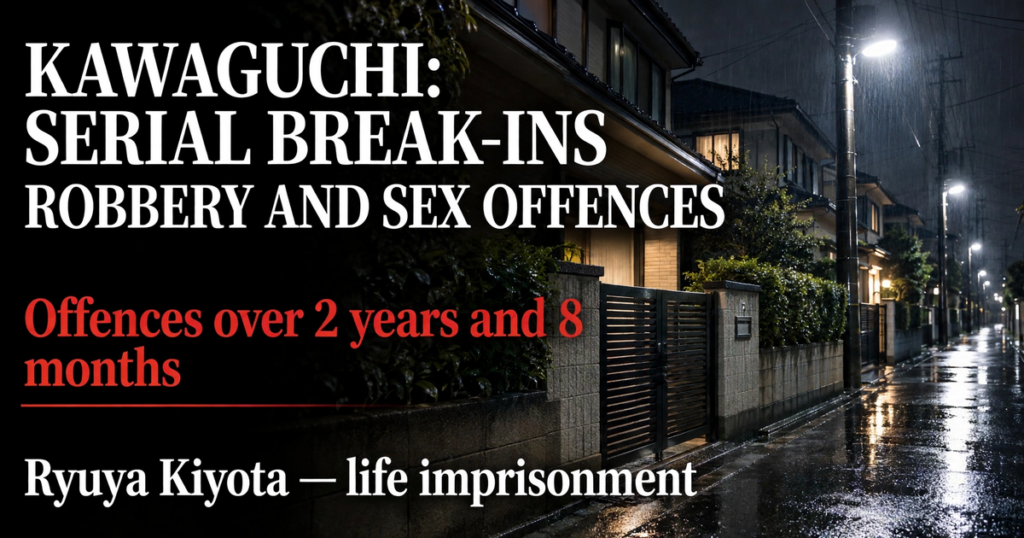
A series of intrusions over two years and eight months
The Kawaguchi case involved a sequence of offences committed between 11 February 2005 and 30 October 2007 by the defendant, Tatsuya Kiyota. The period of two years and eight months is important because the conduct did not begin with the final homicide. Earlier incidents involved entering homes, sexual violence and taking property. The later crimes became more serious, culminating in the killing of a woman in her home. The sequence shows escalation in the level of violence, but each incident still has to be described separately. A later murder does not retroactively turn every earlier intrusion into a murder, and the number of victims or charges must not be inflated by merging separate events.
The first reported offence in February 2005
The first incident in the court record occurred on 11 February 2005. The defendant entered a residence and committed sexual violence against a woman, taking property in the course of the offence. The case was treated by the court as a robbery and sexual offence. The home setting and the use of force were central to the victim's loss of safety. The court's findings are the proper basis for describing the conduct; details that are not necessary to explain the legal issues should be omitted rather than embellished.
Further intrusions and an attempted robbery in 2006
The next phase included incidents in September 2006. On 22 September, the defendant entered a home and stole cash, bank cards and other property. On 24 September he entered another residence using a key taken in the earlier burglary and attempted to rob a 51-year-old woman. She resisted and the attempted robbery failed. These offences were separate from the later homicide and should not be collapsed into a single continuous event. Their significance lies in repeated targeting of residences and the defendant's willingness to use threats or violence to obtain property.
The July 2007 offence showed a further escalation
On 26 July 2007, the defendant committed another home-invasion offence involving sexual violence and robbery. The court found that he entered a residence, threatened and restrained a 28-year-old woman, took cash and bank cards, and later sexually assaulted her while she was unable to resist. He then used the stolen cards to withdraw money. Two ATM transactions totalled ¥945,000. The court examined the similarities between the incidents but did not rely on a vague claim that all offences were identical. The evidence had to establish what happened on each date and how the defendant was connected to it.
The final incident on 30 October 2007 ended in murder
The final incident occurred on 30 October 2007. Saori Watanabe, a 26-year-old woman, was attacked in her residence and killed. The defendant entered through an unlocked window, threatened and restrained her, and took cash, cards and identity documents. The court found that he compressed her neck and upper chest with sustained force, causing death by asphyxiation. The case moved beyond robbery and sexual violence into homicide. The victim's death was treated as murder in the judgment, rather than merely as an injury caused during a theft.
The investigation connected the incidents to one defendant
Investigators examined similarities among the home entries, the locations, the victims' accounts and the property taken. The court's judgment addressed the defendant's acts and the legal elements of robbery, sexual offences and murder. It also examined whether the defendant intended to kill the final victim, as he argued that he only meant to silence her. The court rejected that claim based on the sustained pressure applied to her neck and upper chest. The English draft follows the judgment's sequence and avoids adding unsourced victims, dates or alleged offences beyond those identified in the Japanese source.
The district court imposed life imprisonment
On 12 November 2008, the Saitama District Court sentenced the defendant to life imprisonment, as the prosecution had requested. The sentence reflected the seriousness of the final murder and the broader sequence of violent offences. Life imprisonment is not a fixed term of years. Under Japanese practice, a person sentenced to life imprisonment remains incarcerated indefinitely unless released under the applicable parole system; parole is not automatic. The court's decision should be described as a district-court sentence. The materials checked for this draft did not establish a later appellate ruling with sufficient certainty, so the English text does not invent a date for finality or claim that the Supreme Court affirmed the sentence.
Why the legal stages are kept separate
The case title refers to a life sentence, but the words “life sentence” and “final judgment” do not mean the same thing. A district court may impose a sentence, after which the defendant or prosecutor may appeal. If an appeal is filed, the appellate court may affirm, change or reverse the judgment. If no appeal is filed, the judgment becomes final after the relevant period. The sources reviewed establish the 12 November 2008 sentence, but not the full appeal history. That limitation is stated openly. The case is therefore presented as a life sentence imposed by the Saitama District Court, with finality left unasserted until an appellate record is located.
Original Japanese record: 川口連続侵入・強盗性犯罪事件|2年8か月で強盗殺人へ悪質化、無期懲役を選んだ判決理由
Last updated:
Related articles
Case record
The Ibaraki University Student Murder: DNA Evidence, Two Life Sentences and a Third Suspect Still Sought
Case record
The Tsuyama Third-Grade Girl Murder: A Fourteen-Year Investigation and a Final Life Sentence

Case record
The Attacks on Former Health Ministry Officials' Residences

Case record