
The Tsuyama Third-Grade Girl Murder: A Fourteen-Year Investigation and a Final Life Sentence
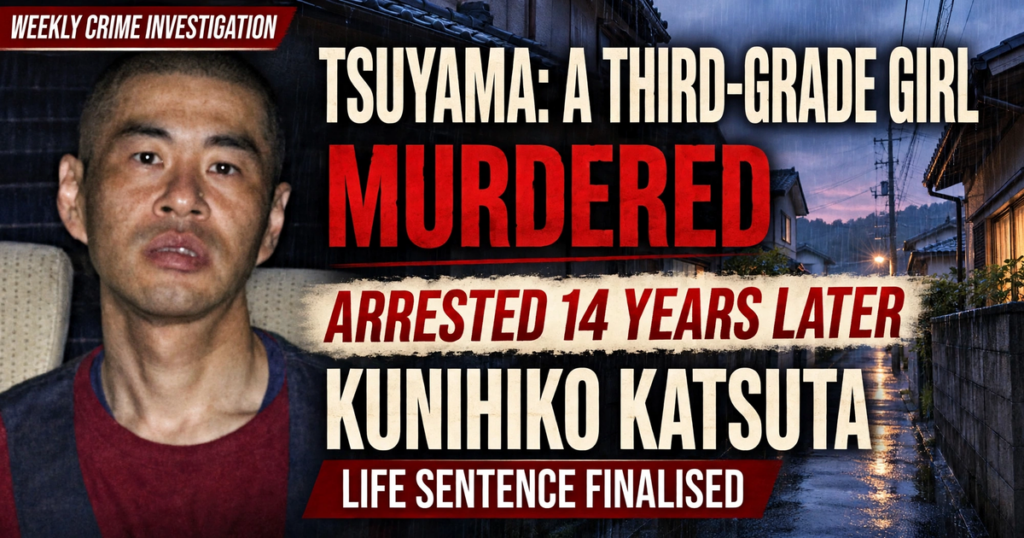
Nine-year-old Yuko Tsutsushio was found dead at her home in Tsuyama, Okayama Prefecture, on September 3, 2004. The case remained unsolved for nearly fourteen years until Katsuhiko Katsuta, then serving a sentence for another attack on a girl, was arrested in May 2018. He later denied the murder at trial. The Okayama District Court imposed life imprisonment in January 2022, and the sentence became final after the Supreme Court rejected his appeal in September 2023.
A nine-year-old girl was found dead after returning from school
On the afternoon of September 3, 2004, Yuko Tsutsushio, a nine-year-old third-grade pupil, was found collapsed inside her home in Soja, Tsuyama City, Okayama Prefecture. She had returned from school and was attacked during a short period when she was at home. Local reporting placed the likely time of the attack between approximately 3:15 p.m. and 3:35 p.m. The investigation found that she had been assaulted and killed inside the residence. The case deeply affected the local community, but the evidence available at the time did not lead investigators to an identified suspect.
The investigation continued without a clear suspect
Okayama Prefectural Police conducted interviews, reviewed information about suspicious people in the area and examined whether the crime might be connected to other attacks involving children. The lack of a clear suspect and the limited direct evidence meant that the case remained unresolved for many years. Investigators retained the materials from the original inquiry and continued comparing them with information that emerged from other cases. The passage of time did not mean that the investigation was simply abandoned. It remained possible that later information about a person or a related offence could provide a new direction.
A man serving a sentence for another attack came under scrutiny
Katsuhiko Katsuta came to investigators' attention because he was serving a prison sentence for an attempted murder involving a girl in Himeji, Hyogo Prefecture, in 2015. Police re-examined cases involving attacks on girls and students and compared them with Katsuta's history and movements. On May 30, 2018, Okayama Prefectural Police arrested him on suspicion of murdering Yuko. The arrest came nearly fourteen years after the 2004 killing. His conviction in another case was an investigative lead, but it was not by itself evidence that he had committed the Tsuyama murder.
Katsuta admitted the killing during questioning but later denied it
During the investigation, Katsuta made statements accepting that he had strangled Yuko and stabbed her in the chest and abdomen with a knife. He later withdrew the statements and claimed that he was innocent. At the first trial hearing in October 2021, he denied the charges. The defence argued that there was little direct physical evidence linking him to the scene, that no weapon had been recovered and that information from news reports could have influenced the content of the statements. The prosecution relied on the detail and consistency of the statements and their relationship to the condition of the victim's body.
The trial examined the reliability of the statements
There was no decisive DNA match or eyewitness identification directly connecting Katsuta to the killing, and the weapon had not been found. The central evidentiary question was therefore whether the statements he had made during the investigation contained details that only the perpetrator would have known and whether those details matched the objective evidence. The defence argued that the statements could have been constructed from information available in reporting. The prosecution maintained that the account was consistent with the injuries and the circumstances of the crime. The court had to assess the statements together with the other evidence, not in isolation.
The prosecution included murder and a sexual offence
Katsuta was indicted for murder and forcible indecent assault causing death, among other charges. The trial considered both the killing and the sexual-offence allegations. The legal question was whether the evidence established that Katsuta had attacked Yuko in her home and whether the different pieces of evidence supported a coherent account of what happened. The fact that Katsuta had been convicted in another case did not remove the prosecution's obligation to prove the charges in this case. The court had to decide the Tsuyama case on the evidence relating to Yuko and the events of September 3, 2004.
The Okayama District Court imposed life imprisonment
On January 6, 2022, the Okayama District Court found Katsuta guilty and sentenced him to life imprisonment, as requested by the prosecution. The court considered that his investigative statement describing one stab with the left hand and three with the right was consistent with the wounds found on the victim. It concluded that the statement was credible when assessed with the other evidence. The defence challenged the reliability of the confession and appealed. The district court's judgment was therefore the first-instance decision, not yet the final legal outcome.
The Hiroshima High Court and Supreme Court upheld the sentence
On September 28, 2022, the Hiroshima High Court's Okayama Branch dismissed the appeal and maintained the life sentence. The defence continued to dispute the credibility of the statements and the inferences drawn from the evidence. On September 7, 2023, the Supreme Court rejected Katsuta's appeal. The life-imprisonment sentence became final. The procedural sequence is therefore a life sentence from the Okayama District Court in January 2022, an appeal dismissed in September 2022 and a final Supreme Court decision in September 2023.
The prior conviction was a lead, not proof of the Tsuyama offence
Katsuta's imprisonment for the 2015 Himeji case helped investigators revisit the Tsuyama file, but a person cannot be convicted of a separate crime simply because he committed another offence. The trial focused on statements, the injuries, the events surrounding the killing and other evidence specific to Yuko's case. This distinction is especially important in a long-unsolved investigation, where later information can point police toward a suspect but the criminal court must still test the evidence. The final conviction followed the courts' assessment of the evidence in this case, not an automatic inference from his prior record.
The final judgment closed a case that had remained unresolved for fourteen years
The established sequence is that Yuko Tsutsushio was killed at her home on September 3, 2004; Katsuta was arrested on May 30, 2018; the Okayama District Court imposed life imprisonment on January 6, 2022; the Hiroshima High Court's Okayama Branch dismissed the appeal on September 28, 2022; and the Supreme Court rejected the appeal on September 7, 2023. The life sentence is final. The case illustrates the importance of preserving investigative records and re-examining earlier cases, while also requiring that the evidence in each prosecution be evaluated independently.
Original Japanese record: 津山市小3女児殺害事件|筒塩侑子さん殺害から14年、勝田州彦の無期懲役が確定
Last updated:
Related articles
Case record
The Hiroshima First-Grader Murder: A Life Sentence After a Complex Appeal and Remand
Case record
The Kawaguchi Serial Home-Invasion and Sexual-Robbery Case: Escalation Over Two Years and Eight Months and the Life Sentence

Case record
The Murder of Misa Kato: A One-Victim Death Sentence Finalized by Withdrawal of Appeal
Case record