
The Karuizawa Ski Tour Bus Crash: Fifteen Deaths and the Management Liability Trial
A ski-tour bus left Route 18 on the Usui Bypass in Karuizawa, Nagano Prefecture, at about 1:55 a.m. on January 15, 2016. Fifteen people died and 26 were injured. Investigations and criminal trials examined the driver's limited large-bus experience and the operator's failure to verify his ability. In 2026, the former president's three-year sentence became final, while former operations manager Tsuyoshi Arai's four-year sentence remained under Supreme Court review in the latest October 31 update.
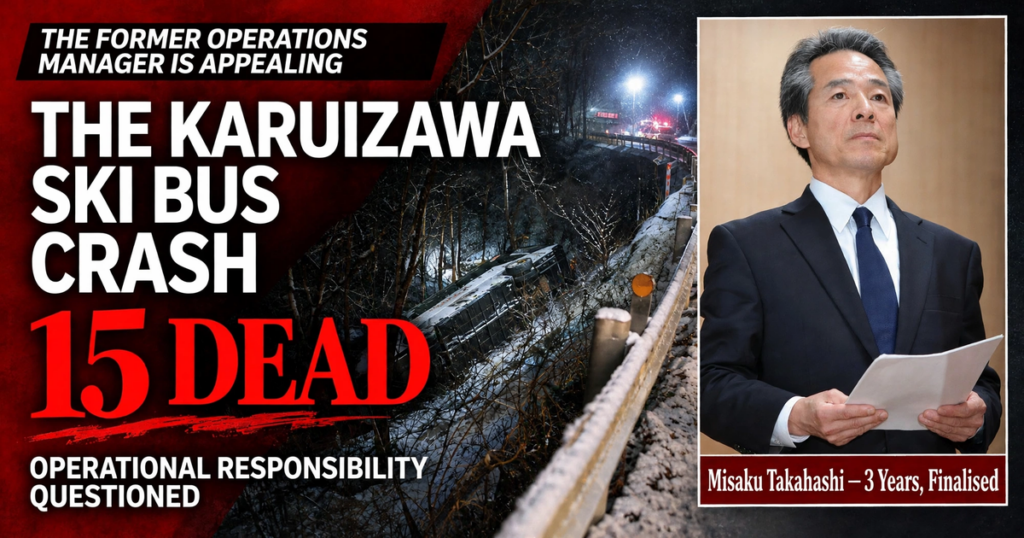
A ski-tour bus left the Usui Bypass before dawn
At about 1:55 a.m. on January 15, 2016, a large bus carrying people on a ski tour left Route 18 on the Usui Bypass in Karuizawa, Nagano Prefecture. The bus crossed into the opposite lane, went beyond the guardrail and fell from the road. The crash occurred on a section with a downhill grade and successive curves. There were 39 passengers and two crew members aboard, making 41 people in total. The accident killed 15 people and injured 26 passengers.
Fifteen people died and 26 passengers were injured
Thirteen of those who died were passengers, many of them university students, and two were members of the crew. The 26 injured people were passengers. The scale of the loss shocked families, universities and the wider public. The bus was carrying people on an ordinary leisure trip, but the journey ended in a crash that exposed serious questions about the way a charter-bus service had been organised and supervised. The driver's death in the accident meant that the later criminal case focused on the responsibilities of the people who had arranged and managed the operation.
The driver had limited experience with large buses
The investigation and later criminal proceedings examined the experience and ability of the driver, who died in the crash. The court found that he did not have sufficient experience or skill for driving a large bus on the route. As the bus descended, its speed increased and it entered the curves in a condition that it could not safely negotiate. The driver's handling was part of the immediate sequence, but the criminal case also asked why a driver with inadequate large-bus experience had been assigned to the journey in the first place.
The operator's management practices came under scrutiny
The operating company was ESP. Inspections by the Ministry of Land, Infrastructure, Transport and Tourism identified problems involving driver instruction and supervision, roll-call procedures and health management. The company had also been subject to administrative action for violations before the crash. These findings raised questions about the company's safety-management system, not just the individual driver's actions. The structure of the charter-bus market was also examined, including price competition, the relationship between travel companies and bus operators, and the pressure created by shortages of experienced drivers.
The former president and operations manager were prosecuted
Because the driver had died, the criminal proceedings focused on the company's former president, Misaku Takahashi, and former operations manager, Tsuyoshi Arai. Prosecutors charged them with professional negligence resulting in death and injury. The allegation was that they had failed to verify the driver's skill and experience adequately and had allowed him to operate a large bus on a demanding route. Both defendants denied that the accident could have been specifically foreseen and argued that they should not be held criminally responsible for the driver's conduct.
The Nagano District Court imposed prison terms in 2023
On June 8, 2023, the Nagano District Court sentenced Takahashi to three years in prison and Arai to four years. The court found that the danger posed by assigning an inadequately experienced driver to the route could have been foreseen. It concluded that the defendants had failed to perform the management and supervisory duties required to prevent the crash. The decision addressed the relationship between the driver's handling of the bus and the company's responsibility for selection, training and verification. The sentences were first-instance judgments and were appealed.
The Tokyo High Court upheld both sentences in May 2026
On May 22, 2026, the Tokyo High Court dismissed the appeals and maintained the sentences imposed by the Nagano District Court. It found no unreasonable basis for the lower court's assessment that the danger was foreseeable under the company's inadequate management system. The defendants had continued to argue that they could not have predicted the accident, but the High Court upheld the finding that their failure to check the driver's ability and experience breached their duties. The appellate judgment therefore left Takahashi's three-year term and Arai's four-year term in place.
The two defendants' legal positions then diverged
Takahashi did not file a further appeal by the deadline, and his three-year sentence became final on June 6, 2026. Arai's defence filed an appeal to the Supreme Court on June 1, challenging the four-year sentence. The two men therefore did not have the same final legal status after the High Court judgment. It would be inaccurate to say that both sentences had become final. The Japanese article's latest update, dated October 31, 2026, continued to report that Arai's appeal was pending.
The crash prompted reforms across the charter-bus industry
The government response extended beyond the prosecution of two managers. In June 2016, a ministry committee produced a package of 85 measures intended to improve the safety of charter-bus operations. The reforms included stronger business-permit and inspection systems, tighter administrative sanctions, better records of driver experience and practical training for newly appointed drivers. The aim was to move beyond relying on a driver's own declaration of experience and to verify the skills needed for the actual work. The relationship between travel agencies and bus operators, including the appropriateness of fares, also came under review.
The latest verified status must be dated
The accident occurred in January 2016 and killed 15 people while injuring 26. The criminal case established management responsibilities in addition to the driver's lack of experience. Takahashi's three-year sentence became final in June 2026. Arai appealed his four-year sentence to the Supreme Court, and the latest Japanese article update located for this translation, dated October 31, 2026, still described that appeal as pending. No later Supreme Court outcome is added here without a verified source. The final legal position must be updated if a new judgment is issued.
Original Japanese record: 軽井沢スキーバス転落事故|15人死亡、運転技量を確認しなかった管理責任と2026年の上告
Last updated:
Related articles
Case record
The Sinking of the KAZU I: Twenty Confirmed Deaths, Six Missing and the Company President's Five-Year Sentence
Case record
The Ikebukuro Runaway-Car Crash: Two Deaths, a Five-Year Sentence and the Driver's Death in Custody
Case record
The Kanuma Crane-Truck Crash: Six Children Killed on Their Way to School and the Limits of the Law
Case record