
The Johnny Kitagawa Sexual-Abuse Scandal: Longstanding Allegations, Corporate Accountability, and the Compensation Process
A 2023 external investigation found that Johnny Kitagawa had sexually abused boys and young performers over many decades. Earlier civil litigation had already upheld the truthfulness of reporting about abuse, but no criminal trial of Kitagawa took place; after the 2023 admission and apology, SMILE-UP. assumed responsibility for compensation while talent management moved to STARTO ENTERTAINMENT.
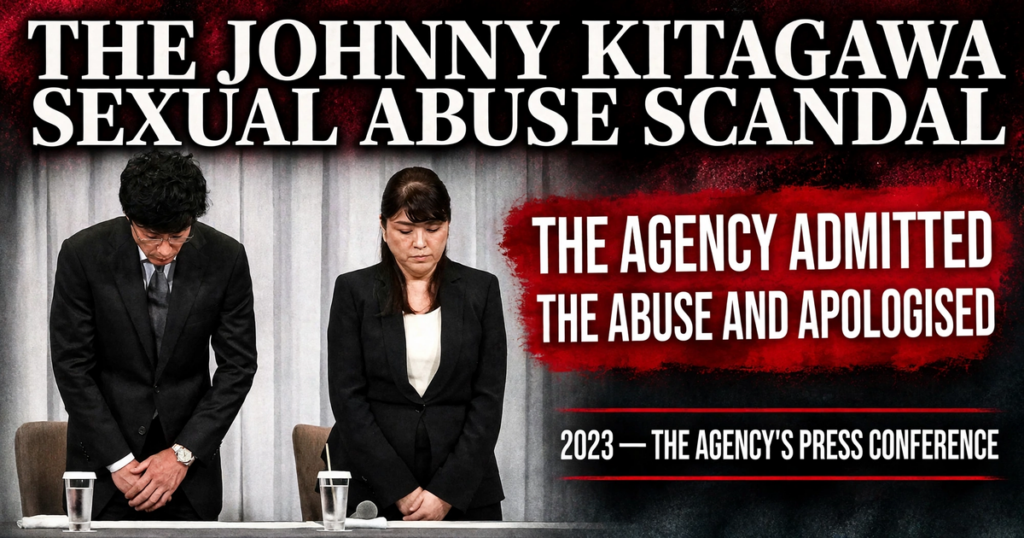
The case concerned abuse by a powerful entertainment-industry founder
Johnny Kitagawa, founder of the former Johnny & Associates talent agency, was the subject of extensive allegations that he sexually abused boys and young performers who entered the agency hoping to work in entertainment. The 2023 external investigation commissioned by the company concluded that abuse had occurred over many decades and involved numerous young performers. The power imbalance was central: Kitagawa had substantial influence over auditions, training, stage opportunities, and access to professional careers. Many of those who described abuse had been minors. The issue therefore extended beyond individual misconduct to the structures that allowed a powerful founder to operate without effective oversight.
Reports and testimony existed long before the 2023 public crisis
Accounts of sexual abuse had appeared before the company publicly acknowledged the problem. Beginning in 1999, weekly-magazine reporting prompted civil litigation. In 2003, the Tokyo High Court recognized the truthfulness of portions of the reporting that concerned sexual abuse, and that judgment became final in 2004. The existence of that civil judgment is an important part of the chronology: the allegations were not first raised in 2023. Nevertheless, the agency did not conduct a full investigation and remedy process at that earlier stage, and the issue did not receive sustained scrutiny from major media organizations.
The external investigation described abuse spanning decades
The external expert team reported that Kitagawa's sexual abuse began in the 1950s and continued within the agency from the early 1970s until the mid-2010s. The report described repeated abuse involving many members of the agency's junior performer groups. It did not establish a single definitive total number of victims. The fact that Kitagawa died in 2019 made it impossible to question him in a criminal trial or to obtain his response to each individual account. The investigation instead reviewed testimony, organizational records, and the company's response. Its conclusions were findings of an external review, not a criminal conviction.
The issue returned to public attention in 2023
In 2023, a BBC documentary about Kitagawa and renewed public statements by former agency members brought the issue back into national and international attention. Former performers spoke publicly about their experiences, press conferences were held, and groups representing people who said they had been harmed organized. The United Nations Working Group on Business and Human Rights also raised concerns during its visit to Japan in the summer of 2023. The discussion widened to include the responsibility of companies that had business relationships with the agency, the media's response, and the need for effective human-rights due diligence in the entertainment industry.
The agency acknowledged the abuse and apologized
Following the external investigation, the agency acknowledged the sexual abuse and apologized publicly. This was a significant change from the earlier period in which the company had not conducted a comprehensive inquiry or provided a structured compensation process. The public acknowledgement did not turn the matter into a criminal conviction of Kitagawa. He had died in 2019, and no criminal trial against him took place. The external report, the company's admission, and the earlier civil judgment each have different legal and evidentiary meanings and should not be treated as interchangeable.
The organization was divided between compensation and talent management
The former agency changed its corporate structure after the 2023 revelations. The company later known as SMILE-UP. took responsibility for responding to claims and providing compensation to people who said they had been abused. Talent management was moved to a separate company, STARTO ENTERTAINMENT, which began full-scale operations in April 2024. The separation was intended to distinguish the compensation and accountability function from the continuing management of performers. The two organizations have different roles; describing STARTO as the entity responsible for compensation, or SMILE-UP. as the current talent-management agency, would confuse the post-scandal structure.
The compensation process had received 1,044 applications by August 2026
SMILE-UP.'s update of 14 August 2026 reported a cumulative total of 1,044 compensation applications. Of these, 226 people had not responded despite repeated attempts to contact them. Among the 818 people with whom contact had been established, 816 had received either a compensation offer or notice that compensation would not be provided. The Victim Relief Committee had sent compensation terms to 585 people; 578 had agreed, and payment had been completed for 576. A further 231 people had been notified that compensation would not be provided, while two cases remained in procedures such as verification of agency membership or interviews.
Application and payment figures do not represent a final count of victims
The 1,044 applications reported in August 2026 are a measure of people who had applied through the compensation process, not a definitive total of everyone who may have experienced abuse. The number of people who received an offer, agreed to it, or had been paid describes different stages of the process. These figures also changed over time: the July 2026 update reported 1,042 applications and 575 completed payments, while the August update reported 1,044 applications and 576 completed payments. The company said that from June 2026 new compensation applications would be handled through the mental-care consultation channel. Compensation figures should therefore always be presented with their reporting date.
There was no criminal trial of Kitagawa, but several forms of accountability remain relevant
Kitagawa died in 2019, so he was not tried as a criminal defendant for the abuse. The 2003 civil appellate judgment, the 2023 external expert report, the company's admission and apology, and the ongoing compensation process are distinct forms of public record. None should be inaccurately described as a criminal conviction. At the same time, the absence of a criminal trial does not erase the findings made in civil litigation or by the external investigation. The continuing questions concern the recognition of survivors, compensation, mental-health support, organizational reform, and whether the safeguards introduced after 2023 are effective over time.
The central issue is whether institutional reform can provide lasting protection
The scandal exposed not only allegations against one founder but also a long period in which minors seeking entertainment careers lacked effective protection and external oversight. The 2023 investigation criticized the agency's governance and the failure to respond adequately to earlier reports. Media organizations also reviewed their own past coverage and business relationships. The post-2023 compensation and corporate restructuring processes are continuing responses, not proof that every harm has been remedied. A careful record must preserve the distinction between confirmed historical findings, individual claims still under review, the compensation statistics published by SMILE-UP., and the separate question of whether the industry's safeguards have changed in practice.
Original Japanese record: ジャニー喜多川性加害問題|長年見過ごされた被害と補償・再発防止の経過
Last updated:
Related articles

Case record
The JR Shinjuku Station Groping Allegation: The Death of Shinsuke Harada and the Unresolved Criminal Allegation

Case record
The Organized Open-Air Bath Voyeurism Case
Case record
The Shibuya Hirohito Multiple-Women Household Cases
Case record